
Is an Epoxy Garage Floor Coating Right for Your Garage?
Epoxy garage floor coating is a two-part system — resin plus hardener — that chemically bonds to concrete to create a hard, durable, high-gloss surface that resists stains, chemicals, hot tires, and daily wear.
Here’s a quick summary of what you need to know:
| Question | Quick Answer |
|---|---|
| What is it? | A two-part resin coating that bonds into concrete |
| How long does it last? | 10–20+ years with a quality multi-layer system |
| DIY or professional? | DIY kits are available, but professional results last far longer |
| How much does it cost? | Varies by project condition and features — we offer a free on-site estimate |
| When can you drive on it? | Typically 72 hours after application |
| Does it resist hot tires? | Yes — when properly installed with the right system |
Your garage floor takes a beating every single day. Hot tires. Road salt. Oil drips. Dropped tools. Knoxville’s freeze-thaw winters don’t help either.
Most homeowners put up with cracked, stained concrete for years — not realizing there’s a fix that’s both durable and good-looking.
A properly installed epoxy system doesn’t just coat your floor. It bonds into the concrete at a molecular level, building a surface that’s far harder and more resistant than bare concrete or standard floor paint.
But not all epoxy products are equal. A bargain kit from a big-box store and a professional-grade multi-layer system may share the word “epoxy” on the label — and almost nothing else.
This guide breaks down everything: how epoxy works, why cheap coatings fail, what surface prep really involves, and how to choose the right system for your garage.
Quick epoxy garage floor coating definitions:
- epoxy floor Vonore install
- epoxy garage flooring 3D design preview Knoxville
- non slip garage floor coating
What is an Epoxy Garage Floor Coating and How Does It Work?
To understand why a high-quality Epoxy Garage Floor Coating performs so well, we have to look at the science behind it. Many people assume epoxy is just a thicker type of paint, but the two are entirely different chemical species.
True epoxy is a two-part thermosetting polymer. It consists of a liquid epoxy resin and a liquid amine hardener. When we mix these two components together, they don’t just “dry” like paint does. Instead, they undergo an exothermic chemical reaction. The molecules cross-link with one another to form a tightly bound, highly organized polymer structure.
This reaction transforms the liquid mixture into a rigid, incredibly tough plastic-like material. But the real magic happens at the interface where the epoxy meets your concrete.
Concrete might look solid and smooth to the naked eye, but under a microscope, it is highly porous—much like a hard sponge. When we apply a properly formulated epoxy system to a clean, open concrete surface, the liquid flows deep into these microscopic concrete pores. As the chemical reaction takes place and the epoxy cures, those liquid fingers solidify.
This creates a mechanical and chemical bond that is virtually impossible to break. In fact, in professional pull-off strength tests, a high-quality, 100% solids epoxy bond is often stronger than the concrete itself—meaning the concrete slab will fracture and pull apart before the epoxy releases its grip.
Why Traditional Garage Floor Paint Fails Compared to Epoxy
If you have ever tried to spruce up your garage with a standard can of concrete paint from a home improvement store, you probably know how that story ends. Within a year—sometimes within just a few weeks—the paint begins to bubble, peel, and flake away, especially right where you park your car.
Why does this happen? It comes down to adhesion and film thickness.
Traditional garage floor paint is usually a one-part acrylic or latex-based product. It relies on the evaporation of water or solvents to dry. As the liquid evaporates, it leaves behind a very thin, delicate film that simply sits on top of the concrete. It doesn’t penetrate the concrete pores, nor does it form a chemical bond.
Because this film is so thin—often less than 1 to 2 mils thick (a mil is one-thousandth of an inch)—it has very little mechanical strength. It cannot withstand the shear forces exerted by heavy vehicle tires turning in place. Furthermore, traditional paint is highly susceptible to “hot tire pickup.” When you drive your car, your tires heat up from friction on the road, sometimes reaching temperatures up to 180°F. When you park on a painted floor, the hot tires soften the thin paint film. As the tires cool down, they contract and physically grab the paint, pulling it right off the concrete when you back out of the garage.
Key Benefits of an Epoxy Garage Floor Coating
Investing in a professionally engineered Epoxy Garage Floor Coatings system transforms your garage from a dark, dusty workspace into a clean, bright, and highly functional extension of your home. The benefits are extensive:
- Extreme Impact Resistance: Whether you drop a heavy wrench, roll a loaded tool chest across the floor, or jack up a vehicle, a thick epoxy system distributes the weight and resists cracking, chipping, and denting.
- Superior Chemical Resistance: From motor oil and gasoline to harsh brake fluids, anti-freeze, and winter road salts, a high-quality epoxy barrier prevents chemicals from penetrating and permanently staining or corroding your floor.
- Enhanced Light Reflectivity: Because epoxy cures to a beautiful, high-gloss finish, it can increase the light reflectivity in your garage by up to 400%. This makes your entire garage feel brighter, safer, and much easier to work in.
- Dust Prevention: Bare concrete naturally sheds fine powder over time (a process called chalking), which settles on your cars, tools, and storage bins. Epoxy completely seals the concrete, eliminating concrete dust at the source.
- Aesthetic Appeal: With options ranging from solid colors to multi-colored decorative flake systems and stunning metallic finishes, you can design a custom look that matches your personal style and increases your home’s resale value.
Understanding Epoxy Quality: Professional 100% Solids vs. DIY Retail Kits
When shopping for garage floor coatings, you will find a massive range of prices. A box kit at a local hardware store in Oak Ridge or Lenoir City might cost under $150, while a professional-grade system costs significantly more. This price gap exists because the products themselves are completely different.
The primary differentiator is the solids content. Solids content refers to the percentage of the product that remains on your floor after the coating has fully cured.
| Feature | Professional 100% Solids Epoxy | Retail DIY Epoxy Kits (Water-Based) |
|---|---|---|
| Solids Content | 100% (No evaporation) | 40% to 60% (Water or solvent-based) |
| Dry Film Thickness (DFT) | 10 to 12+ mils per coat | 2 to 3 mils per coat |
| Hot Tire Pickup Resistance | Excellent (Will not soften or peel) | Poor (Highly prone to peeling) |
| VOC Emissions / Odor | Extremely low to zero VOCs | Variable (Can have strong solvent odors) |
| Bond Strength | Over 10x stronger than steel molecularly | Weak surface-only mechanical bond |
| Expected Lifespan | 10 to 20+ years | 1 to 3 years |
Many retail DIY kits are water-based epoxies with a solids content of only 40% to 50%. This means that when you roll the product onto your floor, half of what you just applied is actually water or solvent that will evaporate into the air as it dries.
If you apply a water-based epoxy at a wet thickness of 6 mils, it will shrink as it dries, leaving you with a dry film thickness of only 2.5 to 3 mils. This paper-thin layer simply does not have the strength or durability to survive the harsh environment of a garage.
In contrast, professional-grade 100% solids epoxy contains zero water or solvents. What goes down wet stays there when dry. If we apply a 100% solids epoxy at 10 mils wet, it cures to a full 10 mils dry. This creates a thick, high-build barrier that hides minor concrete imperfections and provides a deeply durable wearing surface that easily resists hot tire pickup and heavy impacts.
The Lifespan of Epoxy and Why Coatings Fail
A properly engineered, multi-layer professional epoxy system will easily last 10 to 20+ years under normal residential garage traffic in East Tennessee. However, walk into many garages in Maryville or Sevierville, and you will see peeling, bubbling, and chipped floors. Why do so many coatings fail prematurely?

Almost all premature garage floor coating failures can be traced back to three main culprits:
- Inadequate Surface Preparation: This is the single biggest cause of epoxy failure. Epoxy cannot bond to smooth, dirty, or oily concrete. If the floor is not properly profiled to open up the concrete pores, the epoxy will simply sit on top and eventually peel off under the stress of hot tires.
- Moisture Vapor Transmission: Concrete slabs poured on grade naturally absorb moisture from the soil beneath them. This moisture vapor travels upward through the microscopic pores of the concrete. If a high-solids coating is applied over a slab with high moisture emission without a dedicated moisture barrier primer, the rising vapor pressure will build up beneath the epoxy film. This pressure eventually causes the epoxy to blister, bubble, and pop off the surface.
- Using Low-Quality Products: Thin, single-coat water-based retail products simply do not have the chemical strength or thickness to endure thermal expansion, freeze-thaw cycles, and hot vehicle tires over the long term.
At Garage Floor Masters, we believe in doing things right the first time. That is why our professional installations are backed by the robust Garage Floor Masters Warranty, giving you peace of mind that your beautiful new floor is built to stand the test of time.
Step-by-Step Surface Preparation and Installation Process
If you ask any professional floor coating installer what the most important part of the job is, they will all give you the same answer: preparation. In fact, about 80% of the work required to install a successful, long-lasting garage floor coating happens before we ever open a single can of epoxy.
To ensure a permanent bond, we follow a rigorous, highly detailed Garage Floor Installation Process:
- Step 1: Moisture Testing: Before we do anything else, we test the concrete slab for moisture vapor transmission. If moisture levels are high, we integrate a specialized moisture-blocking primer into the system to prevent future bubbling.
- Step 2: Deep Cleaning: We scrape away old paint, drywall mud, and joint compounds, and treat any oil or grease spots with heavy-duty industrial degreasers.
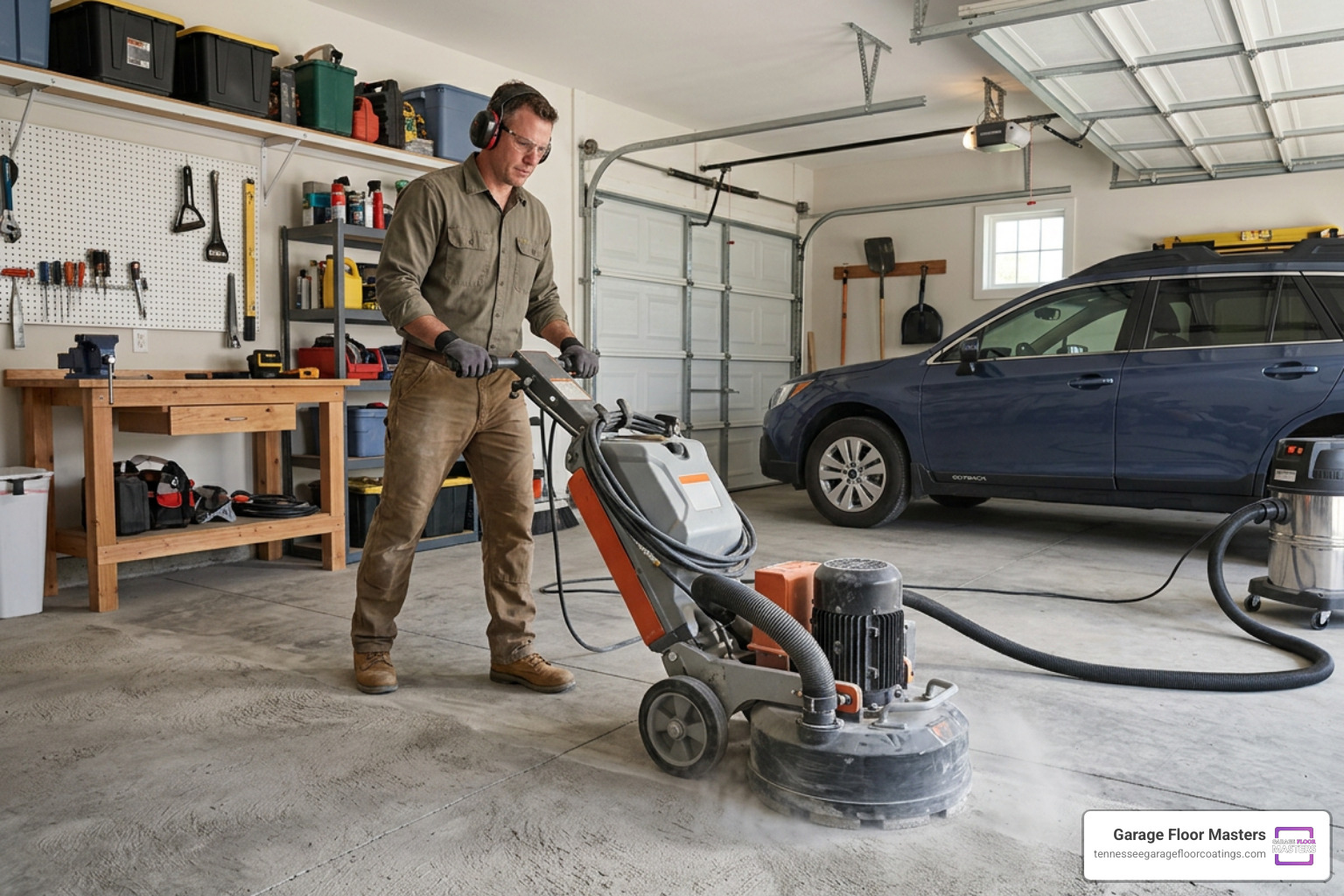
- Step 3: Mechanical Diamond Grinding: We do not rely on weak acid etching. Instead, we use heavy, walk-behind planetary diamond grinders equipped with industrial dust-collection vacuums. This grinding process removes the weak top layer of concrete (called laitance), exposes the open pores of the slab, and profiles the surface until it feels like medium-grit sandpaper (achieving a Concrete Surface Profile of CSP 2 or 3).
- Step 4: Concrete Crack and Divot Repair: Once the floor is ground clean, we patch all cracks, pits, spalls, and divots using a high-strength epoxy joint filler. Once cured, we grind these repairs flush with the surrounding floor to ensure a perfectly seamless finish.
- Step 5: Vacuuming: We perform a final, meticulous sweep and vacuum of the entire floor to remove every single speck of dust and debris, ensuring a pristine surface for the primer coat.
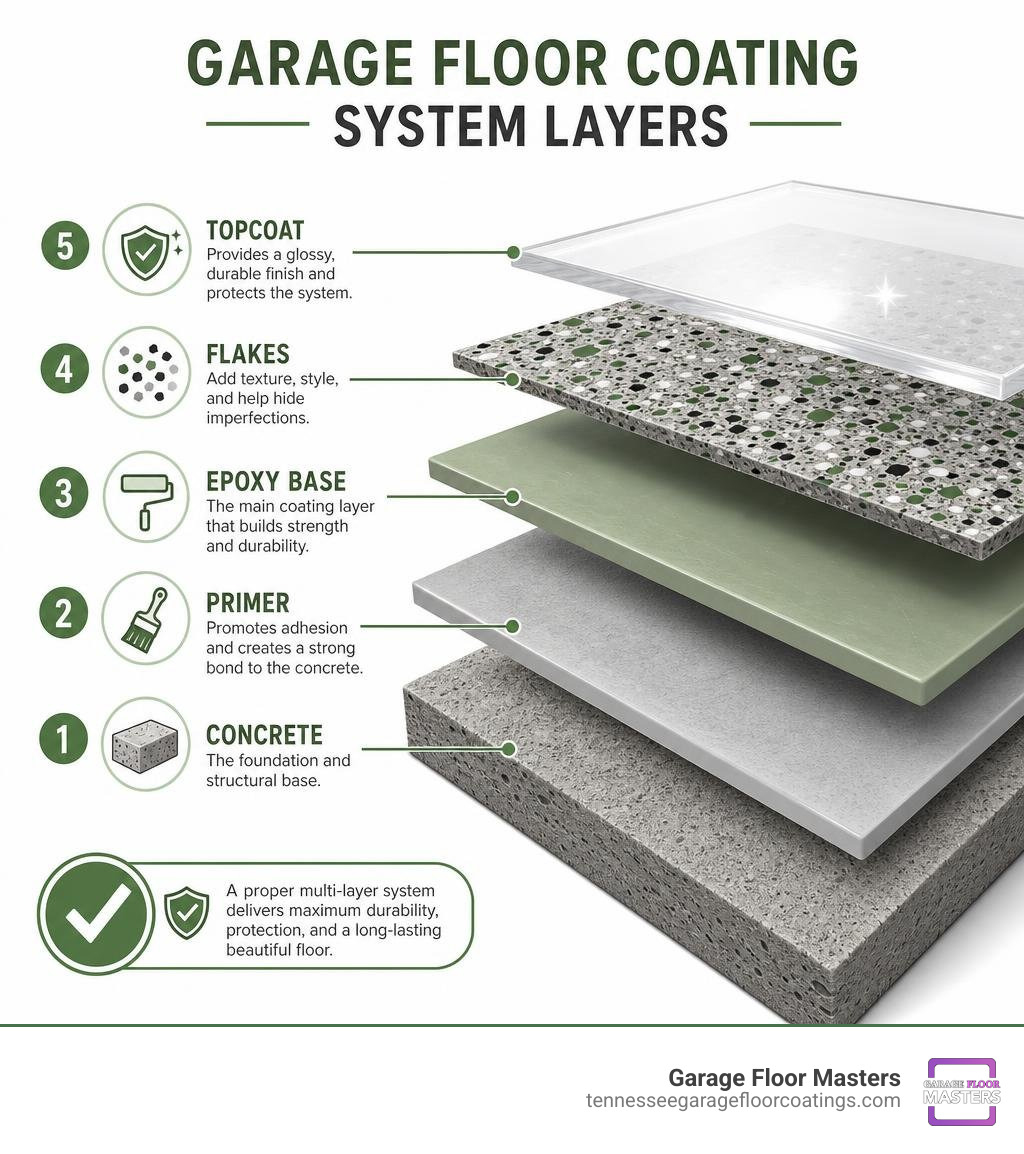
Single-Coat vs. Multi-Layer Systems (Primer, Base, and Topcoat)
Many retail DIY kits advertise a “one-coat” application. While this sounds appealing because it saves time, a single-coat system is a recipe for early failure. A truly durable, industrial-grade garage floor coating requires a multi-layer system where each layer serves a highly specific purpose:
- The Primer Coat: A low-viscosity, deep-penetrating epoxy primer is applied first. Its job is to sink deep into the concrete pores, sealing the slab and creating a highly secure chemical link for the subsequent layers. It also prevents the next coats from sinking unevenly into porous areas of the concrete.
- The Base Coat: This is the high-build, 100% solids epoxy layer. It provides the bulk of the system’s thickness, impact resistance, and color.
- The Decorative Flakes: While the base coat is still wet, we broadcast decorative vinyl color flakes into the floor. A full-broadcast system means we throw flakes until the floor is completely saturated and no wet epoxy is visible. This adds incredible visual depth, hides minor concrete imperfections, and provides built-in slip resistance.
- The Clear Topcoat: Once the base coat is dry and excess flakes are scraped flat, we apply a high-performance clear topcoat (typically a polyaspartic or urethane). This topcoat acts as a sacrificial shield, protecting the color flakes and epoxy from UV yellowing, tire marks, scratches, and chemical spills.
The Risks of DIY Epoxy Application vs. Professional Installation
It is easy to see why homeowners in places like Clinton or Loudon are tempted to try a DIY epoxy garage floor kit. On paper, it looks like a fun weekend project that can save you money. However, DIY epoxy application carries significant risks that often lead to costly mistakes.
The first major challenge is the pot life. Once you mix Part A and Part B of a professional-grade epoxy or polyaspartic, a clock starts ticking. Depending on the temperature and humidity, you may have as little as 15 to 30 minutes to apply the product before it begins to cure, harden, and become completely unusable in the bucket. Professional crews are highly coordinated and work fast to maintain a “wet edge,” preventing unsightly roller marks and uneven curing.
Furthermore, DIYers rarely have access to the specialized equipment required for proper surface preparation. Hand-held grinders or hardware store acid-etching kits simply cannot profile concrete as effectively as a multi-thousand-dollar planetary diamond grinder. Without that profile, the coating cannot bond properly. If a DIY floor fails, grinding off the ruined, sticky epoxy to start over is a massive, incredibly difficult chore that often costs more than hiring a professional in the first place.
Cost Analysis: The True Value of Professional Installation
When planning your garage upgrade, it is important to understand the factors that influence the overall Garage Floor Coating Cost. Rather than thinking only about the immediate upfront expense, we encourage homeowners to look at the “cost per year” over the lifespan of the floor.
Several key variables determine the cost of a professional installation:
- Total Square Footage: Larger garages (like 3-car or 4-car spaces) require more materials but often feature a slightly lower cost per square foot due to economies of scale.
- Concrete Condition: Slabs with extensive cracking, pitting, spalling, or deep oil saturation require additional prep work and repair materials before we can safely apply the coating.
- System Selection: Choosing a premium full-broadcast flake system or a custom metallic design will affect material costs compared to a simple solid-color coating.
To get a detailed understanding of how these factors apply to your specific home, check out The Ultimate Guide to Epoxy Flooring Prices.
While a DIY kit might cost a few hundred dollars initially, if it fails within two years, you will end up spending more money on repairs and replacement kits. At Garage Floor Masters, we design our systems to last for decades. Because every garage slab is unique, our pricing is based entirely on the specific condition of your concrete and the custom design features you select. That is why we are happy to provide a completely free, no-obligation on-site estimate to give you an accurate price for your project.
Maintenance, Curing Times, and Choosing Your Design
Once your beautiful new garage floor is installed, you will want to know how to care for it and when you can start using it.
Curing Schedule
Modern professional coatings cure relatively quickly, but patience is still required to ensure the chemical bonds reach their full strength:
- Foot Traffic: You can typically walk on your new floor in as little as 12 to 24 hours after the final topcoat is applied.
- Moving Items Back: We recommend waiting 36 to 48 hours before placing heavy storage shelves, toolboxes, or workbenches back in the garage.
- Vehicle Traffic: To prevent any risk of tire marking or shifting, wait a full 72 hours before parking your cars or driving heavy vehicles onto the floor.
Design and Color Options
At Garage Floor Masters, we offer an incredible selection of over 140 colors and flake combinations. Whether you want a clean, modern granite look to match your home in Powell, a bold metallic finish for a showroom in Pigeon Forge, or a classic neutral tone for a workshop in Tazewell, we have the perfect design to bring your vision to life.
Keeping It Clean
One of the best features of a high-quality finished floor is how incredibly easy it is to maintain. Because the surface is completely non-porous, dirt, dust, and fluids cannot sink in. For detailed steps on keeping your floor looking brand new, refer to our Floor Care Instructions. For daily cleaning, a quick sweep or dust mop is all it takes. For a deeper clean, simply mop the floor with a mixture of warm water and a mild, non-filming soap (like simple dish soap), then squeegee or wipe it dry.
Frequently Asked Questions about Garage Floor Coatings
How long does it take for an epoxy garage floor to cure before I can drive on it?
For professional-grade systems, you can safely walk on the surface within 24 hours. However, you should wait a full 72 hours before driving vehicles or parking on the new coating. Curing times can be slightly affected by local temperature and humidity—cooler temperatures in late autumn may extend the required cure time slightly, while warm summer days can speed it up.
Can I apply epoxy over a previously painted or sealed concrete floor?
We do not recommend applying high-performance epoxy directly over old paint or concrete sealers. The new epoxy will only bond as well as the old coating is holding onto the concrete. If that old paint decides to peel, your expensive new epoxy will peel right along with it. To ensure a permanent bond, we use our industrial diamond grinders to completely strip away all old paint, sealers, and contaminants down to the bare, clean concrete before applying our system.
How do I repair scratches or chips in my epoxy floor?
If you happen to drop a heavy, sharp tool and chip your floor, don’t panic! Minor chips can be repaired using a small touch-up kit containing a bit of matching base coat epoxy and clear topcoat. For deeper scratches, the area should be lightly sanded with fine-grit sandpaper to create a profile, wiped clean with solvent, and then touched up with a small amount of matching topcoat. Because our systems are incredibly durable, these types of repairs are rarely needed under normal household conditions.
Conclusion
Your garage floor is more than just a place to park your car—it is the entryway to your home, a workshop for your hobbies, and a valuable part of your property. Protecting it with a premium floor coating is one of the smartest home improvements you can make.
While cheap DIY kits promise an easy fix, they simply cannot match the durability, thickness, and permanent bond of a professionally installed, multi-layer system.
If you are ready to transform your dusty, cracked garage into a clean, beautiful, and durable space, let the experts at Garage Floor Masters handle the hard work. We proudly serve homeowners across East Tennessee, including Knoxville, Oak Ridge, Crossville, Vonore, Sevierville, Lenoir City, Maryville, Tazewell, LaFollette, Loudon, Friendsville, Powell, Jefferson City, Pigeon Forge, Clinton, Andersonville, and White Pine.
Get a professional epoxy garage floor coating from Garage Floor Masters today by contacting us for your free, personalized on-site estimate!