
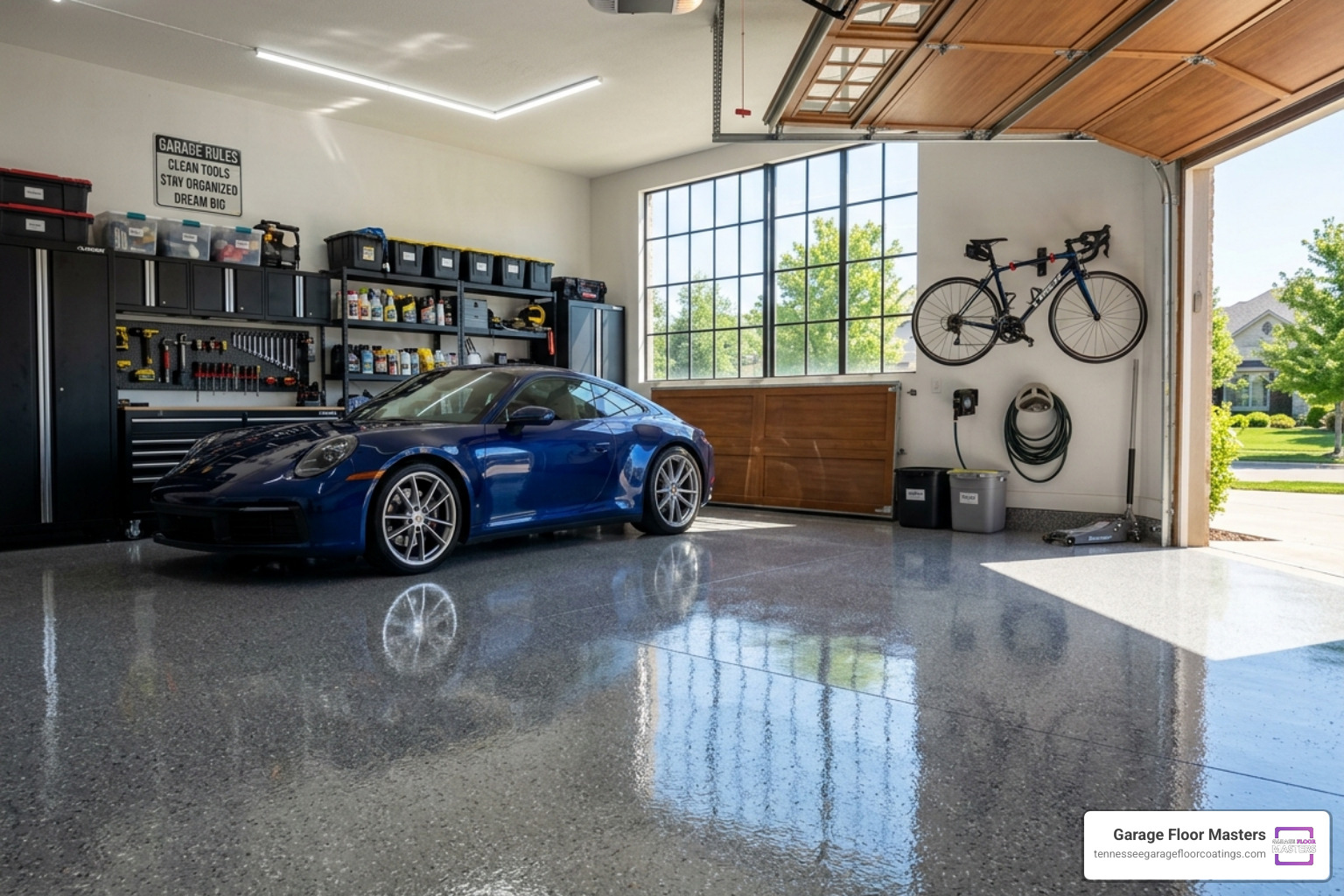
Why UV Resistant Epoxy Floors Are Worth Understanding Before You Buy
UV resistant epoxy floors are specially formulated coatings designed to hold their color and clarity even when exposed to sunlight or artificial light — unlike standard epoxy, which yellows and degrades over time.
Quick answer: Here’s what you need to know at a glance:
| Question | Answer |
|---|---|
| What makes epoxy turn yellow? | UV light breaks down the epoxy polymer, causing ambering |
| What resists this? | UV resistant epoxy uses cycloaliphatic chemistry or UV-blocking additives |
| Best option for garages? | Polyaspartic or UV resistant epoxy with a protective topcoat |
| Does UV resistant mean no yellowing ever? | It slows it significantly — but no epoxy is fully immune long-term |
| Is it worth the cost? | Yes — especially for light colors, metallic finishes, or sun-exposed spaces |
If you’ve ever walked into a garage and noticed the floor had turned a dull, murky yellow — that’s UV damage at work. It’s one of the most common complaints we hear from homeowners in Knoxville.
Standard epoxy looks great on day one. But expose it to sunlight through a garage door, or even the glow of fluorescent shop lights, and the chemistry starts working against you. The polymers break down. The clear coat ambers. Those decorative flakes you paid for? Buried under a yellow haze.
The good news is that this problem is entirely preventable — if you choose the right coating from the start.
This guide walks you through exactly how UV resistant epoxy works, which products perform best, and what your real options are for a floor that stays beautiful for years.
Why Standard Epoxy Floors Turn Yellow
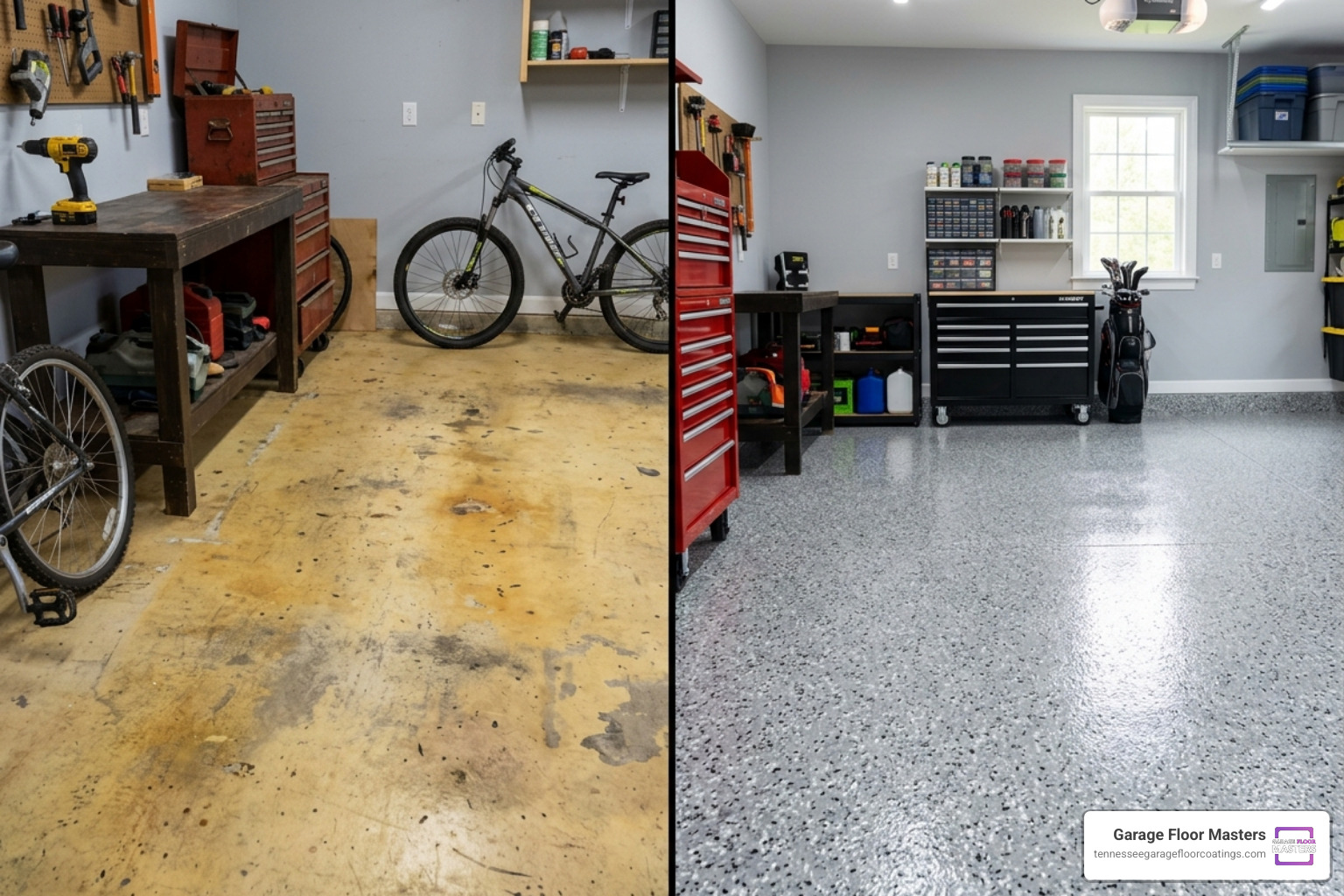
It is a frustrating sight: you invest in a beautiful new floor, only to watch it slowly turn the color of an old tooth. This process is known as “ambering,” and it is the Achilles’ heel of traditional epoxy. But why does it happen?
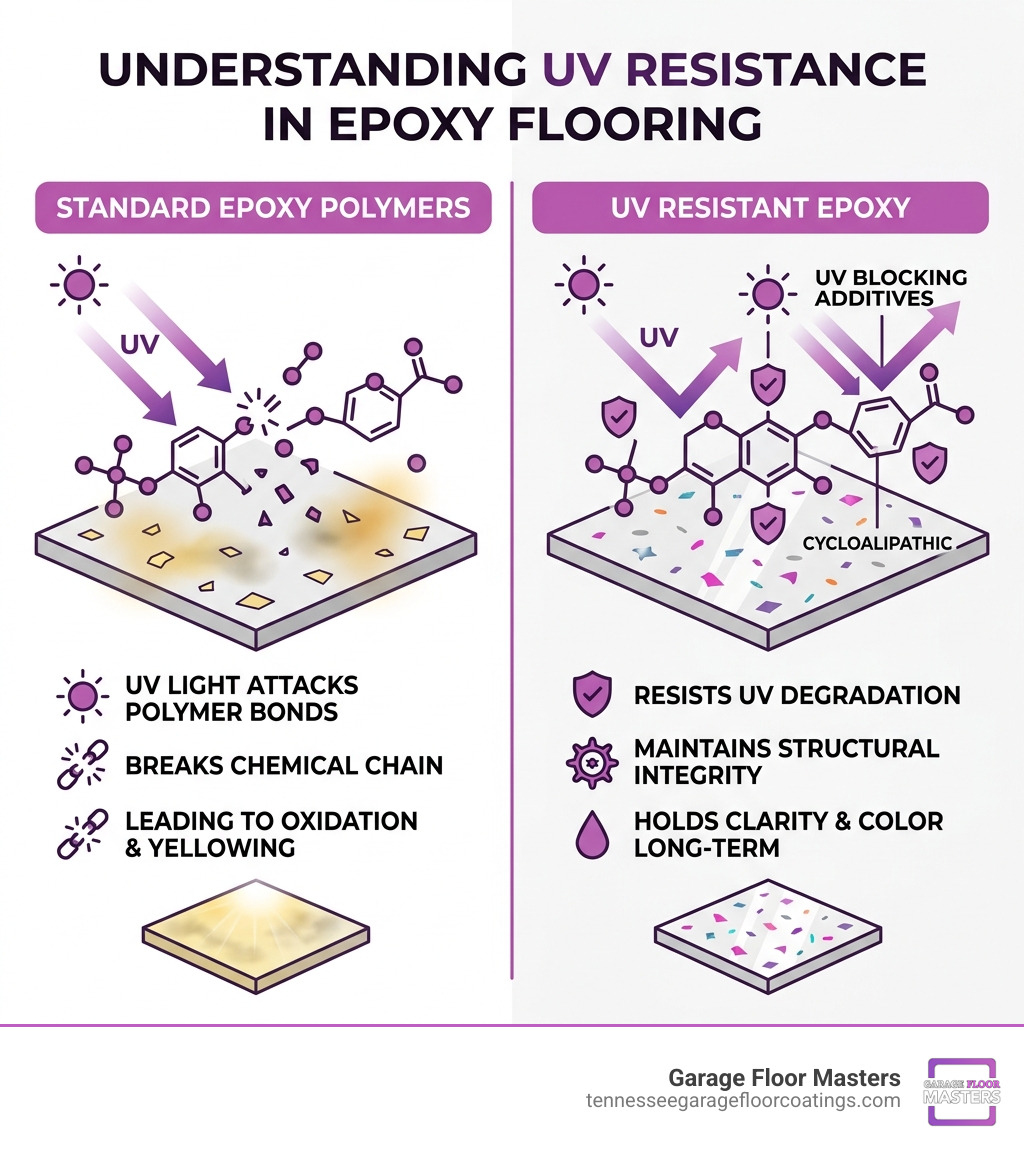
The primary culprit is Ultraviolet (UV) radiation. Even if your garage isn’t in direct sunlight, UV rays bounce off driveways and enter through open doors or windows. This radiation triggers a chemical reaction in the epoxy’s molecular structure. Standard epoxies often use “aromatic” curing agents. When these are hit by UV light, the chemical bonds break apart, leading to oxidation and that dreaded yellow tint.
Interestingly, it isn’t just the sun. High-intensity fluorescent lighting in shops and warehouses can also contribute to Why Epoxy Floors Turn Yellow.
Beyond light, other factors accelerate the degradation:
- Heat Sensitivity: When you pull a car into the garage after a long drive in the Tennessee summer, your tires can reach temperatures over 130°F. This heat, combined with UV exposure, can lead to “hot-tire pickup,” where the epoxy softens and delaminates.
- Polymer Degradation: As the polymers break down, the floor doesn’t just change color; it becomes brittle. This leads to microscopic cracks that can eventually cause the coating to flake or peel.
The Science Behind UV Resistant Epoxy Floors
To fix the yellowing problem, scientists had to change the fundamental “recipe” of the resin. This is where UV resistant epoxy floors come into play. Instead of using standard aromatic amines, high-performance systems utilize cycloaliphatic polyamine technology.
Cycloaliphatic epoxies are “aliphatic,” meaning their chemical structure is much more stable when exposed to light. They don’t have the same “weak links” that allow UV rays to tear the molecules apart.
How UV Resistant Epoxy Floors Differ from Standard Coatings
When we talk about Epoxy Floor Coatings, the difference is all in the additives and the resin quality. High-end UV resistant systems often incorporate:
- HALS (Hindered Amine Light Stabilizers): These act like a chemical scavenger, “trapping” the free radicals produced by UV light before they can damage the floor.
- Tinuvin Absorbers: These are premium UV absorbers (like those from BASF) that act as a microscopic sunscreen for your floor.
- 100% Solids and Zero VOC: Modern formulations like E2U Epoxy 4500 or LABPOX 40 UV are 100% solids. This means there are no solvents to evaporate, resulting in a thicker, more durable film with virtually no odor (Zero VOC).
These modifications ensure that the floor maintains its high gloss and color retention for much longer than a hardware-store DIY kit ever could.
Performance Standards for UV Resistant Epoxy Floors
We don’t just guess if a floor is UV resistant; we test it. In the coating industry, we use ASTM D4587 (QUV testing). This involves putting epoxy samples into a machine that blasts them with intense UV light and moisture for hundreds of hours to simulate years of outdoor exposure.
We measure the results using a Delta E value. A Delta E of 0 would mean no change at all. For context, a high-quality product like LABPOX 40 UV shows a Delta E value of about 5 after rigorous testing, which is considered superior in the epoxy world. We also look at ASTM D3424 standards to ensure the gloss doesn’t dull and the impact strength remains high even after the floor has “weathered.”
Polyaspartic vs. UV Resistant Epoxy: Which is Better?
While UV resistant epoxy floors are a massive upgrade over standard epoxy, they aren’t the only player in the game. In fact, for many homeowners in Knoxville and Maryville, polyaspartic coatings are the gold standard.
At Garage Floor Masters, we often recommend polyaspartic because it is inherently UV stable. It doesn’t need special additives to resist yellowing; its very nature prevents it.
| Feature | UV Resistant Epoxy | Polyaspartic / Polyurea |
|---|---|---|
| UV Stability | High (with additives) | Excellent (Inherently stable) |
| Cure Time | 12–24 hours | 1–3 hours |
| Installation | 2–3 days | 1 day |
| Strength | Very Strong | 4x Stronger than epoxy |
| Flexibility | Rigid | High (resists thermal shock) |
| Hot Tire Pickup | Good | Excellent |
Polyaspartic Floor Coatings are a subset of polyurea technology. When comparing Polyurea vs Polyaspartic Coat, polyaspartic is generally preferred for flooring because it has a slightly longer “working time” for installers but still cures fast enough for you to drive on it in 24 hours.
One of the biggest advantages of polyaspartic is its ability to handle “hydrostatic pressure” (moisture coming up through the concrete) and its incredible elongation, which allows it to move with the concrete during Tennessee’s freeze-thaw cycles without cracking.
Top Applications for UV Stable Flooring
Where should you use these high-performance coatings? Anywhere that aesthetics and longevity matter.
- Residential Garages: This is the most popular use. Whether you are in Oak Ridge or Sevierville, your garage door is likely open often, exposing the floor to the sun. Epoxy Garage Floor Coatings with UV resistance keep your investment looking new.
- Commercial Showrooms & Retail: If you have a high-end car showroom or a boutique in Knoxville, you want a “wow” factor. Metallic systems (often called “Magic Metallic” because of their 3D flow) look incredible but are very sensitive to yellowing. UV resistant resins are a must here.
- Outdoor Patios and Pool Decks: While we generally suggest polyaspartic for full sun, some UV resistant epoxies mixed with UV+ flakes can be used for patios and walkways.
- USDA Regulated Areas: Many UV resistant epoxies are 100% solids and Zero VOC, making them safe for food and beverage facilities where odors could contaminate products.
Installation and Maintenance for Maximum Longevity
A UV resistant floor is only as good as the prep work. You can buy the most expensive resin in the world, but if you put it on a dirty floor, it will peel.
Professional Surface Preparation
We start every project with diamond grinding. This opens the “pores” of the concrete so the coating can achieve a deep chemical bond. We also perform moisture testing; if your concrete is holding too much water, we need to address that before the first drop of epoxy hits the ground.
The Mixing Process
Most professional UV resistant epoxies use a 2:1 mixing ratio. We have a strict “pot life” or working time — usually about 45 minutes to an hour. These products are self-leveling, meaning they flow out into a smooth, glass-like finish if applied correctly with a squeegee and back-roll.
Maintenance Tips
Once your Epoxy Garage Floor Coating is cured, keeping it beautiful is simple:
- Sweep Regularly: Use a soft-bristle broom to remove grit that can act like sandpaper.
- Use pH-Neutral Cleaners: Avoid harsh acids or abrasive chemicals. A simple mixture of warm water and a mild, pH-neutral soap is all you need.
- Avoid Wax: The floor is already high-gloss; adding wax only creates a slippery film that attracts dirt.
Frequently Asked Questions about UV Protection
Can UV resistant epoxy be used for full outdoor exposure?
Epoxy, even the UV resistant kind, has its limits. For a patio in the direct Tennessee sun, we typically recommend a polyaspartic system or an aliphatic polyurethane topcoat. These provide a much higher level of protection against “chalking” (when the surface turns white and powdery) than epoxy alone. If you’re looking for Polyaspartic Floor Coatings Knoxville Tennessee, we can help you choose the right system for exterior use.
How long does it take for UV resistant coatings to cure?
Most UV resistant epoxies are “tack-free” in about 10–12 hours. You can usually walk on them in 24 hours, but we recommend waiting a full 72 hours before parking a heavy vehicle on the surface. Factors like humidity in Lenoir City or Loudon can affect these times, so we always monitor the environment during installation.
Does UV resistant mean the floor will never yellow?
In chemistry, “resistant” is not the same as “proof.” Even the best UV resistant epoxy floors will see a very slight “Delta E shift” over a decade. However, compared to standard epoxy, these floors offer up to 10 times longer lasting clarity. In a garage setting, this usually means the floor stays looking pristine for the entire duration of its 15-year warranty.
Conclusion
At Garage Floor Masters, we believe your garage floor should be as durable as it is beautiful. Whether you are in Knoxville, Maryville, or any of our surrounding service areas like Clinton and Jefferson City, we specialize in high-performance coatings that stand up to the sun.
Our UV stable systems are 4x stronger than standard epoxy and can be installed in as little as one day. With over 140 colors to choose from, you can find the perfect look for your home. Don’t settle for a floor that will turn yellow by next summer.
Ready to upgrade your space? We offer free on-site estimates to evaluate your concrete and help you choose the best features for your project.