
Why Most Epoxy Fails in the Sun (And What to Look For Instead)
Epoxy UV resistant formulations are not all created equal — and if you’ve ever seen a once-glossy garage floor turn yellow and chalky after a few summers, you already know the difference matters.
Here’s a quick answer if you’re comparing your options right now:
Top UV-Resistant Epoxy Options at a Glance
| Product / Type | Best For | UV Protection Method | Outdoor-Ready? |
|---|---|---|---|
| Liquid Stone Ultra UV | Tabletops, bartops, countertops | HALS stabilizers | Indoors or covered areas |
| Stone Coat Art Coat | Light-colored countertops, art | UV additives + HALS | Indoors, indirect light |
| MC-UV Epoxy | Commercial/residential floors | UV absorbers, QUV tested | Interior with UV exposure |
| E671 100% Solids Epoxy | Garage floors, metallic systems | UV additive base coat | Needs urethane topcoat |
| Polyaspartic coating | Garage floors, patios, outdoor | Inherently UV stable | Yes — best outdoor choice |
The hard truth? No epoxy is fully UV-proof forever. UV stabilizers — including hindered amine light stabilizers (HALS) and UV absorbers — slow down yellowing significantly, but they don’t stop it permanently. For true outdoor durability, the best systems pair a UV-resistant epoxy base with an aliphatic urethane or polyaspartic topcoat.
That’s especially important here in Tennessee, where summer sun can be brutal. UV exposure varies enormously by location and season — in fact, 10 minutes of Florida summer sun can equal a full month of sun exposure in a Maine winter. Knoxville sits right in that high-exposure zone.
Whether you’re coating a garage floor, a bartop, or an outdoor surface, choosing the right UV-resistant system from the start saves you from costly do-overs down the road.
Understanding epoxy UV resistant Chemistry and Why Standard Resins Yellow
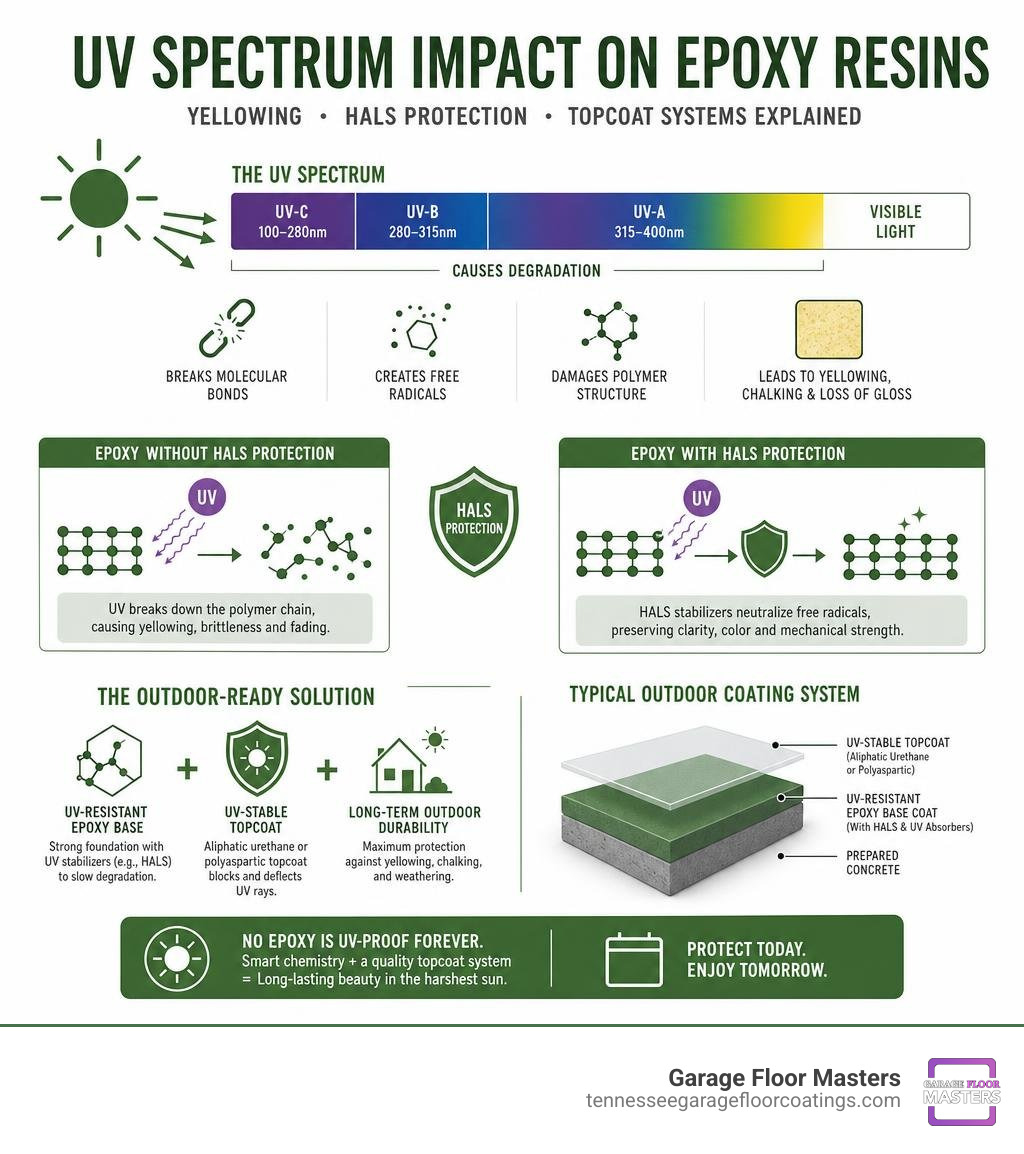
To understand how an epoxy UV resistant system works, we first have to look at why traditional epoxy hates the sun. Standard epoxy is a thermoset plastic formed by the irreversible crosslinking of resin and hardener molecules. While this chemical structure makes epoxy incredibly strong—often four times stronger than concrete—it has a major Achilles’ heel: its molecular bonds are highly sensitive to ultraviolet radiation.
When sunlight hits a standard cured epoxy surface, a destructive photochemical reaction begins. The polymer chains contain light-sensitive structures called chromophores. These chromophores absorb UV radiation (specifically in the 300 to 400 nm wavelength range), which excites the molecules and causes the crosslinked polymer chains to break.
This molecular breakdown manifests visually in three distinct stages:
- Ambering or Yellowing: The clear resin begins to take on a dark, yellow-brown tint. This is particularly noticeable over white base coats, decorative flakes, or clear wood finishes.
- Loss of Gloss and Hazing: The smooth, glass-like finish becomes dull, hazy, and loses its reflective quality.
- Chalking: In advanced stages of UV degradation, the surface physically breaks down, leaving a powdery, white, chalky residue that easily rubs off.
To combat this, specialty manufacturers formulate epoxy UV resistant products with two primary defense mechanisms: UV Absorbers and Hindered Amine Light Stabilizers (HALS).
UV absorbers act like a chemical sunscreen for your floor or tabletop. They intercept incoming UV rays, absorb the destructive energy, and safely convert it into low-level heat before it can damage the polymer chains. HALS, on the other hand, act as radical scavengers. When UV light manages to break a chemical bond and create a destructive free radical, HALS molecules immediately trap and neutralize those radicals, preventing a chain reaction of polymer degradation.
However, even the highest-quality stabilizers have a limited lifespan. Over time, these additives deplete, wash away, or break down under constant sun exposure, which is Why Epoxy Floors Turn Yellow if they aren’t properly maintained or paired with a more stable topcoat.
The Best Types of UV-Resistant Epoxy for Outdoor and High-Sun Projects
When selecting an epoxy UV resistant system, you must match the specific chemistry of the resin to your project’s physical demands. A thin-film floor coating requires vastly different properties than a deep-pour river table resin.
100% Solids epoxy UV resistant Base Coats
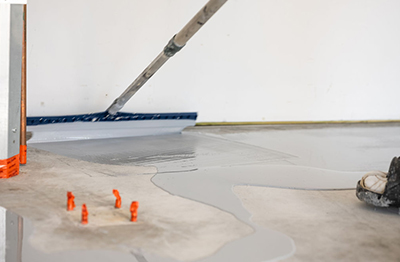
For high-traffic surfaces like industrial floors, commercial spaces, and residential garage floors, a 100% solids epoxy base coat is the standard starting point. These coatings have zero volatile organic compounds (VOCs) and cure to a thick, incredibly durable film.
In decorative flooring systems—such as metallic pigments, full color flake, or quartz broadcast systems—a UV-resistant base coat is essential. Products like E671 are designed specifically as clear, 100% solids epoxy seal coats incorporating advanced UV-resistance additives. With a low mixed viscosity (under 700 cPs) and a Shore D hardness of 75 to 80, E671 provides an ideal clear binder for decorative media.
However, professional installers know that even a high-build, UV-stabilized base coat cannot stand alone in direct sunlight. Because it is not fully UV color-stable on its own, it must be paired with a high-performance topcoat to maintain its appearance. Knowing How to Keep Your Epoxy Floor from Turning Yellow always involves using a multi-layer system where the UV-resistant epoxy base is shielded by a light-stable aliphatic topcoat.
Deep Pour and Tabletop epoxy UV resistant Resins
If you are casting a thick river table, sealing an outdoor bar, or coating resin art, your primary concerns are clarity, bubble release, and working time.
Popular tabletop formulations like Liquid Stone Ultra UV and Stone Coat Art Coat are engineered with high concentrations of HALS and UV absorbers. These resins are mixed at a simple 1:1 ratio by volume and offer generous working times (from 30 minutes up to 55 minutes) to allow trapped air bubbles to escape. They cure to a hard, high-gloss finish with a Shore D hardness between 75 and 82, and boast impressive heat resistance (up to 450°F to 475°F temporarily).
In simulated QUV weathering tests, these premium art and tabletop epoxies deliver up to 10 times longer lasting clarity compared to standard, non-stabilized formulas. While they perform beautifully indoors near sunny windows, continuous outdoor exposure will still eventually deplete their stabilizers, requiring a protective clear varnish or urethane topcoat for long-term outdoor survival.
Cationic UV-Cured Epoxy Systems
In precision industrial, electronic, and aerospace applications, standard two-component epoxies are often replaced by cationic, light-cured epoxy systems. Products like Master Bond UV22 and UV-8300LV represent a completely different class of epoxy technology.
Rather than curing over several days via a chemical reaction between a resin and a hardener, these one-component systems cure in a matter of seconds (15 to 45 seconds) when exposed to a specific wavelength of UV light (typically 320 to 405 nm).
These systems offer incredible performance characteristics:
- Exceptional physical properties: Shore D hardness up to 85, tensile strength of 5,000 to 8,500 psi, and service temperatures ranging from -80°F to +350°F.
- Nanosilica fillers: Provide outstanding dimensional stability, high abrasion resistance, and minimal shrinkage during curing.
- NASA low outgassing: Meet strict ASTM E595 specifications for aerospace use.
While cationic UV-cured epoxies are perfect for bonding glass, optics, and electronics, their rapid, light-dependent curing mechanism makes them completely impractical for large-scale outdoor projects like patios or garage floors.
Real-World Longevity: Lab Testing vs. Outdoor Reality
To prove the effectiveness of an epoxy UV resistant product, manufacturers rely on standardized laboratory testing. The industry benchmark is QUV accelerated weathering testing performed in accordance with ASTM D4587.
In a QUV machine, epoxy samples are subjected to alternating cycles of intense ultraviolet light and moisture condensation at elevated temperatures. This simulates years of outdoor exposure in a fraction of the time. Another critical metric is ASTM D2244, which measures the exact mathematical color change (Delta E) of a coating over time. For example, high-quality industrial formulations like MC-UV Epoxy show a color change index of less than 30 after 1,000 hours of continuous QUV testing, proving their superior resistance to ambering compared to standard epoxies.
But how do these laboratory hours translate to real-world longevity under the East Tennessee sun?
| Exposure Environment | Expected Time to First Yellowing (Standard Epoxy) | Expected Time to First Yellowing (UV-Resistant Epoxy) | Expected Time to First Yellowing (Epoxy + Aliphatic Topcoat) |
|---|---|---|---|
| Direct Outdoor Sun (Knoxville, TN) | 1 to 3 months | 6 to 12 months | 3 to 5+ years |
| Indirect Sun / Indoors near Windows | 6 to 12 months | 3 to 5 years | 8+ years |
| Full Shade / Controlled Indoor Light | 2 to 3 years | 7 to 10+ years | Decades |
As the table shows, even a heavily stabilized epoxy UV resistant formula will begin to show signs of ambering within a year if left completely unprotected in direct outdoor sunlight. The harsh reality of real-world weathering includes temperature swings, acid rain, and physical abrasion—all of which accelerate the depletion of chemical UV stabilizers.
To keep any outdoor epoxy surface looking pristine, you must apply maintenance coats of a UV-blocking clear finish every few years, or upgrade to a fundamentally superior coating chemistry.
Beyond Epoxy: The Role of Aliphatic Topcoats and Polyaspartic Alternatives
If you want a truly sunproof, maintenance-free floor for your garage, patio, or driveway, relying on epoxy alone is a losing battle. To achieve permanent UV stability, professional installers look beyond epoxy to aliphatic urethanes and polyaspartic coatings.
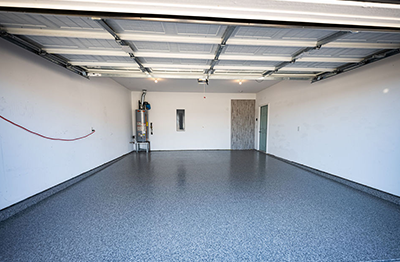
Aliphatic polyurethane topcoats are highly resistant to UV light. Unlike epoxy, their molecular structure does not contain the specific carbon bonds that absorb UV radiation and break down. When applied as a clear topcoat over a cured, lightly sanded epoxy base coat, an aliphatic urethane acts as an impenetrable shield, blocking UV light from ever reaching the vulnerable epoxy underneath.
However, the ultimate solution for sun-exposed concrete is a polyaspartic floor coating. Originally developed in the 1980s for high-performance industrial applications like truck bed liners and bridge coatings, polyaspartics are a specialized class of polyurea.
Polyaspartic coatings offer massive advantages over traditional epoxy:
- Inherent UV Stability: They are 100% aliphatic, meaning they do not absorb UV light between 300 and 400 nm. They will never yellow, fade, haze, or chalk, even under direct, continuous sunlight.
- Extreme Durability: Polyaspartic coatings are highly flexible, allowing them to expand and contract with the natural movement of concrete during seasonal temperature shifts. This prevents the cracking and peeling common with rigid epoxies.
- Rapid Cure Times: While epoxy floors can take up to a week to fully cure, a polyaspartic floor can be installed and ready for full vehicle traffic in just 24 hours.
- Hot-Tire Pickup Resistance: Polyaspartics easily withstand the intense heat radiating from car tires, preventing the unsightly black tire marks that plague cheap epoxy DIY kits.
For a deeper dive into how these advanced systems protect your home, read about UV Resistant Polyaspartic Coatings for a Sunproof Garage and discover why homeowners are upgrading to professional Polyaspartic Floor Coatings.
Frequently Asked Questions About UV-Resistant Epoxy
Is there a truly permanent UV-proof epoxy?
No. There is no such thing as a permanently UV-proof epoxy. While an epoxy UV resistant formula contains high-quality stabilizers (HALS and UV absorbers) that delay the yellowing process, these chemical additives are sacrificial. They gradually degrade and deplete over time. Eventually, any epoxy chemistry exposed to direct sunlight will experience polymer degradation, leading to ambering, loss of gloss, and chemical breakdown.
Can a clear urethane topcoat fully protect standard epoxy from yellowing?
This is a common industry myth. While a clear aliphatic urethane topcoat is highly UV-stable and will not yellow itself, most clear topcoats do not completely block UV rays from passing straight through them. The UV light penetrates the clear topcoat and ambers the vulnerable standard epoxy underneath, causing the entire system to discolor and potentially delaminate.
To fully protect concrete in high-sun areas, you must use a pigmented base coat or choose an inherently UV-stable system. To understand the long-term value of these high-performance systems, check out our guide on The Real Cost of Polyaspartic Garage Floors.
How do you maintain an outdoor epoxy surface to prevent sun damage?
To maximize the lifespan of an outdoor epoxy surface, follow these maintenance best practices:
- Apply a sacrificial wax or clear coat: Reapply a high-quality, UV-blocking clear topcoat or marine varnish every 1 to 2 years.
- Keep it clean: Regularly wash the surface with a non-abrasive, pH-neutral cleaner to remove dirt and grime that can trap heat and accelerate UV damage.
- Avoid harsh chemicals: Never use acetone or abrasive scrubbers. For spot cleaning stubborn stains, use a mild soap or 91% isopropyl alcohol.
- Utilize shade: Whenever possible, use umbrellas, shade sails, or covers to protect outdoor epoxy tables and countertops from direct midday sun.
Conclusion
When it comes to protecting your outdoor concrete, patios, or garage floors from the blazing East Tennessee sun, settling for standard DIY epoxy is a recipe for heartbreak. While an epoxy UV resistant base coat plays an important role in professional multi-layer systems, achieving true, lifelong durability requires the right chemistry and expert installation.
At Garage Floor Masters, we provide high-performance polyaspartic and epoxy floor coatings throughout Knoxville, TN, and the surrounding areas, including:
- Oak Ridge, TN
- Sevierville, TN
- Maryville, TN
- Lenoir City, TN
- Clinton, TN
- …and many more surrounding communities!
Our advanced UV-stable coatings are 4x stronger than standard epoxy, can be fully installed in just one single day, and are available in over 140 beautiful, flake-resistant colors.
We can include ranges for pricing, but the final cost is always based on the unique condition of your concrete and the specific design features you select. That is why we are proud to offer a completely free, no-obligation, on-site estimate to help you plan your project perfectly.
Ready to upgrade your home with a sunproof floor built to handle everyday life? Learn more about our specialized Polyaspartic Floor Coatings Knoxville Tennessee, find out Why Polyaspartic is the Knoxville King of Concrete Coatings, and Get a professional garage floor coating quote from Garage Floor Masters today!