
What Does Epoxy Floor Cost Per Foot Actually Run in 2026?
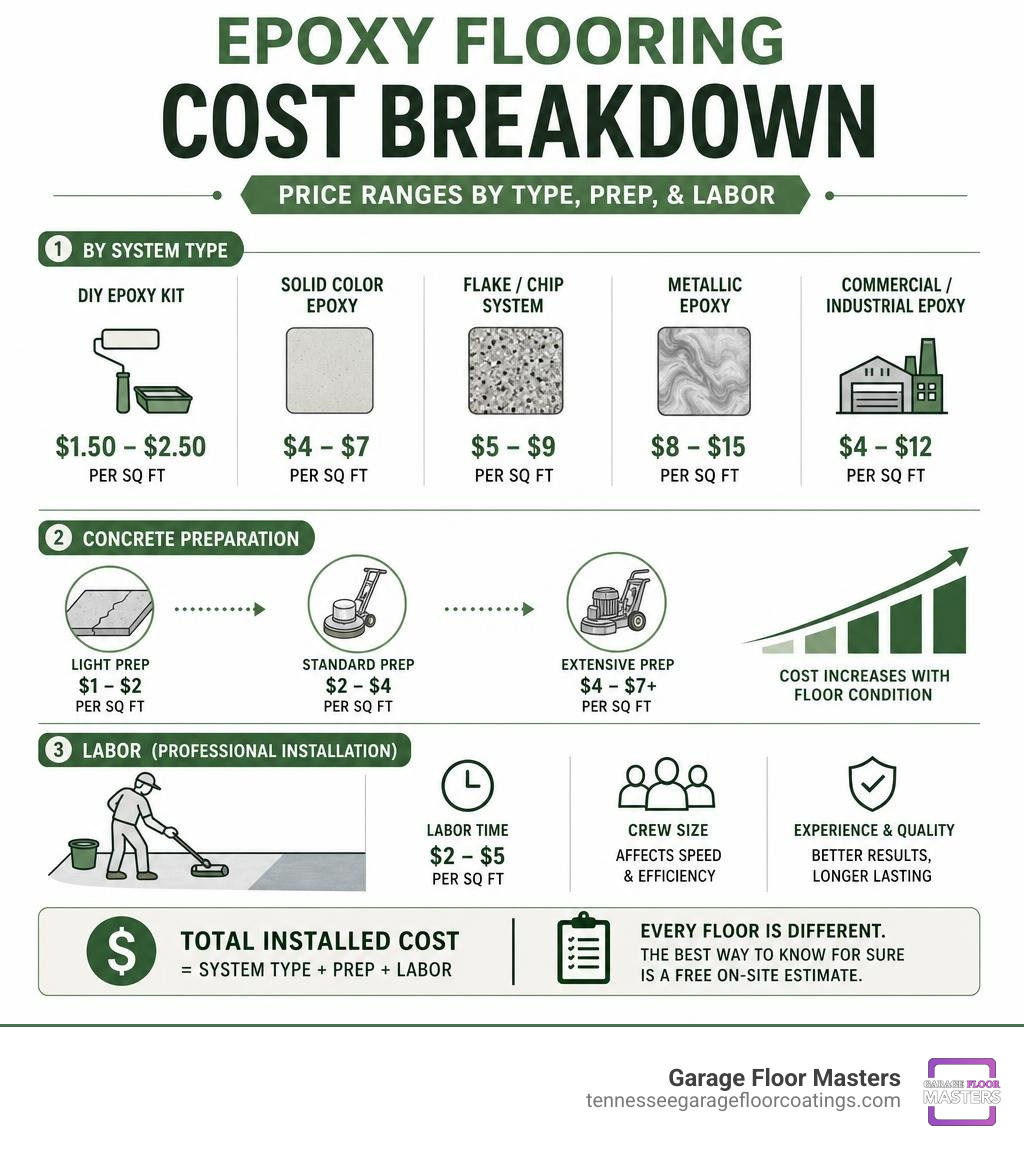
If you’re trying to figure out the epoxy floor cost per foot before committing to a project, here’s the short answer:
| Installation Type | Cost Per Square Foot |
|---|---|
| DIY epoxy kit | $1.50 – $2.50 |
| Professional solid color epoxy | $4 – $7 |
| Professional flake/chip system | $5 – $9 |
| Professional metallic epoxy | $8 – $15 |
| Commercial / industrial epoxy | $4 – $12 |
Costs vary based on your floor’s condition, the system you choose, and your location. The only way to get a number you can actually budget from is a free on-site estimate.
So you’ve got a garage floor that’s cracked, stained, and looking rough — and you want to know what it’s going to cost to fix it before you call anyone. That’s smart.
The frustrating reality is that epoxy flooring prices are all over the map online. You’ll see figures ranging from under $2 a square foot to well over $15, with very little explanation of why.
A lot of that variation is real. The final price depends on factors like your concrete’s condition, the type of coating system you choose, and whether you’re going DIY or hiring a professional crew. A basic water-based epoxy kit and a full broadcast flake system with a polyurethane topcoat are completely different products — but they both get called “epoxy flooring.”
At Garage Floor Masters, we believe you shouldn’t have to guess. This guide breaks down exactly what drives the cost, what’s worth paying for, and where the hidden fees tend to sneak in.
Epoxy floor cost per foot terminology:
- average cost of epoxy flooring
- average cost of metallic epoxy flooring
- cost effective garage flooring
Average Epoxy Floor Cost Per Foot in 2026
In 2026, the national average cost to install professional epoxy flooring ranges between $5 and $12 per square foot. This is a shift from 2018 when typical pricing sat closer to $3 to $7 per square foot. Rising raw material costs, higher shipping fees, and an increased demand for high-performance polymers have steadily pushed these numbers up over the last several years.
When you look at the local East Tennessee market — from Knoxville and Oak Ridge down to Maryville and Loudon — pricing generally follows these national trends. However, because labor rates in our region are slightly more stable than those in massive coastal metropolitan areas, homeowners here often get premium quality without the inflated big-city markups.
Understanding the How Much Does Epoxy Flooring Cost Per Square Foot? equation means looking at what goes into that final number. The price of a floor isn’t just the liquid poured out of a bucket; it is a combination of meticulous concrete profiling, heavy machinery wear-and-tear, high-grade resins, and skilled labor.
How Epoxy Floor Cost Per Foot Varies by Material Type
The type of liquid polymer used on your floor is the single biggest driver of your material costs. Let’s break down the four most common options you will encounter:
- Water-Based Epoxy ($0.50 – $2.50 per square foot): This is the stuff you find in colorful boxes at local big-box home improvement stores. It is highly diluted with water, meaning that as it dries, a massive portion of the thickness evaporates into the air. What is left behind is a incredibly thin film (often only 1 to 2 mils thick) that is highly prone to peeling, scratching, and lifting under hot car tires.
- 100% Solids Epoxy ($5 – $8 per square foot installed): This is the true industrial-grade standard. It contains zero solvents or water. When a professional pours down a gallon of 100% solids epoxy, every single drop stays on the floor, curing via a chemical reaction into a thick, impact-resistant barrier that is typically 10 to 20 mils thick.
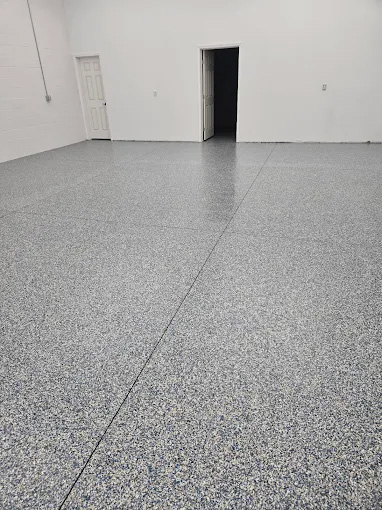
- Flake/Chip Systems ($5 – $9 per square foot installed): This system starts with a thick colored base coat of epoxy or polyurea, followed by a dense layer of vinyl chips broadcast across the entire surface until it is completely covered. Once cured, the excess chips are scraped away, and a heavy-duty clear topcoat is applied. This creates a highly durable, textured, slip-resistant finish that hides minor concrete imperfections beautifully.
- Metallic Epoxy ($8 – $15 per square foot installed): If you want a floor that looks like flowing lava, polished marble, or metallic waves, this is your choice. Metallic pigments are mixed into a clear 100% solids epoxy base and manipulated using rollers, squeegees, or solvents to create stunning 3D visual depths. Because of the artistry and multiple layers required, How Much Does Metallic Epoxy Flooring Really Cost? is always on the higher end of the pricing spectrum.
Here is a quick look at how these material choices compare over their expected lifespans:
| Epoxy Coating Type | Average Installed Cost / Sq. Ft. | Average Lifespan (Years) | Best For |
|---|---|---|---|
| Water-Based | $0.50 – $2.50 (DIY) | 1 – 3 | Low-traffic basements, light utility rooms |
| 100% Solids | $5 – $8 | 10 – 20 | Indoor workshops, cleanrooms, warehouses |
| Flake/Chip Systems | $5 – $9 | 15 – 20+ | Garages, patios, high-traffic entryways |
| Metallic Epoxy | $8 – $15 | 10 – 15 | Showrooms, retail spaces, custom basements |
Cost Breakdown by Space and Garage Size
Square footage is a major factor in pricing, but it doesn’t scale in a straight line. Because every project requires a crew to load up a truck, drive to your home, set up heavy diamond grinding equipment, and clean up afterward, larger spaces often benefit from lower per-foot rates.
Let’s look at how typical residential and commercial spaces break down:
- 1-Car Garage (~200 – 250 sq. ft.): Because of the fixed mobilization costs, a professional installation for a small single-car garage often ranges from $1,200 to $3,900.
- 2-Car Garage (~400 – 500 sq. ft.): This is the most common residential project size. A standard professional flake system on a 2-car garage typically runs between $2,000 and $4,500. For a deeper dive into these specific numbers, read The Complete Guide to Garage Epoxy Installation Costs.
- 3-Car Garage (~600 – 750 sq. ft.): Larger residential garages often see a slight price break on the per-square-foot rate, with total professional costs running from $3,000 to $6,500.
- Basements ($4 – $8 per square foot): Basements require careful moisture testing because they sit below grade. If high moisture levels are detected, a specialized vapor barrier primer must be applied first, which can add to the baseline cost.
- Commercial and Industrial Spaces ($4 – $12 per square foot): For massive warehouses or retail floors over 5,000 square feet, the epoxy floor cost per foot can drop significantly due to volume pricing. However, if the facility requires heavy-duty coatings like urethane cement or fast-curing MMA (methyl methacrylate) to minimize business downtime, those specialized systems will increase the overall rate.
Key Factors That Drive Up the Final Invoice
If you have ever received a home improvement quote that ended up being hundreds of dollars higher than the initial phone estimate, you know how frustrating hidden fees can be. When it comes to concrete coatings, the “hidden” costs are almost always hiding in the physical state of your concrete slab.
To help you Calculate Your Epoxy Floor Costs Like a Pro, you need to look closely at your floor’s current condition, the moisture levels in your concrete, and the specific design finishes you want.
Concrete Preparation and Repair Costs
A coating is only as good as the surface it is bonding to. If you pour premium epoxy over dirty, oily, or weak concrete, it will peel off like a sunburn within a few months. That is why professional installers spend up to 80% of their time on surface preparation.
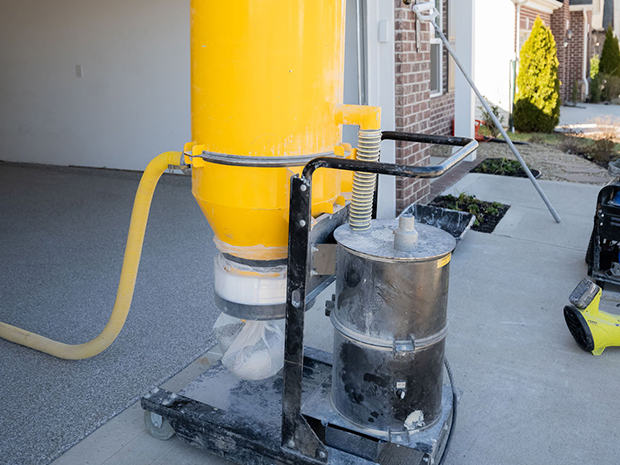
- Diamond Grinding: True professionals do not rely on weak acid washes. We use heavy, walk-behind planetary diamond grinders connected to industrial HEPA vacuums. This process mechanically opens up the “pores” of the concrete, creating a rough Concrete Surface Profile (CSP) that resembles 80-grit sandpaper.
- Crack and Joint Repair: If your concrete has settling cracks, spalling, or deep pits from winter salt damage, those must be filled with a high-strength polyurea or epoxy joint filler before any coating can be applied. Minor repairs are often included in a standard quote, but extensive patching can add to the total cost.
- Moisture Mitigation: Concrete is like a giant sponge. If moisture is rising up from the soil beneath your slab, it will create hydrostatic pressure that can literally push the epoxy coating off the surface. Testing for moisture vapor transmission is essential. If your slab has high moisture levels, a specialized moisture-blocking primer must be applied, which can add $1.50 to $3.50 per square foot to the prep phase.
Design Complexity and Topcoat Upgrades
The final layers of your floor also play a massive role in the final invoice.
Standard epoxy is highly reactive to ultraviolet (UV) light. If your garage floor gets direct sunlight throughout the day, a basic epoxy topcoat will eventually turn a dull, chalky yellow. To prevent this, we recommend upgrading to a UV-stable topcoat like polyurethane or polyaspartic.
Additionally, if you want custom color blends, multi-colored flake combinations, or specialized slip-resistant additives (like aluminum oxide or quartz broadcast), these upgrades will naturally adjust the final price. To avoid getting surprised by these choices, check out our guide on how to Don’t Get Floored by High Epoxy Rates.
DIY vs. Professional Installation Costs
It is a Saturday morning. You are standing in the aisle of a home improvement store in Knoxville or Sevierville, looking at a DIY epoxy garage kit that costs $150. You do the quick math in your head: My garage is 400 square feet, so this is going to cost me less than $0.50 a foot! Why on earth would I pay a professional crew thousands of dollars?
It is a fair question. But before you grab that box and head to the register, you need to understand the massive gap between DIY retail kits and professional-grade installations.
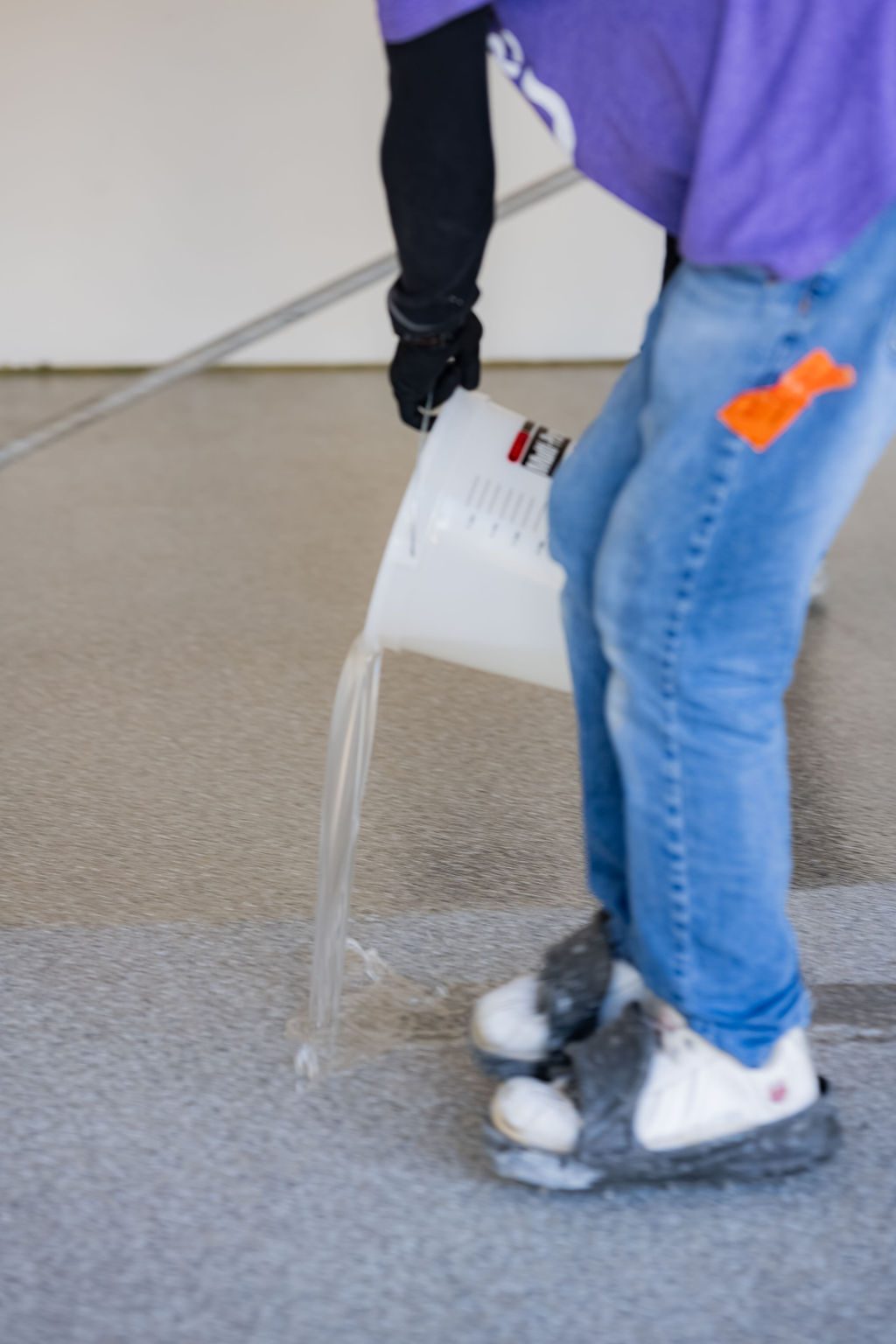
DIY vs. Professional Epoxy Floor Cost Per Foot
A DIY kit looks incredibly cheap on paper. However, the kit itself is only a small part of the actual cost. To do the job right, you also need to factor in the tools and equipment you will have to rent or buy:
- Sanding/Grinding Equipment Rental: $150 – $250 per day
- Industrial Diamond Blades: $50 – $100
- Squeegees, Professional Rollers, and Spiked Shoes: $75 – $150
- Crack Fillers and Concrete Patching Compounds: $50 – $100
- Personal Protective Equipment (Respirators, Gloves, Eye Protection): $40
When you add up the cost of the retail kits, the tool rentals, and the specialized supplies, a proper DIY installation often ends up costing closer to $1.50 to $2.50 per square foot in materials alone.
More importantly, DIY kits are almost always water-based or solvent-based. They cure to a very thin layer that simply cannot withstand the weight of a heavy vehicle, hot tires, or dropped tools over the long haul.
If you do decide to go the professional route, there are still several smart ways to keep your costs down. To help you plan, read The Ultimate Guide to Epoxy Flooring Prices and keep these practical cost-saving tips in mind:
- Empty the Space Yourself: Most professional crews charge an extra fee if they have to move heavy workbenches, refrigerators, or storage shelves out of your garage. Doing this prep work yourself keeps those labor charges off your bill.
- Choose Standard Flake Colors: Custom-colored vinyl chips or multi-colored metallic pigments require specialized ordering and extra labor. Sticking to a company’s standard, high-volume flake blends can save you money.
- Bundle Your Projects: If you are thinking about coating your garage floor, your basement, and your back patio, try to schedule them all at once. Crews can prep and coat multiple areas during the same mobilization, which significantly lowers your average cost per foot.
The Hidden Costs of DIY Failures
The single biggest risk of a DIY epoxy project is failure. According to industry statistics, DIY epoxy floors fail at an incredibly high rate. The most common culprit? Improper surface preparation.
Most DIY kits instruct you to clean your concrete with a mild acid etch (often citric acid or muriatic acid). Acid etching is highly unreliable. If your concrete has a tight, steel-troweled finish, or if there is an old sealer or paint on the surface, the acid won’t open up the pores of the concrete. The epoxy will simply sit on top of the slab like a giant sheet of plastic.
When a DIY floor fails, you will experience:
- Hot-Tire Pickup: When you drive your car into the garage after a long trip, the heat from your tires will soften the thin DIY epoxy. As the tires cool down overnight, they contract and literally pull the epoxy right off the concrete.
- Peeling and Bubbling: Moisture vapor rising through the concrete will easily blister and crack a thin, water-based DIY coating.
- The Cost of Re-Prep: If your DIY floor peels, you cannot simply paint over it. The failed coating must be completely ground off back to bare concrete. Hiring a professional to grind away a sticky, half-cured DIY mess can cost $2.50 to $6.00 per square foot just for the removal process before the new floor can even be installed!
Epoxy Flooring vs. Alternative Concrete Coatings
When you are looking at upgrading your concrete, traditional epoxy is not your only choice. In fact, modern polymer chemistry has introduced advanced coatings that completely outperform old-school epoxy systems.
Let’s look at how traditional epoxy compares to alternative options like polyaspartic coatings, polished concrete, and interlocking tiles:
- Polyaspartic Coatings ($6 – $12 per square foot): Originally developed to line heavy-duty pickup truck beds, polyaspartic is a specialized hybrid polymer. It is 4 times stronger than traditional epoxy, highly flexible (so it won’t chip or crack as your concrete expands and contracts), and 100% UV-stable. Best of all, while epoxy takes 3 to 7 days to fully cure, polyaspartic can be installed in a single day, allowing you to walk on it in 24 hours and park your car on it in 72 hours. To see why this is often the most cost-effective long-term choice, read The Real Cost of Polyaspartic Garage Floors.
- Polished Concrete ($3 – $8 per square foot): This process involves grinding your existing concrete slab down with progressively finer diamond abrasive pads until it achieves a smooth, glossy shine. It is incredibly durable and easy to clean, but it does not hide stains, cracks, or color variations in your concrete. It also offers no chemical or oil resistance.
- Interlocking Vinyl/Plastic Tiles ($3 – $7 per square foot): These tiles snap together directly over your concrete. They are highly DIY-friendly and come in various colors. However, they do not seal your concrete. Water, dirt, road salt, and automotive fluids can easily seep through the seams, trapping moisture and grime underneath the tiles, which can lead to mold and unpleasant odors.
Frequently Asked Questions About Epoxy Flooring Costs
How long does an epoxy floor take to dry and cure?
This depends entirely on the chemistry of the system you choose.
- Water-Based Epoxy: Typically takes 12 to 24 hours to be dry to the touch, but requires a full 7 days to chemically cure before you can park a car on it.
- 100% Solids Epoxy: Usually ready for light foot traffic in 18 to 24 hours, but requires 3 to 5 days to fully cure for vehicle traffic.
- Polyaspartic Coatings: Walk-on dry in just 5 to 8 hours, and fully cured for heavy vehicles in 24 to 72 hours.
Is epoxy flooring cheaper than tile or polished concrete?
In terms of upfront installation costs, a basic professional epoxy floor is generally more affordable than high-end ceramic tile, natural stone, or intricate vinyl plank systems. While a basic polished concrete floor can sometimes cost less than a decorative flake or metallic epoxy system, polished concrete does not offer the seamless waterproof protection, stain resistance, or impact durability that a resinous coating provides. Over a 15-year period, a high-quality concrete coating is almost always the most cost-effective option because it requires virtually zero maintenance and will not need to be replaced.
Can you apply epoxy over existing floor paint or sealer?
The short answer is no. You should never apply a professional-grade epoxy or polyaspartic coating directly over old floor paint, latex garage paint, or concrete sealers. The new coating will only bond to the old paint, not the concrete itself. If that old paint begins to peel (which it eventually will), your expensive new floor will peel right along with it. A professional crew will always use industrial diamond grinding equipment to completely remove all traces of old paint, sealers, and oils before applying the new coating system.
Conclusion
Upgrading your concrete floor is a fantastic investment that adds real value, beauty, and durability to your home. But as we have shown in this guide, trying to cut corners with cheap DIY retail kits or choosing contractors who skip the crucial preparation steps will almost always cost you more money in the long run.
At Garage Floor Masters, we do things differently. We provide professional garage floor coatings across East Tennessee, including:
- Knoxville, TN
- Oak Ridge, TN
- Maryville, TN
- Sevierville, TN
- Lenoir City, TN
- And surrounding areas like Crossville, Vonore, Tazewell, LaFollette, Loudon, Friendsville, Powell, Jefferson City, Pigeon Forge, Clinton, Andersonville, and White Pine.
Our high-performance polyaspartic coatings are 4 times stronger than traditional epoxy, 100% UV-stable (so they will never turn yellow in the East Tennessee sun), and can be completely installed in just one day. With over 140 beautiful flake colors to choose from, you can easily find the perfect look for your home.
We don’t believe in high-pressure sales tactics or hidden fees. Because every concrete slab is unique, the only way to give you an honest, accurate price is to see your floor in person. That is why we offer a completely free, no-obligation on-site estimate. We will test your concrete for moisture, assess any cracks or damage, and help you select the perfect system for your budget and lifestyle.
Ready to transform your concrete into a beautiful, low-maintenance floor that is built to last? Head over to our Garage Floor Coating Cost page or contact us today to schedule your free on-site estimate!