
What Is the Epoxy Flooring Rate in 2026? (Quick Answer)
The epoxy flooring rate in 2026 typically falls between $3 and $12 per square foot for professional installation, depending on the system type, surface condition, and finish you choose.
Here’s a quick breakdown to help you compare:
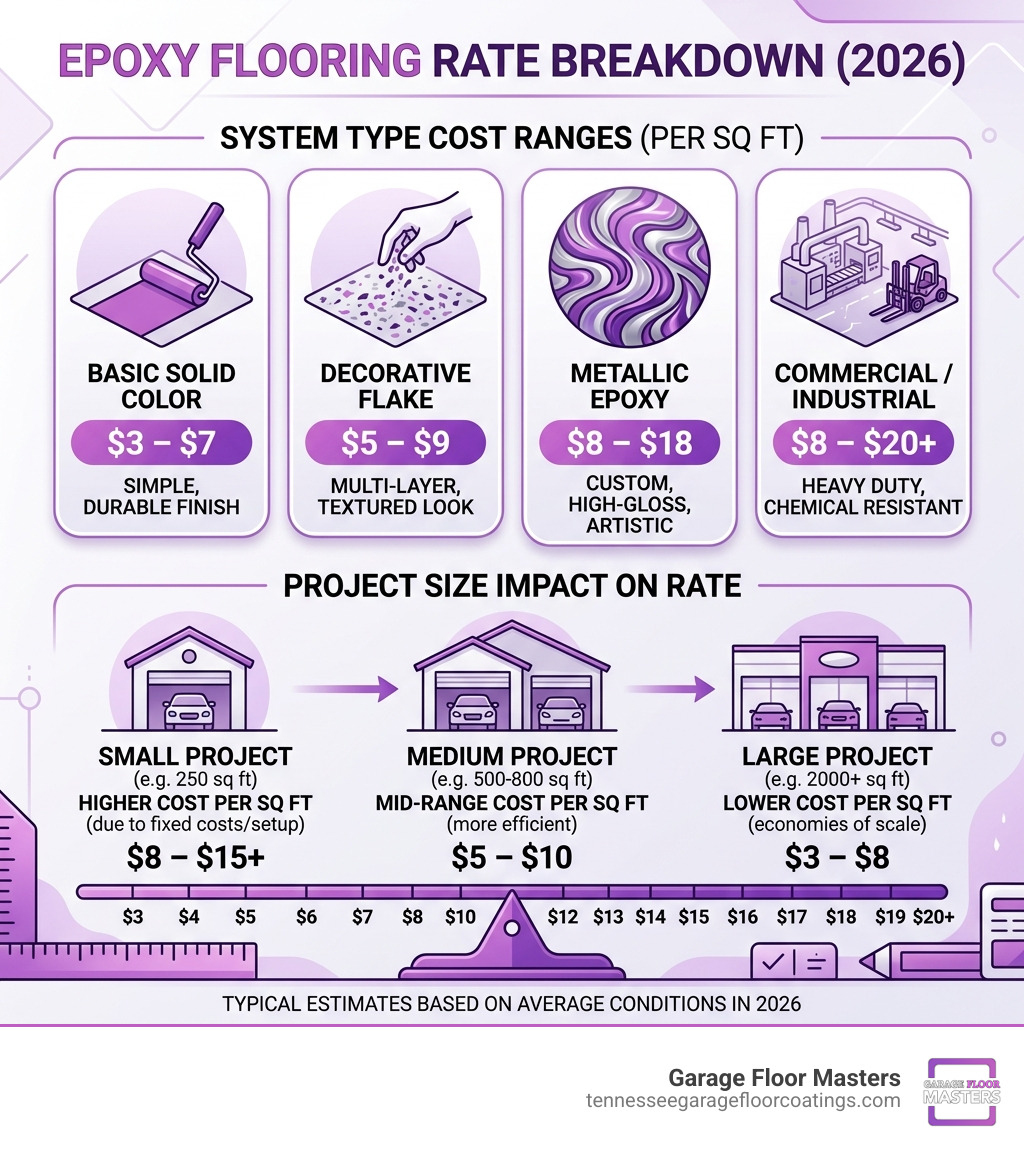
| Epoxy System Type | Typical Rate (per sq ft) |
|---|---|
| Basic solid color | $3 – $7 |
| Decorative flake | $5 – $9 |
| Metallic epoxy | $8 – $18 |
| Commercial / industrial | $8 – $20+ |
Actual costs vary based on your project’s condition and the features you select. That’s why we offer a free on-site estimate.
Your garage floor takes a beating. Salt, oil, tire marks, cracking concrete — it adds up fast, especially through a tough Tennessee season. So when you start looking at epoxy coatings, the first question is almost always the same: “What’s this actually going to cost me?”
The honest answer is: it depends. A simple solid-color coat on clean concrete sits at the lower end of the range. A custom metallic or multi-layer flake system on a damaged slab pushes higher. The gap between those two scenarios can be thousands of dollars.
That’s what makes comparing epoxy rates so frustrating. You’ll find prices all over the map online — and without context, those numbers don’t mean much.
This guide breaks it all down clearly, so you know exactly what drives the cost and what to look for when comparing quotes.
Understanding the Average epoxy flooring rate in 2026
When we talk about the epoxy flooring rate in 2026, we are looking at a market that has stabilized after the supply chain fluctuations of previous years. Nationally, most homeowners find that professional Epoxy Floor Coatings land in that $3 to $12 per square foot sweet spot. But what exactly are you paying for in that rate?
Generally, the cost is split into three main buckets: materials, labor, and equipment overhead. Materials like high-quality resins can cost anywhere from $40 to $150 per gallon depending on the solids content. Labor usually accounts for 40% to 60% of the total project cost because applying these systems correctly is a multi-day, labor-intensive process.
Water-Based vs. 100% Solids Epoxy
One of the biggest factors in the rate you’re quoted is the type of epoxy being used.
| Feature | Water-Based Epoxy | 100% Solids Epoxy |
|---|---|---|
| Rate (Installed) | $3 – $5 per sq ft | $6 – $12 per sq ft |
| Durability | Moderate (3-5 years) | High (10-20 years) |
| Thickness | 2-3 mils | 10-20+ mils |
| Best For | Light foot traffic | Garages, shops, industrial |
While water-based options have a lower initial epoxy flooring rate, they are much thinner and prone to “hot-tire pickup”—where your tires literally peel the floor up after a drive. At Garage Floor Masters, we focus on high-performance systems that are built to handle the heavy use of a Tennessee garage.
Factors That Influence Your Total Project Cost
If you’ve called around for quotes in Knoxville or Maryville, you’ve likely noticed that prices aren’t one-size-fits-all. Several variables can shift your total investment.
Square Footage and Economies of Scale
The size of your project is a major driver. Interestingly, the epoxy flooring rate per square foot often decreases as the project size increases. This is because fixed costs—like mobilizing the crew and setting up the heavy diamond grinding equipment—are spread out over a larger area. A small 100-square-foot laundry room might cost $15 per square foot, while a 5,000-square-foot warehouse might drop to $5 or $6 per square foot.
Project Complexity and Location
While we serve a wide range of areas from Sevierville to Oak Ridge and down to Loudon, local factors still play a role. The layout of your space matters too; a wide-open garage is much faster to coat than a basement with five different small rooms and dozens of edge-cuts. Seasonal scheduling can also impact rates; spring and fall are peak seasons in Tennessee, so booking during “off-peak” winter months can sometimes lead to better availability.

Why Surface Prep Dictates the epoxy flooring rate
We have a saying in the industry: “A floor is only as good as the prep.” You could buy the most expensive resin in the world, but if it’s applied to dirty or smooth concrete, it will peel. This is where a significant portion of your epoxy flooring rate goes.
Mechanical Profiling
Professional installers don’t just “wash” the floor. We use heavy-duty diamond grinding or shot blasting to “open up” the pores of the concrete. This creates a profile that the epoxy can mechanically bond to. If a contractor offers a suspiciously low rate and says they only use an “acid wash,” be careful—acid etching is often insufficient for long-term adhesion.
Repairs and Moisture Mitigation
If your concrete has deep cracks, spalling (flaking), or oil stains, these must be treated before the first coat goes down. Furthermore, moisture is the “silent killer” of epoxy. If your slab has high moisture vapor transmission, we may need to apply a specialized moisture-mitigating primer. This adds to the initial epoxy flooring rate, but it prevents the floor from bubbling and failing six months later.
Comparing Rates by Room Type and Finish
The intended use of the room will dictate which Epoxy Garage Floor Coating system is best, which in turn affects the price.
- Residential Garages: These usually require a full broadcast flake system to hide imperfections and provide slip resistance.
- Basements: Rates here are often influenced by moisture levels. Basements in places like Jefferson City or Clinton often benefit from antimicrobial properties to prevent mold growth under the coating.
- Commercial Warehouses: These often use high-build solid color systems designed for forklift traffic and chemical resistance.
- Kitchens and Bathrooms: Safety is the priority here. We often add extra anti-slip aggregates, which can slightly adjust the rate but provide peace of mind in wet areas.
How Finish Types Impact Your epoxy flooring rate
The “look” you choose is the final piece of the pricing puzzle.
- Solid Color Systems: The most budget-friendly professional option. It’s clean, industrial, and effective.
- Decorative Flake Finishes: Our most popular choice. It involves broadcasting vinyl chips into a base coat. It’s durable, masks dirt, and looks fantastic.
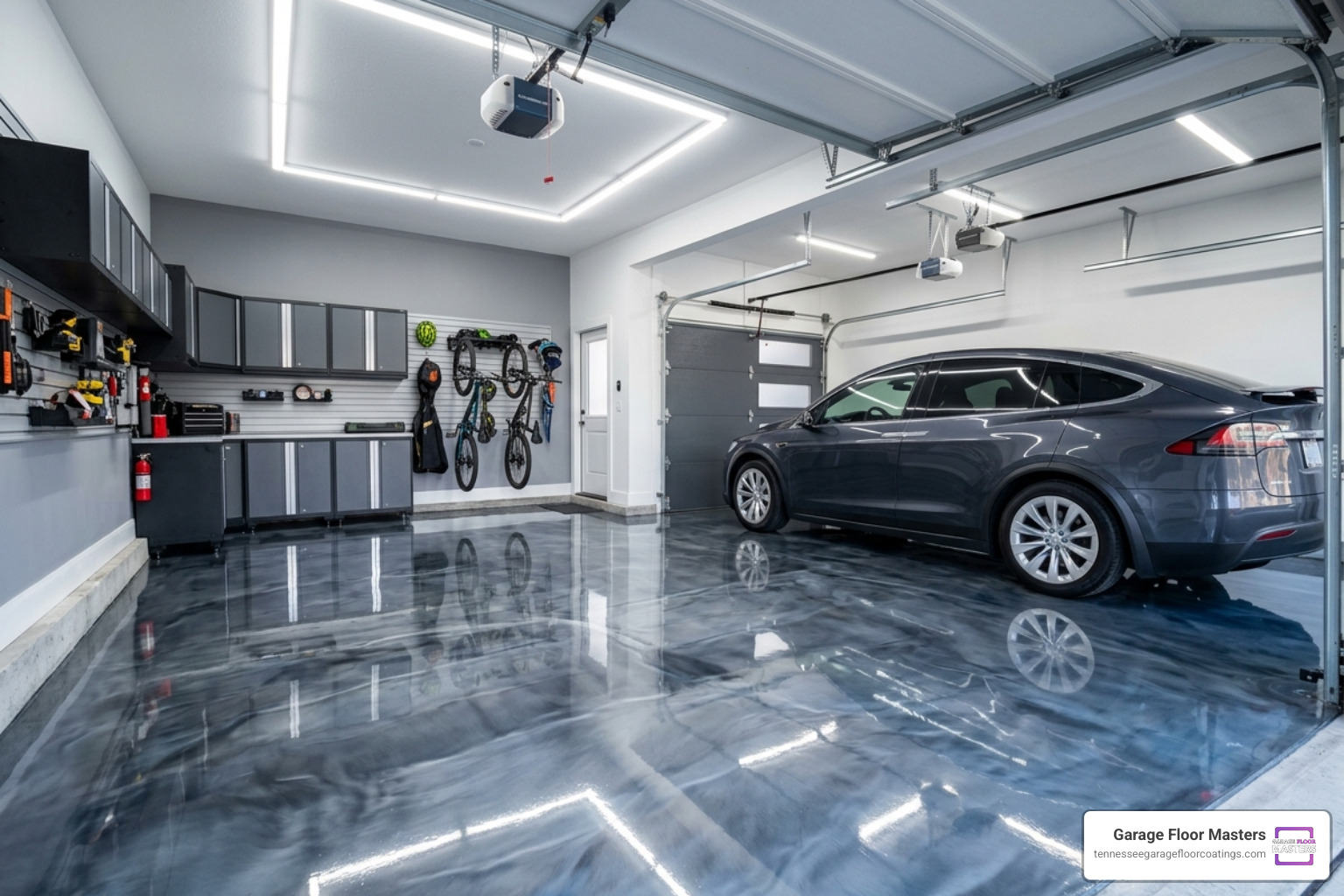
- Metallic Pigments: This is the “high-art” of flooring. Using pearlescent pigments, we create a 3D, marbled effect. Because it is highly labor-intensive and requires artistic skill, the epoxy flooring rate for metallic is the highest.
- Quartz Broadcast: Similar to flake but uses colored sand. It is incredibly tough and often used in commercial kitchens or pool decks.
Professional Installation vs. DIY: The Long-Term Value
It’s tempting to grab a $150 kit from a big-box store in Lenoir City and spend a weekend doing it yourself. However, DIY kits are almost always water-based or solvent-based with low solids content.
The “False Economy” of DIY
A DIY floor typically lasts 1 to 3 years before it begins to flake or peel. When you factor in the cost of the kit, your time, and the eventual cost of having a professional grind off the failed coating (which costs more than prepping bare concrete!), the “cheap” DIY route becomes very expensive.
At Garage Floor Masters, we offer Polyaspartic Floor Coatings that are 4x stronger than traditional epoxy. Our systems are UV stable (meaning they won’t turn yellow in the Tennessee sun) and can be installed in just one day. When you look at the Garage Floor Coating Cost over a 15-year period, a professional installation is significantly more affordable than repeating a DIY project five times. Plus, we back our work with a 15-year warranty, something no DIY kit can offer.
Frequently Asked Questions about Epoxy Rates
How much does it cost to epoxy a 2-car garage?
For a standard 2-car garage (roughly 400 to 500 square feet), most professional installations range between $2,500 and $4,500. This includes full mechanical prep, crack repairs, a base coat, a full decorative flake broadcast, and a high-performance topcoat. The final price depends on the condition of your concrete and the specific system you choose.
Why is metallic epoxy more expensive than flake systems?
Metallic epoxy is a “boutique” finish. It requires a perfectly smooth primer coat, a thick layer of metallic-infused resin that must be manipulated by hand using squeegees or rollers to create patterns, and often a specialized high-wear topcoat. The material cost is higher, and the labor requires a much higher level of expertise.
Does the price per square foot decrease for larger commercial projects?
Yes, absolutely. For large commercial spaces in areas like Knoxville or Vonore, we can often offer a lower epoxy flooring rate per square foot. This is due to material bulk pricing and the efficiency of using larger equipment over vast, open areas.
Conclusion
Investing in your floors is about more than just aesthetics; it’s about protecting your home’s foundation and increasing your property value. While the epoxy flooring rate in 2026 varies based on your specific needs, the long-term value of a professionally installed, high-solids system is undeniable.
Whether you’re in Maryville, Tazewell, or right here in Knoxville, don’t let confusing pricing floor you. Focus on the quality of the prep and the durability of the materials.
Ready to see exactly what your project will cost? We’re here to help. Get a Quote today for a personalized, no-obligation on-site estimate. Let’s give your garage the floor it deserves!
To learn more about budgeting for your project, check out our detailed guide on Garage Floor Coating Cost.