
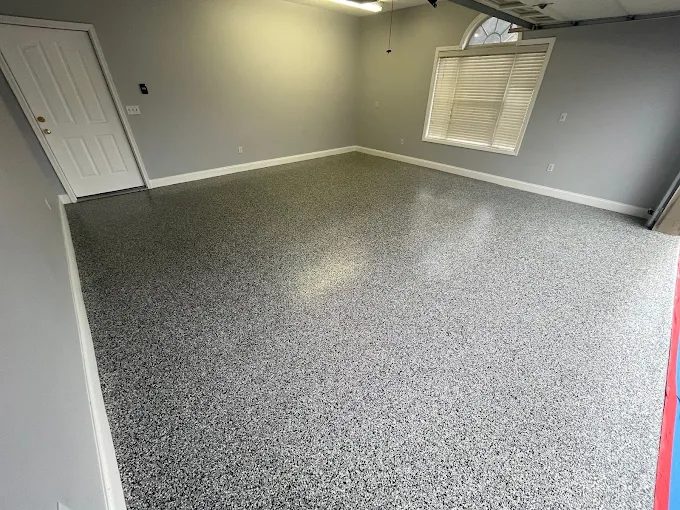
What Does Epoxy Flooring Actually Cost in 2026?
The average price for epoxy flooring runs between $3.50 and $12.00 per square foot installed, depending on the type of system, your floor’s condition, and the finish you choose. Most homeowners land somewhere in the $5 to $9 per square foot range for a quality residential installation.
Here’s a quick snapshot of typical costs:
| Epoxy System | Cost Per Sq Ft | 500 Sq Ft Total (Est.) |
|---|---|---|
| Basic solid color epoxy | $3 – $7 | $1,500 – $3,500 |
| Paint chip / flake system | $6 – $9 | $3,000 – $4,500 |
| Metallic epoxy | $8 – $15 | $4,000 – $7,500 |
| Quartz or river rock | $10 – $15 | $5,000 – $7,500 |
| Grind & seal | $2 – $6 | $1,000 – $3,000 |
Note: Every project is different. Final pricing depends on your floor’s current condition, the system you choose, and your location. That’s why we always start with a free on-site estimate.
If your garage floor is cracked, stained, and starting to look like it’s given up — you’re not alone. It’s one of the most common frustrations we hear from Knoxville homeowners. And when you start looking into solutions, the first question is almost always the same: “How much is this actually going to cost me?”
The honest answer is: it varies. A lot. Prices shift based on the size of your space, how damaged the concrete is, which coating system you pick, and even the time of year. A basic solid-color epoxy and a premium metallic system can differ by $5 or more per square foot — that’s a $2,500+ difference on a standard two-car garage.
This guide breaks it all down clearly so you know exactly what you’re paying for — and why.
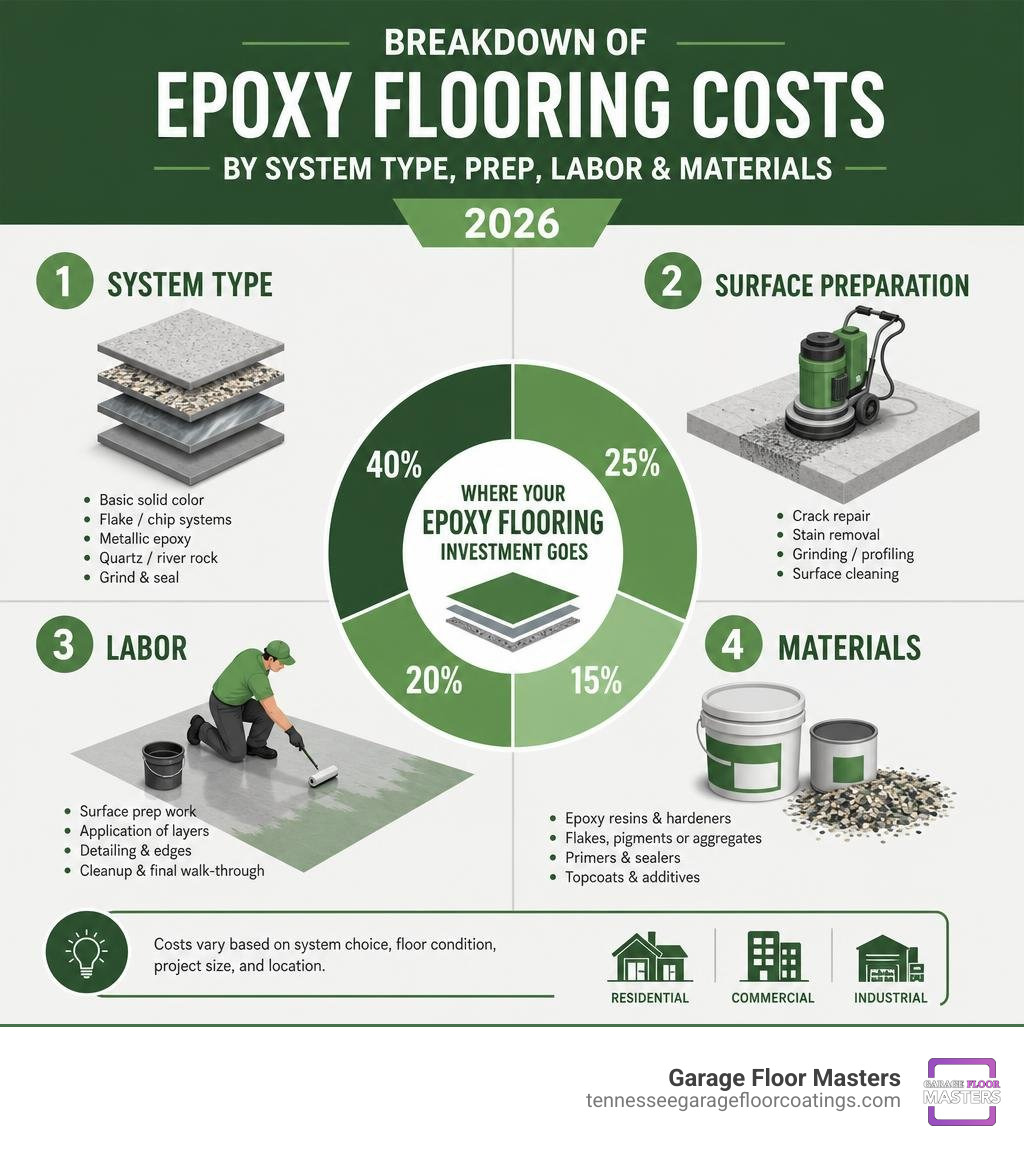
Average price for epoxy flooring terms to remember:
- average cost of metallic epoxy flooring
- concrete epoxy flooring cost calculator
- cost effective garage flooring
What is the Average Price for Epoxy Flooring in 2026?
As we move through 2026, the average price for epoxy flooring continues to hover around $7.00 per square foot for a professionally installed, mid-range system. For a standard 500-square-foot two-car garage, you can expect a typical investment of about $3,500. However, depending on the complexity of your floor, prices can range anywhere from $3.50 to $12.00 per square foot total.
To help you visualize where your budget might go, we’ve put together a comprehensive comparison of how different epoxy systems stack up in terms of price and expected longevity:
| Coating Type | Average Cost Per Sq. Ft. | Typical Lifespan | Best Suited For |
|---|---|---|---|
| Grind & Seal | $2 – $6 | 3 – 8 Years | Warehouses, budget basements |
| Water-Based Epoxy | $3 – $7 | 1 – 3 Years | Low-traffic utility rooms, DIY |
| Solvent-Based Epoxy | $4 – $9 | 3 – 5 Years | Light-duty residential garages |
| 100% Solids Epoxy | $5 – $12 | 10 – 20 Years | Heavy-duty residential & commercial |
| Decorative Flake System | $6 – $9 | 10 – 20 Years | Garages, workshops, high-traffic |
| Metallic Epoxy | $8 – $15 | 15 – 20+ Years | Showrooms, retail, luxury basements |
| Quartz Epoxy | $10 – $15 | 15 – 20 Years | Commercial kitchens, wet areas |
| River Rock / Pebble Epoxy | $10 – $15 | 5 – 15 Years | Patios, pool decks, walkways |
As you can see, the initial cost is closely tied to how long the floor will last. Choosing a cheaper material might save you money today, but if you have to reapply it in three years, those savings quickly vanish. For a deeper look into how these systems are priced across different applications, check out The Ultimate Guide to Epoxy Flooring Prices.
Cost Breakdown by Epoxy Type
The chemical makeup of the epoxy resin you select is the single biggest driver of material costs. Here is how the three primary formulations compare:
- Water-Based Epoxy ($3 – $7 per sq. ft. installed): This is the most budget-friendly option. It is thin, easy to apply, and has very low odor. However, because it contains water that evaporates during the curing process, the dry film left behind is incredibly thin (often only 2 to 3 mils). It is prone to peeling under hot tires and wears down quickly.
- Solvent-Based Epoxy ($4 – $9 per sq. ft. installed): Slightly thicker and more durable than water-based options, solvent-based epoxies offer better resistance to chemicals and petroleum. The downside? They emit extremely strong, toxic fumes (VOCs) during installation, requiring professional-grade respirators and heavy ventilation.
- 100% Solids Epoxy ($5 – $12 per sq. ft. installed): The gold standard of true epoxy coatings. This system contains zero solvents or water. Every drop you apply stays on the floor, curing via a chemical reaction into a thick, virtually indestructible shell (typically 10 to 20 mils thick). It resists impact, heavy vehicles, and harsh chemicals, lasting up to two decades.
If you are looking for a show-stopping visual, you might also consider metallic resin floors. These premium systems use metallic pigments suspended in 100% solids epoxy to create a three-dimensional, marbled effect. Because of the specialized artistry required to swirl the pigments, the average cost of metallic epoxy flooring typically ranges from $8 to $15 per square foot.
Decorative and Specialty Systems
If a plain, solid-color floor feels a bit too industrial for your home, decorative and specialty systems allow you to customize your space:
- Paint Chip / Flake Systems ($6 – $9 per sq. ft.): This is the most popular option for residential garages. Vinyl color chips are broadcast into a wet epoxy base coat until the floor is completely covered, then sealed with a durable topcoat. This creates a beautiful, textured surface that hides dirt, resists slips, and stands up to heavy abuse.
- Quartz Epoxy ($10 – $15 per sq. ft.): Similar to flake systems, but instead of vinyl chips, colored quartz sand is broadcast into the epoxy. This creates an incredibly hard, slip-resistant, and sanitary surface commonly used in commercial kitchens, dog kennels, and commercial locker rooms.
- River Rock / Pebble Epoxy ($10 – $15 per sq. ft.): This system blends natural stone pebbles with a clear epoxy binder to resurface uneven or damaged concrete. It is highly popular for outdoor spaces, but because outdoor projects require specialized UV-resistant resins and complex forming around stairs or edges, you’ll want to carefully review your budget. For a detailed breakdown of these outdoor stone projects, see our Pebble Epoxy Pricing: A Rock Solid Guide to Your Patio Budget.
Key Factors That Influence Your Total Installation Cost
When estimating your project, it is easy to get caught up in the cost of the epoxy itself. But in the professional flooring world, the old saying holds true: preparation is 90% of the job.
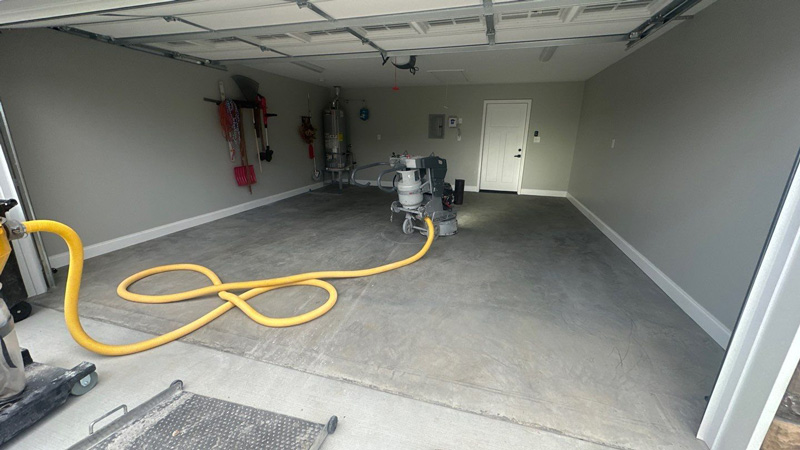
Several key variables will influence your final quote, including:
- The Condition of Your Concrete: Is your slab brand new, or is it covered in 30 years of oil stains, deep cracks, and peeling paint?
- Moisture Levels: Concrete is like a sponge. If moisture vapor is rising up through your slab, it will pop the epoxy right off the surface. High moisture requires a specialized moisture-mitigating primer.
- Project Size: Because of the setup time, travel, and equipment required, larger projects often benefit from economies of scale. A three-car garage will usually cost less per square foot than a small utility closet.
Surface Preparation and Concrete Repair
You cannot apply professional epoxy over dirty, sealed, or damaged concrete. If a contractor tries to roll epoxy onto a floor without prepping it first, run away!
Proper preparation typically includes:
- Diamond Grinding ($2 – $4 per sq. ft.): Using heavy planetary grinding machines equipped with industrial diamonds to open up the concrete’s pores. This creates a rough profile (like sandpaper) that the epoxy can mechanically grip.
- Crack and Joint Patching ($3 – $5 per linear foot): Filling all hairline cracks, divots, and expansion joints with a rigid epoxy gel so they don’t telegraph through your beautiful new finish.
- Shot Blasting ($3 – $4 per sq. ft.): For severely contaminated industrial floors, shot blasting fires tiny steel beads at the concrete to blast away the damaged top layer.
If your floor has extensive damage or needs old adhesive scraped off, expect preparation to add $1 to $3 per square foot to your base cost. You can calculate these prep variables yourself using our concrete epoxy flooring cost calculator.
Regional Labor Rates and Climate Impact
Your geographic location plays a major role in labor costs. Here in East Tennessee — including Knoxville, Oak Ridge, Maryville, and Sevierville — our local labor rates are generally more stable than in massive coastal metropolitan areas. However, our unique climate still introduces specific challenges.
East Tennessee is famous for its high humidity during the summer and freezing temperatures in the winter. Epoxy is highly sensitive to both. If the humidity is too high, moisture can settle on the wet resin, causing it to cure with a cloudy, white film. If the temperature drops below 50°F, standard epoxy stops curing entirely.
To avoid these climate headaches, professional installers must carefully monitor dew points and use climate-control equipment, which can occasionally affect the project timeline and labor costs. To make sure you aren’t paying premium rates unnecessarily, read our guide on how to avoid getting floored by high epoxy rates.
DIY Epoxy Kits vs. Professional Installation
It is Saturday morning, you are walking through a big-box home improvement store, and you spot a colorful DIY epoxy kit for $150. It promises a “complete garage transformation in a weekend.” It sounds incredibly tempting. But before you grab a cart, let’s look at the real math behind DIY kits versus professional installation.
The True Cost of DIY Kits
DIY kits are almost always water-based or solvent-based epoxies with very low solids content (often around 40-50%). This means that as the floor dries, half of what you painted on evaporates into the air, leaving behind a tissue-thin layer.
The DIY process usually looks like this:
- Materials: $300 to $600 for the kit, rollers, brushes, and acid-etching solution.
- Surface Prep: Acid-etching (which is included in DIY kits) only cleans the surface; it does not profile the concrete deeply enough for long-term adhesion.
- The Result: Within 1 to 3 years, hot tires from your car will soften the thin epoxy. The next time you back out of the garage, the epoxy peels off under the tires — a classic failure known as “hot-tire pickup.”
Once a DIY floor fails, you have to pay a professional to grind off the failing sticky mess, which actually doubles your preparation costs. If you are looking for workshop flooring but are on a tight budget, read our breakdown of budget-friendly coatings for your workshop to find a smarter way forward.
Why Professional Installation is a Better Long-Term Investment
When you hire a professional team, you aren’t just paying for the liquid in the bucket; you are paying for industrial-grade equipment, premium materials, and peace of mind.
- Industrial Equipment: Professionals use 600-pound diamond grinders connected to massive HEPA dust extractors. This profiles the concrete perfectly without filling your home with silica dust.
- 100% Solids Materials: Professional-grade 100% solids epoxy or polyaspartic coatings cure to a thick, chemical-resistant barrier that will not peel, chip, or lift under hot tires.
- Warranty Protection: A professional installation comes with a multi-year or lifetime warranty. If something goes wrong, the contractor comes back to fix it — not you.
Over a 15-year period, a single professional installation is actually much more cost effective garage flooring than buying and applying five separate DIY kits. For a detailed breakdown of labor, material, and equipment costs, check out The Complete Guide to Garage Epoxy Installation Costs.
Typical Costs for Common Residential Projects
To give you a realistic idea of what homeowners in East Tennessee actually spend, let’s look at the two most common residential projects: garages and basements.
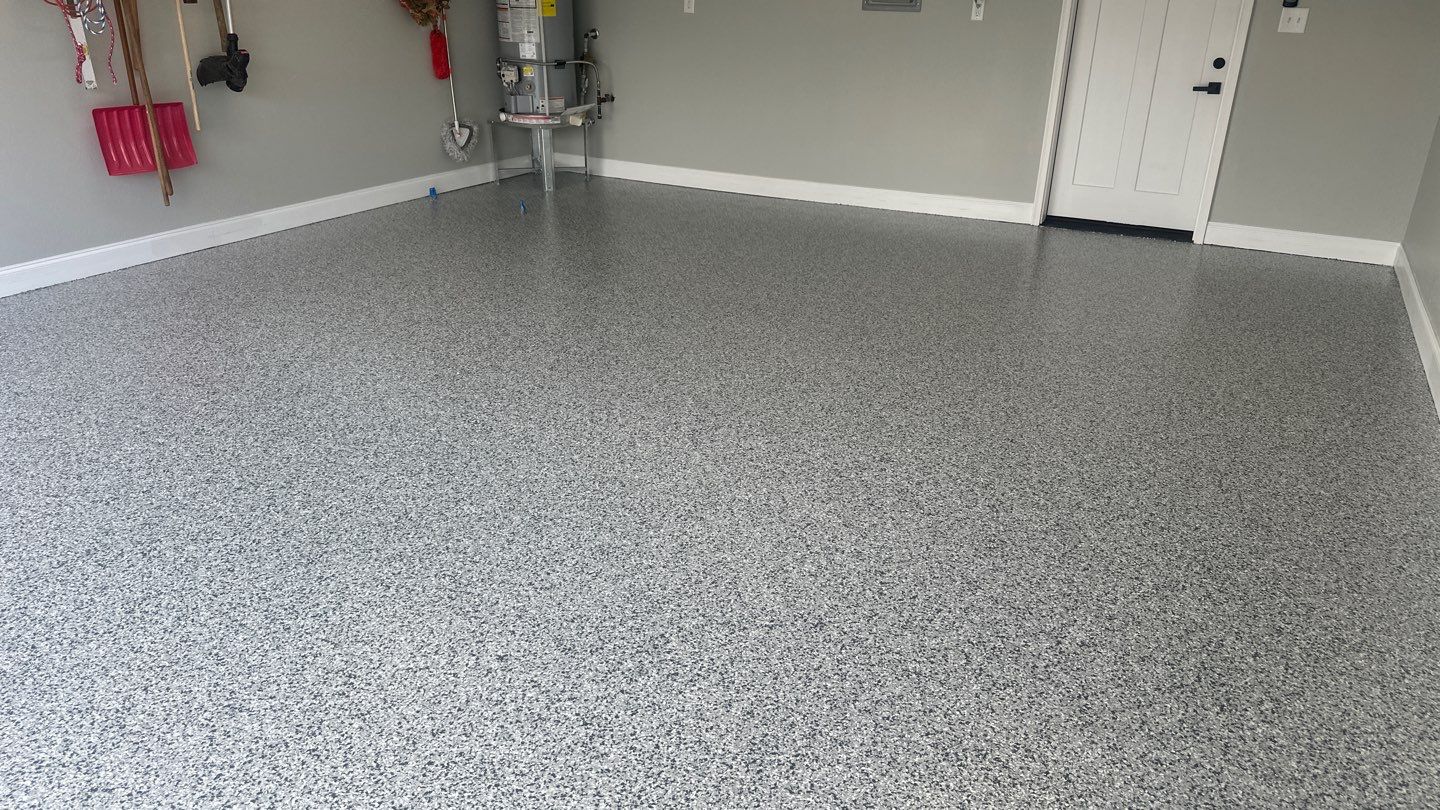
Average Price for Epoxy Flooring in a 2-Car Garage
A standard two-car garage in areas like Lenoir City, Clinton, or Powell typically measures between 400 and 600 square feet (averaging 500 square feet).
For a professional decorative flake system on a 500-square-foot garage:
- Base Cost: Typically ranges from $3,000 to $4,500 ($6 to $9 per sq. ft.).
- What’s Included: Full diamond grinding, crack repairs, a 100% solids epoxy primer/base coat, a full broadcast of vinyl color flakes, and a durable polyaspartic topcoat.
- Solid Color Option: If you choose a simple, solid-color system, the price may drop to $1,500 to $3,500 ($3 to $7 per sq. ft.).
While epoxy is highly durable, many homeowners are upgrading to polyaspartic coatings because they cure faster and resist yellowing from sunlight. To see how these systems compare in price, read about the real cost of polyaspartic garage floors.
Average Price for Epoxy Flooring in Basements and Patios
Basements and outdoor patios present entirely different challenges than garages:
- Basements ($4 – $8 per sq. ft.): Basements are prone to high moisture levels. Before installing epoxy, a professional must conduct a calcium chloride or electronic moisture test. If moisture levels are high, a specialized moisture vapor barrier base coat must be applied, which can add $1 to $2 per square foot to the project.
- Patios and Pool Decks ($10 – $15 per sq. ft.): Outdoor concrete is exposed to direct sunlight and extreme temperature changes. Standard epoxy will turn yellow and chalky under UV rays. For outdoor spaces in Sevierville or Pigeon Forge, a UV-stable polyaspartic or pebble epoxy system is required to prevent fading and cracking.
Here is a quick look at typical residential project totals:
- Single-Car Garage (approx. 250 sq. ft.): $1,500 – $2,500
- Two-Car Garage (approx. 500 sq. ft.): $3,000 – $4,500
- Three-Car Garage (approx. 750 sq. ft.): $4,500 – $6,500
- Standard Basement (approx. 800 sq. ft.): $3,200 – $6,400
- Outdoor Patio (approx. 300 sq. ft.): $3,000 – $4,500
Longevity, Maintenance, and Alternatives
Once your new floor is installed, how do you keep it looking like a million bucks? Fortunately, professional floor coatings are incredibly easy to care for.
How to Maintain Your Epoxy Floor
Because epoxy creates a non-porous, seamless surface, dirt and chemicals cannot penetrate the material.
- Weekly Maintenance: Simply sweep or dust mop the floor to remove loose dirt and grit that could scratch the surface over time.
- Deep Cleaning: Every few months, mop the floor with a mixture of warm water and a small amount of clear ammonia (about 1/2 cup of ammonia per gallon of water). Avoid using soap-based cleaners or vinegar, as they can leave a dull film or slowly etch the glossy finish.
- Chemical Spills: Wipe up oil, gasoline, or brake fluid spills immediately. While professional coatings are highly chemical-resistant, leaving harsh solvents on the floor for weeks can eventually stain the topcoat.
Polyaspartic Coatings: The Next-Generation Alternative
While epoxy has been the industry standard for decades, technology has evolved. At Garage Floor Masters, we specialize in high-performance polyaspartic coatings rather than traditional epoxy.
Why have we made the switch?
- 4x the Strength: Polyaspartic coatings are four times stronger and significantly more flexible than standard epoxy, meaning they won’t chip or crack when you drop heavy tools.
- 1-Day Installation: Epoxy can take 3 to 5 days to fully cure before you can drive on it. Our polyaspartic systems are installed and cured in just one day, letting you park your car back in the garage the very next day.
- UV Stability: Unlike epoxy, which turns yellow and brittle when exposed to sunlight, polyaspartic is 100% UV stable. It will stay bright and beautiful for decades.
- 140+ Colors: We offer an incredible selection of colors and flake blends to match any home design.
Frequently Asked Questions About Epoxy Flooring Costs
How long does professional epoxy flooring last compared to DIY?
Professionally installed 100% solids epoxy or polyaspartic systems typically last 10 to 20 years in residential garages with minimal maintenance. In contrast, cheap DIY water-based epoxy paint kits usually begin to peel, chip, and fade within 1 to 3 years, especially in high-traffic areas or under hot tires.
What is the cheapest type of epoxy flooring?
The cheapest option is water-based epoxy paint, which costs around $3 to $5 per square foot installed (or as low as $1 per square foot for a DIY kit). However, because it is incredibly thin and wears out quickly, it requires frequent recoating, making it more expensive in the long run.
How can I save money on my epoxy flooring project?
The best way to save is by bundling multiple spaces (like your garage, basement, and patio) into a single project, which can reduce your per-square-foot cost by 10% to 20%. You can also save by clearing out the space yourself before the installation crew arrives to avoid any labor surcharges.
Conclusion
Upgrading your concrete with a professional floor coating is one of the smartest investments you can make for your home. It protects your concrete from damage, makes cleanup a breeze, and adds significant value to your property.
At Garage Floor Masters, we are proud to serve homeowners across East Tennessee, including Knoxville, Oak Ridge, Crossville, Vonore, Sevierville, Lenoir City, Maryville, Tazewell, LaFollette, Loudon, Friendsville, Powell, Jefferson City, Pigeon Forge, Clinton, Andersonville, and White Pine.
Our UV-stable polyaspartic coatings are 4x stronger than traditional epoxy, installed in just one day, and built to handle everyday life. Because every concrete slab is unique, we base all of our final pricing on the specific condition of your floor and the custom features you select.
Ready to see what your floor actually costs? Check out our detailed guide on Garage Floor Coating Cost or contact us today to schedule your free, no-obligation on-site estimate!