
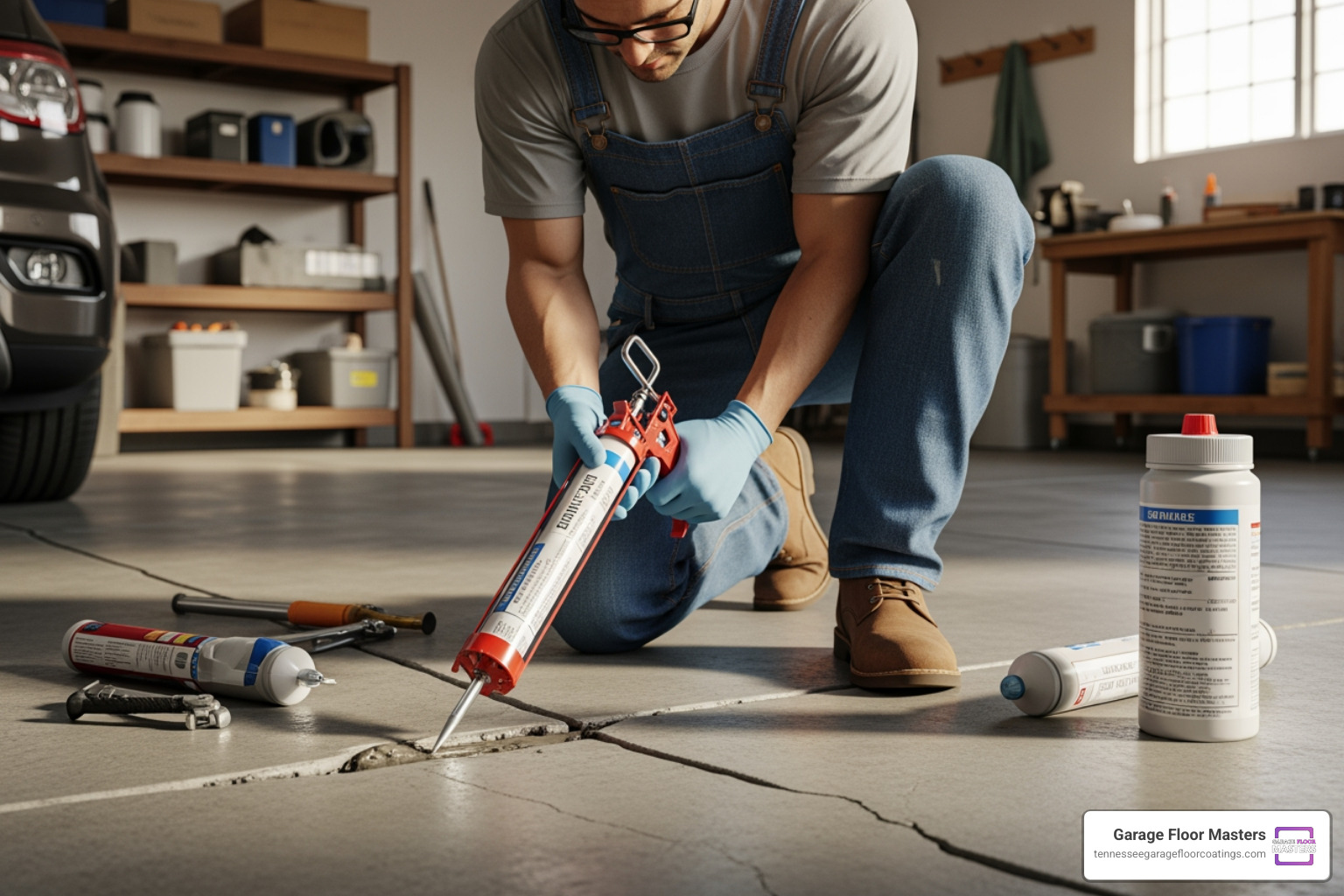
Every Concrete Garage Floor Cracks — Here’s What to Do About It
Fixing cracks in your garage floor is something almost every homeowner will face eventually. Concrete is strong, but it moves. It shrinks when it cures, expands in heat, contracts in cold, and shifts when the ground beneath it settles. Cracks are not a sign that something went terribly wrong — they’re a sign that concrete is behaving exactly like concrete.
The real question is: which cracks actually matter, and what do you do about them?
Here’s a quick answer based on crack size:
| Crack Type | Width | Action Needed |
|---|---|---|
| Hairline crack | Under 1/8 inch | Monitor or DIY fill |
| Moderate crack | 1/8 to 1/4 inch | Fill with epoxy or polyurethane filler |
| Wide crack | Over 1/4 inch | Professional evaluation recommended |
| Uneven crack (one side higher) | Any width | Call a professional — possible structural issue |
| Crack with water seeping through | Any width | Call a professional immediately |
What makes this more than a cosmetic problem is what happens inside the crack. Water gets in. Road salt gets in. In Knoxville, freeze-thaw cycles do the rest — water freezes, expands, and pushes the crack wider every winter. A hairline crack today can become a serious structural problem in just a few seasons if left untreated.
The good news: most garage floor cracks can be repaired, and repaired well — whether you do it yourself or bring in a pro.
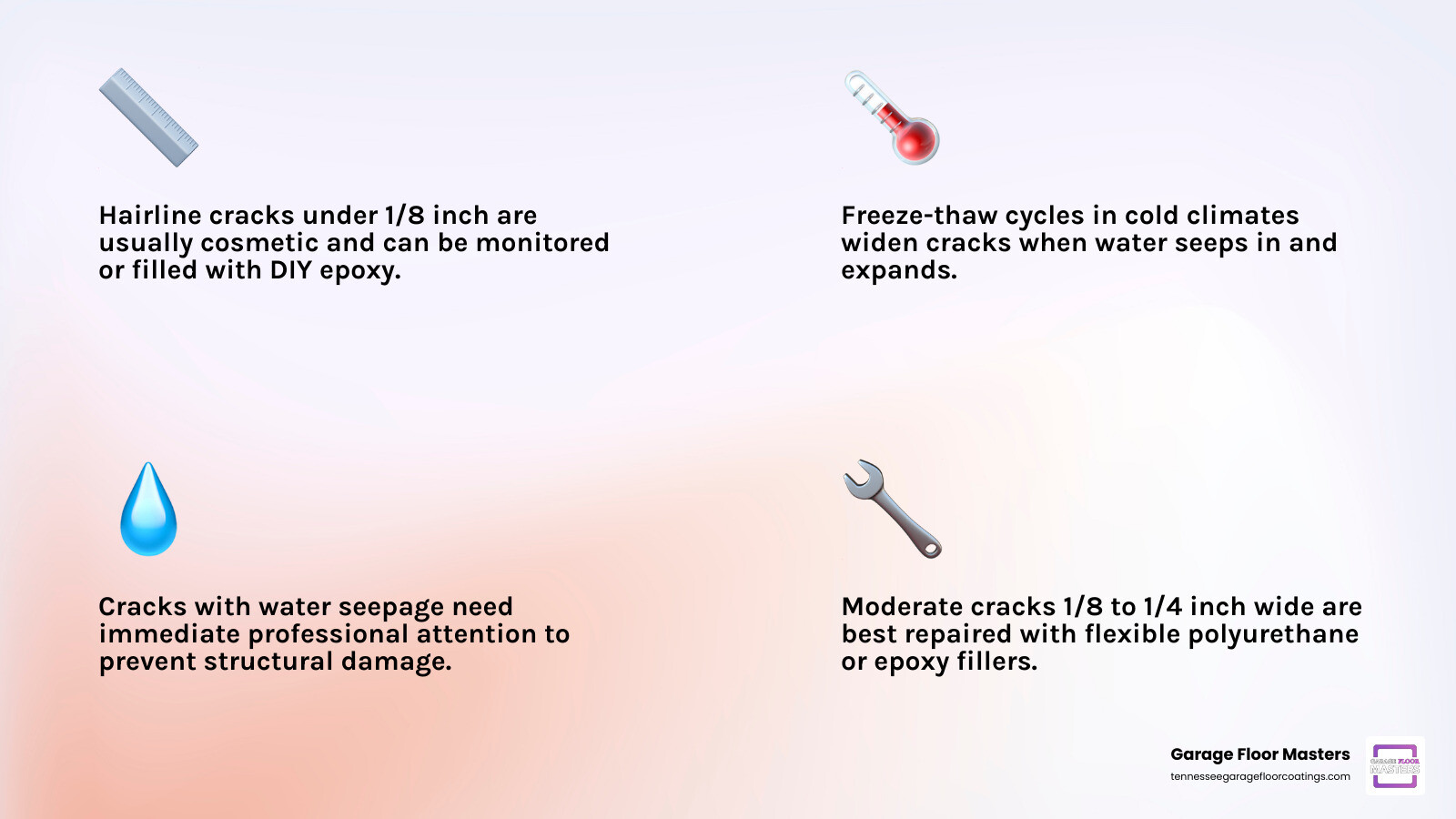
Explore more about fixing cracks in garage floor:
Identifying the Root Causes of Concrete Damage
Before we repair anything, we want to know why the crack formed. If you only fill the surface and ignore the cause, the crack often comes back like an uninvited relative.
The most common causes of garage floor cracks in East Tennessee include:
- Concrete shrinkage during curing
- Soil settlement under the slab
- Freeze-thaw movement from moisture getting below the slab
- Heavy vehicle loads, tool drops, and repeated impact
- Poor drainage around the garage
- Improper slab thickness, reinforcement, or joint placement
- Expansion and contraction from temperature swings
Shrinkage cracks are usually the least dramatic. They often show up early, stay fairly narrow, and don’t create height differences between sides. Settlement cracks are more serious because they can mean the slab is moving unevenly. If one side is higher than the other, that’s a warning sign.
Water is another major troublemaker. If gutters dump water near the garage, or if the yard slopes toward the slab, moisture can soften the subgrade and create voids. That leads to sinking, cracking, and sometimes heaving. We cover that issue in more detail in this guide to cracked garage foundations and risks and in our overview of garage floor cracking.
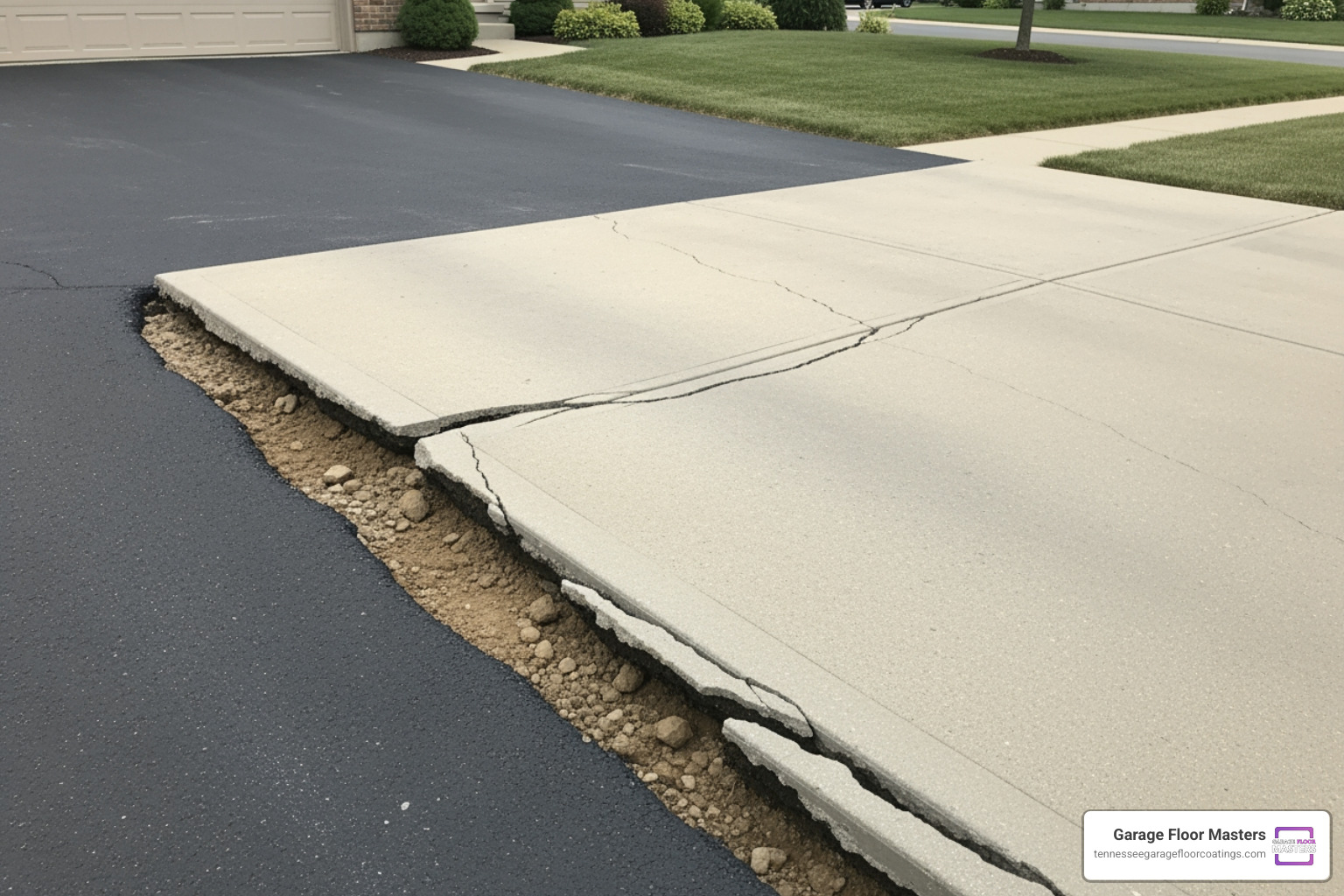
Differentiating Cosmetic vs. Structural Cracks
Not every crack is an emergency. Some are mostly visual. Others point to slab movement or foundation trouble.
Here is a simple way to tell the difference:
| Crack Feature | Usually Cosmetic | Possible Structural Problem |
|---|---|---|
| Width | Under 1/8 inch | Over 1/4 inch |
| Height difference between sides | None | One side higher or lower |
| Pattern | Random, light shrinkage lines | Long continuous cracks, widening over time |
| Water seepage | Rare | Common concern |
| Change over time | Stable | Growing, spreading, or reopening |
| Nearby signs | No other issues | Sticking doors, wall cracks, slab settling |
Cosmetic cracks are typically:
- Thin
- Dry
- Stable
- Level on both sides
Structural cracks are more likely to:
- Widen beyond 1/4 inch
- Run deep through the slab
- Show vertical displacement
- Reappear after repair
- Appear alongside settlement or foundation issues
A good rule: if the crack is wide, wet, uneven, or growing, stop thinking “quick patch” and start thinking “professional inspection.”
Step-by-Step Guide to Fixing Cracks in Garage Floor
For small to medium, stable cracks, DIY repair can work well if you do the prep correctly. Prep is the whole game here. Most failed repairs do not fail because the filler was terrible. They fail because the crack was dirty, weak at the edges, or repaired with the wrong material.
If you want a deeper dive into repair prep before coatings, this article on epoxy floor crack repair secrets is worth reading.
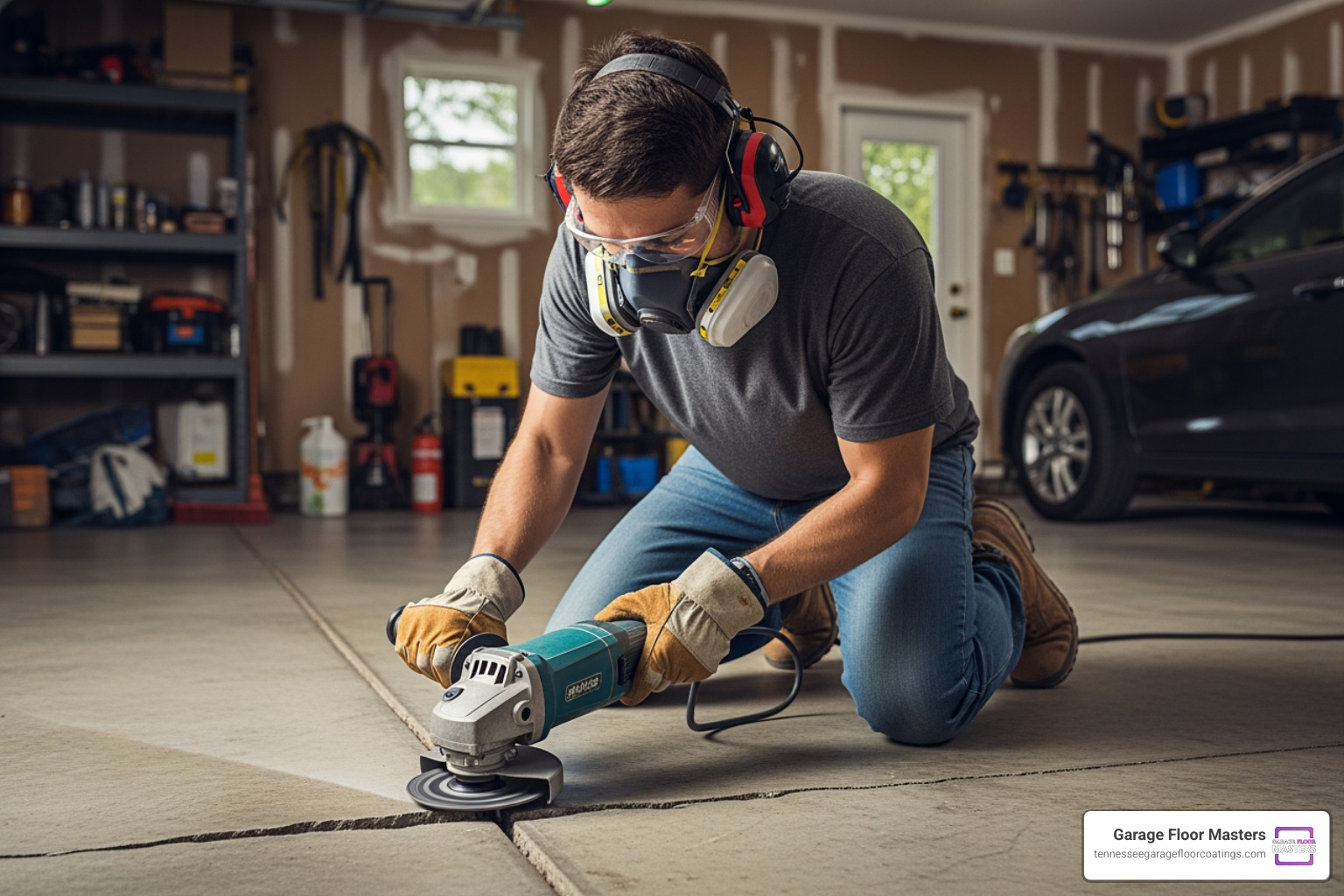
Follow these steps for fixing cracks in garage floor the right way:
Inspect the crack first
Measure the width and look for movement. If it’s under about 1/4 inch, level on both sides, and dry, it’s usually a DIY candidate.Remove loose debris
Use a wire brush, scraper, or utility tool to pull out weak concrete, dirt, and anything already flaking out of the crack.Chase the crack
Use an angle grinder with a diamond blade to open very narrow cracks slightly and create clean edges. This gives the repair material something solid to bond to. Hairline cracks often need this step to hold filler long term.Vacuum thoroughly
Use a shop vacuum and get the crack as dust-free as possible. Concrete dust is sneaky. It gets everywhere and ruins adhesion if left behind.Make sure the crack is dry
Most fillers bond best to dry concrete unless the product specifically says otherwise. If the garage has moisture coming through the crack, pause and diagnose that problem first.Add backer rod for deep cracks
If the crack is deeper than about 1/2 inch, insert foam backer rod so you are not filling the whole void with expensive repair product. Leave the top portion open for filler.Apply the right filler
Use epoxy, polyurea, or another repair material suited to the crack size and expected movement. Press it in firmly so it contacts both sides of the crack.Overfill slightly, then smooth
Slight overfill helps account for settling. Use a putty knife or trowel to level it flush with the surrounding slab.Let it cure fully
Some fast repair products can be coated quickly, but many need 24 to 48 hours before grinding, coating, or heavy use. Always follow the product instructions.Grind or sand flush if needed
If the repair sits proud of the slab, grind it smooth before applying any coating.Seal or coat the floor afterward
A repaired crack is better protected when the slab is sealed or professionally coated. Bare concrete is like a sponge wearing work boots.
Best Materials for Fixing Cracks in Garage Floor
Different cracks need different repair materials. There is no one-size-fits-all magic tube.
Here is what works best in most cases:
Epoxy putty or epoxy crack filler
Best for:
- Stable cracks
- Hairline to moderate cracks
- Repairs that need high strength
Why we like it:
- Bonds strongly to concrete
- Creates a durable repair
- Works well before coatings when the slab is stable
Keep in mind:
- Rigid epoxies are not ideal for expansion joints or actively moving cracks
- Some formulas can be coated quickly, but many need cure time first
Polyurea or polyurethane crack filler
Best for:
- Small to medium cracks
- Areas with temperature swings
- Cracks with slight movement
Why it works:
- More flexible than rigid epoxy
- Good for garages that see seasonal expansion and contraction
- Often cures fast
This is a strong option when you want some flexibility instead of a rock-hard patch.
Silica sand with resin systems
Best for:
- Deeper cracks
- Fast-set repair systems
- Repairs that need bulk without using all resin
Why it’s used:
- Helps fill larger voids
- Improves body and support in certain repair systems
- Can be ground smooth after cure
The key is using completely dry sand. Moisture and resin are not friends.
Backer rod
Best for:
- Deep cracks
- Wide joints
- Reducing material waste
Backer rod is not the final repair. It is a support material that sits lower in the crack so the filler can bridge properly near the top.
Polymer-modified cement patch
Best for:
- Spalled areas
- Surface crumbling
- Wider damaged sections where concrete is missing
These products can work well for patching damaged surface areas, but they are not always the best choice for thin moving cracks. If movement is the issue, rigid cement patches may crack out again.
When to Call a Pro for Fixing Cracks in Garage Floor
DIY is great right up until the slab is sinking, heaving, or trying to become modern art.
Call a professional if you notice:
- Cracks wider than 1/4 inch
- One side of the crack higher than the other
- Water seeping through the crack
- Repaired cracks that keep reopening
- Multiple cracks spreading across the slab
- Surface spalling combined with settlement
- Nearby wall, foundation, or door alignment issues
- A section of slab that sounds hollow or feels unsupported
Large, uneven, or deep cracks often need more than filler. They may need:
- Slabjacking or foam lifting to raise a sunken slab
- Foundation repair
- Partial slab removal and replacement
- Full resurfacing if damage is widespread
If the underlying issue is settlement, simple filling is usually temporary. In those cases, we recommend learning more about garage foundation repair options.
Professional Repair Costs and Structural Solutions
Cost depends on the condition of the slab, how many cracks there are, whether the floor is level, and whether you want patching only or a full finished system afterward.
In 2026, common repair ranges look like this:
- DIY crack filling: about $20 to $50 per crack
- Professional crack injection or repair: about $150 to $500 per crack
- Crack filling and patching: roughly $2 to $10 per square foot
- Resurfacing: roughly $3 to $10 per square foot
- Full professional resurfacing projects: about $1,500 to $4,000
- Full slab replacement: about $3,000 to $7,000
- Complete replacement by square foot: roughly $6 to $15 per square foot
Those are broad ranges, and local conditions in Knoxville, Oak Ridge, Maryville, Sevierville, and the surrounding areas can shift pricing based on access, moisture issues, and how much prep is required. That is exactly why we recommend an on-site evaluation instead of guessing from a photo taken at a dramatic angle.
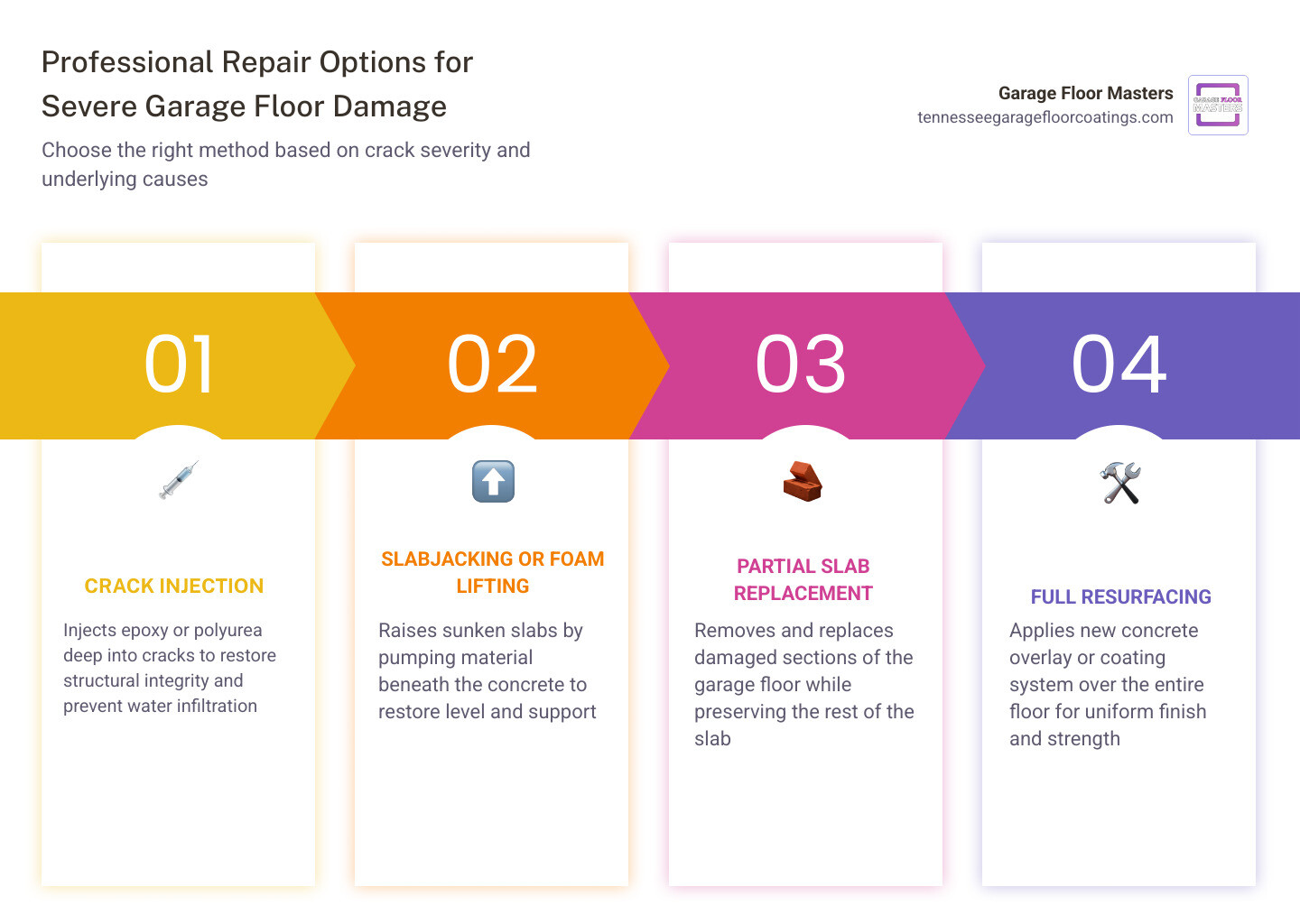
For severe damage, the main professional options are:
Crack injection
Used for:
- Certain deep but stable cracks
- Restoring continuity in concrete
- Filling voids inside the crack path
Slab lifting
Used for:
- Sunken areas
- Settlement-related unevenness
- Cracks caused by voids under the slab
This addresses the elevation issue before cosmetic repair.
Resurfacing
Used for:
- Widespread surface cracking
- Pitting and spalling
- Slabs that are structurally sound but ugly
A resurfacer can improve appearance, but it is not a cure for active slab movement.
Partial or full replacement
Used for:
- Severe structural damage
- Extensive settlement
- Repeated failure of prior repairs
- Broken sections with major height differences
If you’re weighing repair versus replacement, it also helps to understand surface finishing options afterward. For related reading, see this article on concrete floor finishing and repair considerations.
Long-Term Prevention and Maintenance
The best crack repair is the one you don’t have to do twice.
Here are the most effective ways to prevent future cracking:
- Keep water away from the slab with proper gutter extensions
- Make sure soil grades away from the garage, not toward it
- Seal concrete to reduce water and salt penetration
- Maintain control joints so they can do their job
- Avoid using harsh de-icing salts on the slab
- Clean up standing water, oil, and chemicals promptly
- Spread heavy point loads with pads or plywood under jacks and stands
- Repair small cracks early before they widen
- Monitor recurring cracks for movement over time
In our area, freeze-thaw cycles matter. Water gets into tiny openings, freezes, expands, and slowly turns small defects into larger ones. That makes regular sealing and drainage control especially important.
If you plan to coat the garage floor after repair, prep matters even more. Research consistently shows that surface preparation is the biggest factor in coating success. Cracks need to be repaired first, then the whole slab needs proper mechanical prep so the coating bonds well and lasts.
Frequently Asked Questions about Fixing Cracks in Garage Floor
Can I apply epoxy over repaired cracks immediately?
Sometimes, but not always.
Some fast-cure two-part repair products are designed to be coated right away or the same day. Many other crack fillers need 24 to 48 hours before coating. The answer depends on the specific repair product, the temperature, and whether the crack is stable.
More importantly, you should not coat over an unrepaired crack and hope the coating hides it. It usually won’t. Cracks tend to telegraph through coatings, and moisture coming up through the slab can cause peeling, bubbling, or delamination later.
If the floor is being professionally finished, we always want repairs completed correctly first.
How much does it cost to fix a cracked garage floor in 2026?
A basic DIY repair may cost as little as $20 to $50 per crack. Professional repair often runs $150 to $500 per crack. Larger patching projects generally fall around $2 to $10 per square foot. Resurfacing usually lands around $3 to $10 per square foot, while full replacement can range from $3,000 to $7,000 depending on garage size and condition.
For any real quote, the condition of the slab matters most. Depth, width, movement, moisture, spalling, and your finish choice all affect price. That’s why we offer a free on-site estimate.
Will a garage floor coating hide existing cracks?
No, not by itself.
A coating can improve appearance and protect the slab, but it is not a substitute for crack repair. Existing cracks need to be cleaned, repaired, and made flush first. Otherwise, the cracks often remain visible or come back through the coating.
The upside is that after proper repair, a professional coating system can make the entire floor look dramatically better while helping protect it from moisture, chemicals, stains, and daily wear.
Conclusion
Cracks in a garage floor are common, but ignoring them is how small problems become expensive ones. The right approach starts with identifying the cause, deciding whether the crack is cosmetic or structural, and choosing the repair method that fits the actual condition of the slab.
For small, stable cracks, DIY repair can work if you clean, prep, fill, and finish the crack properly. For wide, uneven, wet, or recurring cracks, professional help is the smart move.
If you’re planning a long-term upgrade after repair, we can help. At Garage Floor Masters, we provide professional garage floor solutions in Knoxville, TN and surrounding communities with durable coating systems built for real-life use. Our high-performance polyaspartic and epoxy garage floors are designed for strength, low maintenance, UV stability, and one-day installation, with more than 140 color options available.
For more background on lasting repair strategies, read The Ultimate Guide to Permanent Garage Floor Repair. When you’re ready for expert help, schedule your professional garage floor assessment today.