
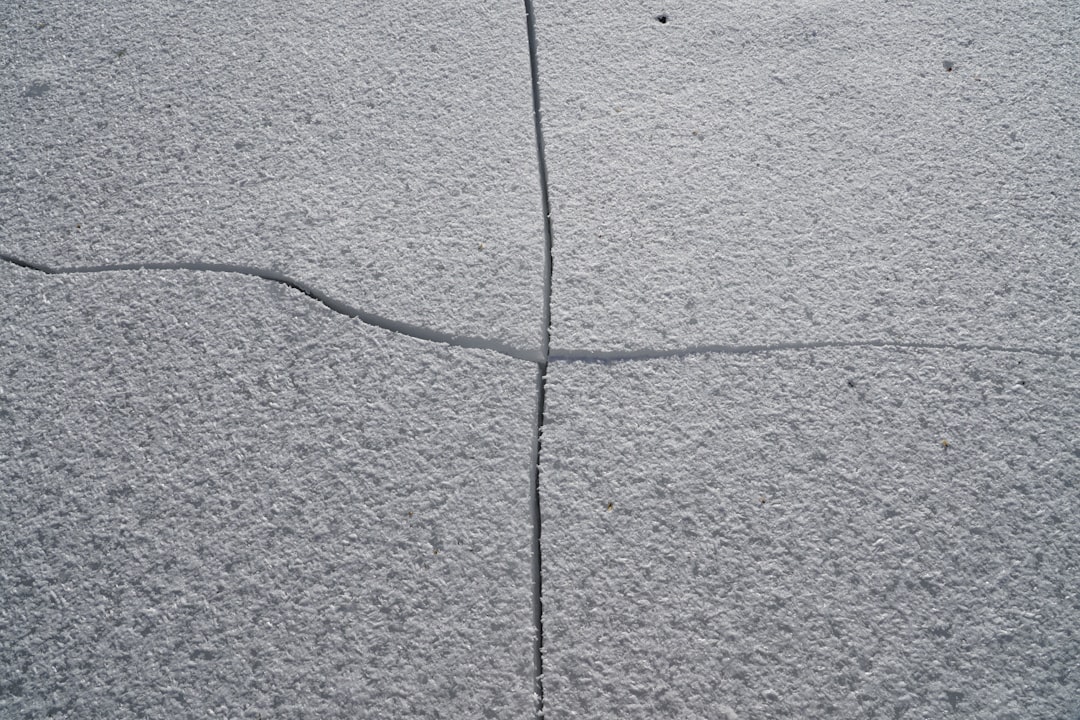
That Crack in Your Epoxy Floor Is More Common Than You Think
Crack repair epoxy floors is something thousands of homeowners deal with every year — and if you’ve spotted a split running across your garage floor, you’re not alone.
Quick answer: How to repair cracks in an epoxy floor
- Clean the crack – Remove all debris, dust, and grease from inside and around the crack
- Dry the surface – Make sure there’s zero moisture before applying any repair product
- Choose the right filler – Use epoxy putty for cracks up to 3/16″ deep; use flexible joint sealer for expansion joints with slab movement
- Mix and apply – Blend equal parts (1:1 ratio) of Part A and Part B, then trowel into the crack
- Level and topcoat – Scrape flush with the surface; many epoxy putties allow you to paint over them immediately
Here’s the frustrating reality: you pay for a professional epoxy coating, your floor looks great for a season — and then spring arrives and there’s a crack staring back at you.
This happens a lot in Tennessee. Temperature swings between cold winters and hot summers cause concrete to expand and contract. Over time, that movement shows up as cracks through your epoxy layer, not just under it.
The good news? Most cracks can be repaired without tearing out your entire floor. The right epoxy repair product, applied correctly, can restore your floor’s look and protect it from water infiltration.
This guide walks you through exactly how to do it — and when it makes more sense to call a pro.
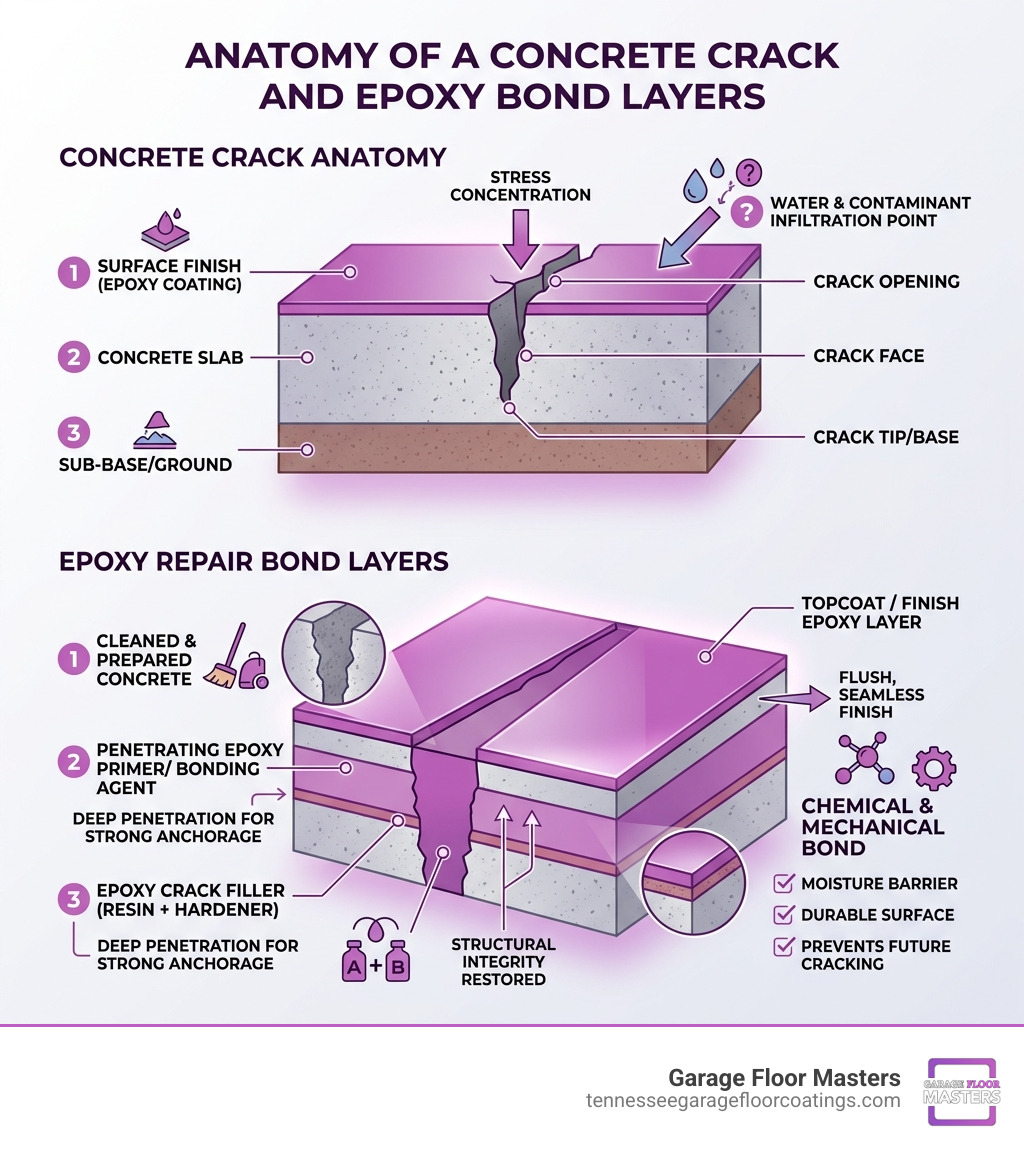
Why Cracks Appear in Epoxy-Coated Garage Floors
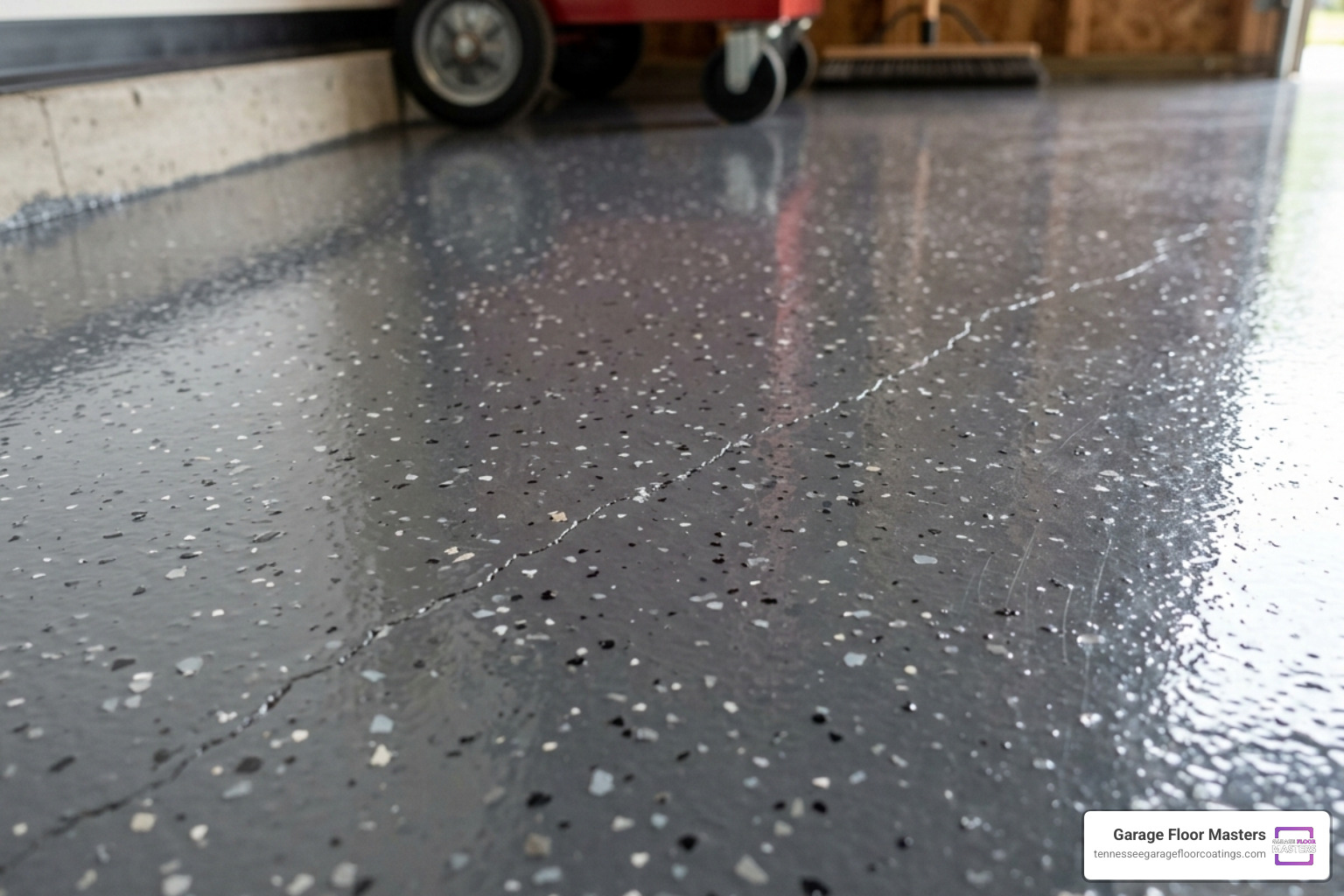
Seeing a crack in a floor you recently invested in can be heartbreaking. However, understanding Garage Floor Cracking is the first step toward a permanent fix. In our experience serving East Tennessee—from Knoxville to Maryville—the culprit is rarely a “bad” installation and almost always related to the nature of concrete itself.
The Freeze-Thaw Cycle and Temperature Swings
In regions like ours, temperature fluctuations are the primary enemy. Concrete is a porous material that expands when it’s hot and contracts when it’s cold. While epoxy is incredibly hard, it doesn’t always have the elasticity to bridge a moving concrete gap during a 40-degree temperature swing. This is why many homeowners notice Garage Floor Cracking specifically in the spring after a harsh winter.
Old vs. New Concrete Joints
If you’ve recently had a section of your garage floor replaced or extended, a crack along the joint between the old and new concrete is almost inevitable. Even if rebar was used to pin the slabs together every 16 inches, the two sections will cure and move at different rates. This “cold joint” is a natural weak point where the epoxy is likely to split.
Hydrostatic Pressure and Moisture
Moisture is the silent killer of floor coatings. If water vapor is pushing up through the slab (hydrostatic pressure), it can weaken the bond of the coating. In some cases, this leads to Removing Garage Floor Coating because the entire system begins to delaminate.
Slab Settlement and Shrinkage
New concrete shrinks as it loses moisture during the first year of its life. If an epoxy coating is applied too soon—before the standard 30-day cure time—the concrete may continue to shrink and pull the epoxy apart. Similarly, if the soil beneath your home in Sevierville or Oak Ridge settles, the resulting slab movement will telegraph right through the surface. For older homes, Garage Floor Restoration In Oneida Tn often requires addressing decades of minor settlement before a new coating can be successful.
Choosing the Right Materials for Crack Repair Epoxy Floors
Not all fillers are created equal. Using the wrong “patch” from a big-box store is often worse than doing nothing, as many of those products shrink or fail to bond to the existing epoxy.
Comparison: Repair Material Types
| Feature | Rigid Epoxy Putty | Flexible Joint Sealer |
|---|---|---|
| Best For | Hairline cracks, divots, spalls | Expansion joints, moving slabs |
| Strength | 8,710 psi (5x stronger than concrete) | Lower psi, high elongation |
| Shrinkage | Zero (100% solids) | Minimal |
| Topcoating | Immediate (with specific types) | Requires full cure or specific primers |
| Bonding Power | 4x stronger than mortar | Designed for adhesion to sidewalls |
When we perform Epoxy Floor Coatings, we prioritize 100% solids epoxy. These systems have less than 11 g/L VOC, making them safe for indoor garage use, and they provide a Shore D 65 hardness that stands up to heavy vehicle traffic.
Best Products for Crack Repair Epoxy Floors
For most crack repair epoxy floors, a high-strength epoxy putty is the gold standard.
- Compressive Strength: At roughly 8,710 psi, these repairs are five times stronger than the concrete itself (which typically sits around 1,700–3,000 psi).
- Bonding Power: These putties offer 4x the bonding power to concrete compared to traditional mortar-type repairs.
- Coverage: A quart-sized kit typically covers 500 lineal feet of 1/8″ x 1/8″ cracks. For larger projects, a 2-gallon kit can cover up to 2,000 lineal feet.
- Ease of Use: Most professional-grade kits use a simple 1:1 mix ratio, making them very DIY-friendly for small touch-ups.
Flexible vs. Rigid Repair Options
Choosing between a rigid putty and a flexible sealer depends on the crack’s location. If the crack is in an expansion joint (the deep grooves cut into your floor to control cracking), you must use a flexible joint sealer. These joints are meant to move. If you fill them with rigid putty, the floor will just crack again right next to the repair.
Flexible sealers allow for slab movement while maintaining a seamless look. This is a critical part of Epoxy Garage Floor Coatings Knoxville Tennessee because it ensures the floor remains easy to clean without sacrificing structural integrity.
Step-by-Step Guide to Repairing Cracks in an Existing Epoxy Floor
If you’re ready to tackle crack repair epoxy floors yourself, following a strict protocol is the only way to ensure the patch doesn’t pop out next winter.
Preparing the Surface for Success
Preparation is 90% of the job. You cannot simply smear putty over a dirty crack.
- Mechanical Grinding: Use a small hand grinder or a “crack chaser” blade to slightly widen the crack into a “V” shape. This creates more surface area for the epoxy to bond to.
- Cleaning: Use a vacuum to remove every speck of dust. If there is oil or grease, use a degreaser and follow up with a solvent like acetone or xylol.
- Drying: Moisture is the enemy of Epoxy Garage Floor Coatings. Ensure the crack is bone-dry. In humid Tennessee summers, you might need a heat gun to ensure no deep-seated moisture remains.
- Etching: If the surrounding epoxy is very smooth, lightly sand the edges to give the new repair material something to “bite” into.
Applying the Repair Material
Once prepared, it’s time to mix.
- Mixing: Scoop out equal parts of A and B onto a piece of cardboard. Mix thoroughly until the color is uniform (usually a solid gray).
- Application: Use a putty knife or marginal trowel to press the material deep into the crack. For cracks deeper than 1/2″, we recommend inserting a foam backer rod first to within 3/8″ of the surface to save on material.
- Leveling: Scrape the excess material away so the repair is flush with the existing floor.
- Feathering: Use your putty knife to “feather” the edges, making the transition between the old floor and the new patch as invisible as possible.
Our Our Process at Garage Floor Masters emphasizes that while some putties can be topcoated immediately, larger repairs may require a 24-48 hour cure time before they can be ground smooth and finished. This attention to detail is what separates a DIY patch from a Garage Floor Installation Process that lasts a lifetime.
Long-Term Prevention and Professional Solutions
While DIY repairs work for small hairline fractures, they are often a “band-aid” for larger structural issues. If your floor is riddled with cracks, it might be time to consider a more robust system.
The Polyaspartic Advantage
At Garage Floor Masters, we often recommend polyaspartic coatings over traditional epoxy. Why?
- Strength: Polyaspartic is 4x stronger than standard epoxy.
- Speed: We can complete an installation in just one day, whereas epoxy can take up to a week to fully cure.
- Flexibility: Polyaspartic has better elongation properties, meaning it can handle those Tennessee temperature swings without splitting.
- UV Stability: Unlike epoxy, which yellows in the sun, our coatings stay vibrant for years.
We offer over 140 color options and a surface that is 100% antibacterial and antimicrobial. Whether you are in Knoxville, Maryville, or Crossville, we provide a durable, low-maintenance solution that handles the heavy lifting of daily life.
DIY vs. Professional Crack Repair Epoxy Floors
When you hire a professional for Epoxy Garage Floor Coatings Knoxville Tennessee, you aren’t just paying for the material. You’re paying for:
- Industrial Equipment: We use planetary diamond grinders that a handheld DIY tool simply can’t match.
- Moisture Barriers: We test for slab moisture and apply specialized primers to prevent future delamination.
- Warranty: Most DIY kits have zero recourse if they fail. Our professional installations come with the peace of mind that the job was done right the first time.
Frequently Asked Questions about Epoxy Floor Crack Repair
Can I paint over the repair immediately?
Yes, but it depends on the product. Some high-performance epoxy putties are designed for “instant” repair, allowing you to apply a topcoat immediately after leveling the crack. This is ideal for small hairline fractures under 1/8″. However, if the crack is deep or wide, we usually recommend waiting for the material to reach a “tack-free” state to prevent the repair from shifting under the weight of the new coating.
Will cracks reappear every winter?
In a climate like Tennessee’s, concrete movement is a fact of life. If a crack is “active” (meaning the slab is still settling or moving significantly), a rigid epoxy repair may eventually crack again. For these active areas, we use semi-rigid or flexible sealants that can “give” a little during the freeze-thaw cycle. This is a key part of our Our Process for ensuring long-term success.
How do I fix hairline cracks vs. wide expansion joints?
- Hairline Cracks: These are usually aesthetic and can be filled with a thin epoxy liquid or putty.
- Wide Cracks (up to 3/8″): These require a thicker putty. If they are deeper than 1/2″, always use a backer rod first.
- Expansion Joints: Never fill these with rigid epoxy. Use a flexible joint sealer to maintain the “seamless” look while allowing the concrete to breathe.
Conclusion
Crack repair epoxy floors doesn’t have to be a nightmare. By choosing high-strength 100% solids epoxy and following a meticulous preparation process, you can stop the split and keep your garage looking pristine.
Whether you’re dealing with a single hairline fracture or a floor that needs a total overhaul, we’re here to help. We provide professional coating services across East Tennessee, including Knoxville, Oak Ridge, Maryville, and as far out as Crossville and Tazewell.
Every garage is unique, and the cost of your project will depend on the condition of your concrete and the features you choose. That’s why we offer a free, no-obligation on-site estimate to give you an accurate picture of what it takes to get your floor back in shape.
Contact Garage Floor Masters for a durable, crack-resistant finish and let us help you “stop the split” for good!