
What Does Epoxy Flooring Actually Cost? Your 2026 Starting Point
Using a concrete epoxy flooring cost calculator is the fastest way to get a ballpark number before calling a single contractor. Here’s what most Knoxville homeowners are looking at in 2026:
| Epoxy System | Typical Installed Cost (per sq ft) |
|---|---|
| Basic solid color | $3 – $5 |
| Decorative flake | $5 – $8 |
| Metallic epoxy | $8 – $12 |
| Polyaspartic topcoat system | $5 – $12 |
Quick estimate formula:
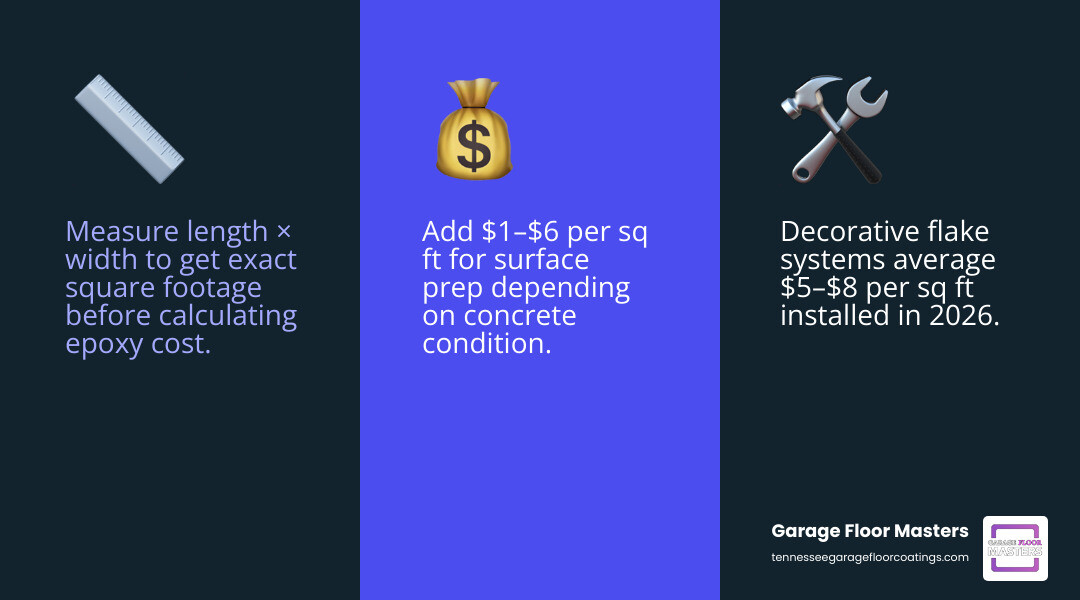
- Measure your floor (length × width = square footage)
- Pick your system from the table above
- Multiply square footage × the per-sq-ft rate
- Add $1 – $6 per sq ft for surface prep, depending on concrete condition
Example: A 480 sq ft two-car garage with a decorative flake system at $6/sq ft = roughly $2,880 – $3,840 before prep.
That said, every number above is a range — not a firm quote. Your final price depends heavily on your concrete’s condition, the features you choose, and local labor rates. That’s exactly why we offer a free on-site estimate.
Most people start Googling epoxy prices after staring at a cracked, oil-stained garage floor one too many times. You want something that looks sharp, holds up under a daily driver, and won’t need replacing in three years.
The problem? Epoxy quotes vary wildly — sometimes by thousands of dollars for the exact same garage. One contractor says $1,500. Another says $5,000. Without understanding what drives those numbers, it’s nearly impossible to know who to trust or what you actually need.
This guide walks you through exactly how to calculate your epoxy floor costs — from square footage and system type to prep work and add-ons — so you can walk into any conversation with a contractor fully informed.
Concrete epoxy flooring cost calculator terms at a glance:
How to Use a Concrete Epoxy Flooring Cost Calculator
A concrete epoxy flooring cost calculator is really just a smart estimating method. It takes the main cost drivers of a project and turns them into a rough number you can use for budgeting.
At the simplest level, most calculators use this formula:
Square footage x coating price per square foot + prep costs + optional upgrades = estimated total
That sounds easy enough, until real life enters the chat.
Concrete is rarely perfect. Some floors are smooth and clean. Others have cracks, old paint, oil contamination, moisture issues, or mystery stains from 2009. Good calculators account for those variables, not just floor size.
A useful calculator should help you estimate:
- Floor area in square feet
- Coating system type
- Number of coats
- Concrete condition
- Surface prep needs
- Moisture testing or mitigation
- Decorative add-ons
- Waste factor for materials
The key word here is estimate. Even the best calculator cannot fully replace an on-site inspection, because concrete porosity, previous coatings, and slab condition can change the real cost fast. We always recommend using your calculator result as a planning number, then confirming it with a free site visit.
If you want more background on pricing logic, this resource on epoxy flooring prices is a helpful companion read.
Measuring Your Space for Accuracy
Before you use any calculator, measure the floor correctly. This is where many estimates go wrong. A surprisingly large number of garages are not perfect rectangles, no matter how much we wish they were.
Use this basic process:
- Measure the full length of the floor.
- Measure the full width.
- Multiply length by width.
- Subtract areas that will not be coated, if any.
- Add a small waste factor for cuts, texture, and coverage variation.
Example:
- Garage length: 24 feet
- Garage width: 20 feet
- Total area: 480 square feet
If your floor has bump-outs, closets, alcoves, or a workbench nook, break it into smaller rectangles and add them together.
You may also want to measure linear feet for items that can affect price, such as:
- Expansion joints
- Control joints
- Cracks needing repair
- Perimeter cove base in commercial spaces
Useful measurement tools:
- Tape measure
- Laser measure
- Notepad or phone notes
- Graph paper
- Chalk or painter’s tape for marking sections
One more tip: round up a little. Coverage rates vary based on slab texture and porosity. Smooth primed concrete may cover far more than rough, thirsty concrete. That is why material calculators often include waste or overage.
Primary Factors Influencing Your Total Project Price
A floor is never priced by square footage alone. The biggest pricing swings usually come from four variables:
- Floor size
- Coating system type
- Concrete condition
- Site access and project complexity
That is why one 450-square-foot garage can be much cheaper than another 450-square-foot garage across town.
Access matters too. An open garage in Knoxville is easier to prep and coat than a basement with tight stairs, limited ventilation, and lots of furniture to work around. In general, garages are simpler projects than basements, and residential jobs are usually less complex than industrial floors.
The more your slab needs before coating starts, the more your estimate rises. That is also why it helps to understand articles like Don’t Get Floored by High Epoxy Rates before comparing bids.

Key Variables in Your Concrete Epoxy Flooring Cost Calculator Estimate
The epoxy type you choose directly affects both price and lifespan. In 2026, installed costs commonly fall somewhere between $3 and $12 per square foot for standard epoxy projects, with decorative and heavy-duty systems pushing higher.
Here is a practical comparison:
| Epoxy Type | Typical 2026 Installed Range | Typical Lifespan | Notes |
|---|---|---|---|
| Water-based epoxy | $3 – $5/sq ft | 3 – 5 years | Lowest-cost option, common for DIY, thinner and less durable |
| Solvent-based epoxy | $5 – $8/sq ft | 5 – 7 years | Better penetration and durability, stronger odor/VOC concerns |
| 100% solids epoxy | $7 – $12/sq ft | 10 – 20 years | Thick, durable, better for demanding use |
| Decorative flake epoxy | $5 – $12/sq ft | 7 – 15 years | Popular for garages, better texture and slip resistance |
| Metallic epoxy | $8 – $15/sq ft | 10 – 20 years | Most decorative, highly labor-intensive |
| Heavy-duty 3-coat system | $7 – $10/sq ft | 10 – 15 years | Common for tougher commercial use |
A few takeaways:
- Water-based systems are the cheapest up front, but they usually wear out the fastest.
- 100% solids systems cost more initially but often deliver much better long-term value.
- Metallic floors cost more because they are artistic, hand-worked installations.
- Decorative flake systems are popular because they balance looks, traction, and durability well.
From a budgeting standpoint, lifespan matters. A coating that lasts 15 years can be much cheaper over time than a coating that needs replacement after 3 to 5 years. Cheap is not always cheap. Sometimes it is just early payment on your next redo.
Surface Preparation and Repair Costs
If there is one place homeowners underestimate cost, it is prep work.
Surface prep can add around $1 to $6 per square foot depending on slab condition. On damaged concrete, prep may equal or even exceed the coating cost itself. That is not contractor drama. That is concrete reality.
Common prep items include:
- Diamond grinding
- Shot blasting
- Acid etching in limited situations
- Crack filling
- Joint repair
- Pitting repair
- Old coating removal
- Oil contamination treatment
- Moisture testing
- Moisture-mitigating primer
Typical add-on ranges seen in 2026 include:
- Basic prep: $1 – $2/sq ft
- Heavy grinding or coating removal: $1.50 – $3/sq ft
- Extensive prep or shot blasting: up to $4 – $6/sq ft
- Crack filling: about $1 – $5 per linear foot
- Joint filling: about $3 – $8 per linear foot
- Moisture testing: often a separate line item
- Moisture mitigation primer: can add roughly $1.50 – $3/sq ft on problem slabs
Why so much? Because proper prep takes time, equipment, and skill. Diamond grinders, dust control vacuums, repair materials, and labor all add up. And skipping prep is the fastest route to peeling, bubbling, and callbacks nobody wants.
For deeper prep-related pricing context, see The Complete Guide to Garage Epoxy Installation Costs.
Professional vs. DIY: Analyzing the Labor Gap
DIY epoxy looks cheap on paper. Sometimes very cheap. Material-only kits can cost around $0.40 to $1.60 per square foot, with basic garage kits sometimes running a few hundred dollars.
Then reality shows up with a grinder rental, a shop vacuum, crack repair products, degreaser, mixing buckets, rollers, spiked shoes, weather delays, and one unforgettable moment where the epoxy starts kicking in the bucket faster than expected.
Professional installation usually adds labor and equipment costs, but it also includes the stuff that determines whether the floor actually lasts.
Most research puts professional epoxy installation in the range of roughly $3 to $5 per square foot for labor on top of materials, though many contractors price by full system rather than splitting line items evenly. Some projects come in lower, some much higher, depending on prep and specification.
For a broader look at project budgeting, this page on garage floor coating cost is worth reviewing.
Professional vs. DIY Concrete Epoxy Flooring Cost Calculator Results
Here is the basic difference between DIY and pro calculator outputs:
| Category | DIY | Professional |
|---|---|---|
| Material cost | Lower | Higher-grade systems cost more |
| Equipment cost | Often overlooked | Included in bid |
| Prep quality | Varies a lot | Usually mechanical prep and repairs |
| Risk of failure | Higher | Lower when installed correctly |
| Lifespan | Often 2 – 5 years | Commonly 10 – 20 years |
| Warranty | Limited or none | Often available |
| Total hassle | High | Much lower for owner |
DIY pros:
- Lower upfront spending
- Good for very small, low-demand spaces
- Can work for experienced homeowners with the right prep tools
DIY cons:
- Most kits are lower-solids and less durable
- Prep is physically demanding
- Pot life can be short
- Coverage assumptions are often optimistic
- Moisture issues are easy to miss
- Mistakes can require full grinding and redoing
Professional pros:
- Better surface prep
- Better materials
- Faster installation
- More consistent finish
- Longer service life
- Lower risk of peeling or hot-tire issues
Professional cons:
- Higher upfront investment
- Scheduling is required
- Premium systems cost more
This is where long-term cost matters. A DIY kit that lasts 3 years is not necessarily a bargain if a professionally installed system lasts 10 to 20 years. In many garages, the cheapest path is actually the most expensive path with better marketing.
Specialized Systems and Decorative Add-ons
Once you move beyond a plain solid-color floor, the calculator needs to include feature upgrades.
Popular upgrades that increase price include:
- Full flake broadcast
- Metallic pigments
- Quartz broadcast
- Anti-slip additives
- UV-stable clear topcoats
- Extra clear coats
- Cove base
- Chemical-resistant topcoats
- Line striping or markings for commercial spaces
Decorative flake is usually the most practical upgrade for garages. It hides dirt well, adds texture, and gives the floor that finished showroom look without pushing pricing into metallic territory.
Metallic epoxy is the show-off option. It can look incredible in basements, retail spaces, and display areas, but it costs more because application is part coating and part art project. It is also less forgiving than flake when the slab has visual imperfections.
UV-stable topcoats matter too, especially where sunlight reaches the floor. Standard epoxy is not known for the best UV stability. That is one reason many modern systems use a tougher top layer over the base coat.
If you are comparing premium upgrades, this page on the cost of polyaspartic garage floors helps explain why topcoat choice can change both price and performance.
At Garage Floor Masters, we also install high-performance polyaspartic and epoxy garage floors across Knoxville and surrounding communities. Our UV-stable coatings are built for everyday use, installed in one day, and available in more than 140 colors. For homeowners who want long-term durability without babysitting the floor, that can be a strong value play.
Pricing for Commercial and Industrial Applications
Commercial and industrial floors are a different animal.
A residential garage is usually priced with homeowner-friendly aesthetics in mind. Commercial and industrial jobs are often driven by performance:
- Forklift traffic
- Chemical exposure
- Slip resistance requirements
- Wash-down conditions
- Safety striping
- Fast return to service
- Thickness and wear layers
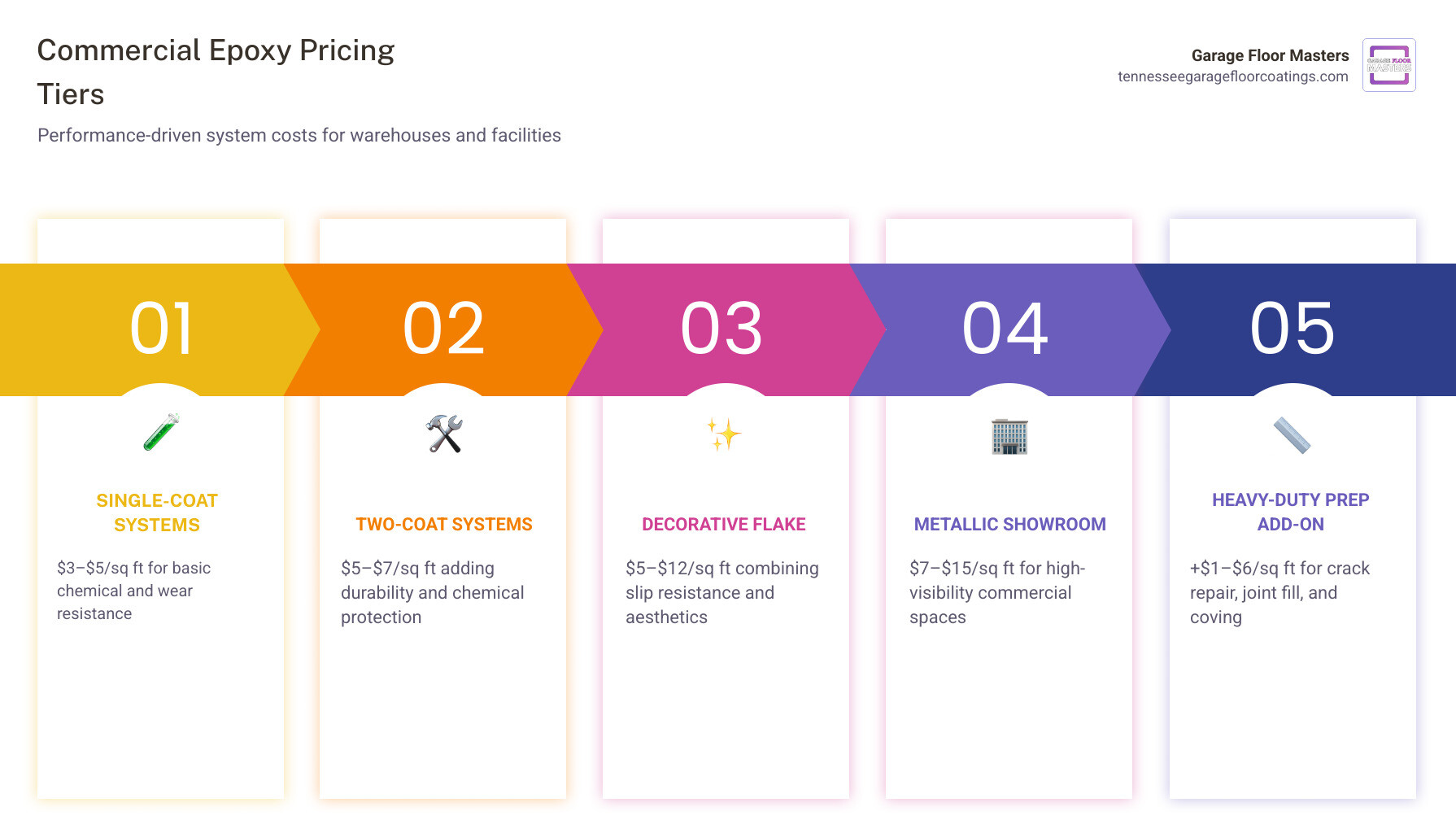
Typical commercial pricing often starts around standard epoxy ranges, then rises with prep intensity and performance requirements. For example:
- Single-coat systems: roughly $3 – $5/sq ft
- Two-coat systems: roughly $5 – $7/sq ft
- Decorative flake: roughly $5 – $12/sq ft
- Metallic or showroom systems: roughly $7 – $15/sq ft
- Heavy-duty prep: add $1 – $6/sq ft or more
Large commercial projects may benefit from volume pricing, but they can also require extensive crack repair, joint filling, line striping, anti-static additives, or cove base. A large warehouse with major prep needs can end up with prep costs nearly matching the coating budget.
Specialty textures and outdoor-adjacent decorative systems can also shift pricing. If you are exploring textured decorative surfaces, this pebble epoxy pricing guide adds useful context.
Frequently Asked Questions about Epoxy Costs
How much does it cost to epoxy a 2-car garage in 2026?
Most 2-car garages fall in the 400 to 576 square foot range. In 2026, a professionally installed epoxy floor for that size space often lands somewhere around $1,500 to $5,800 depending on the system, slab condition, and features selected.
A basic coating on clean concrete will sit toward the lower end. A decorative flake or metallic system with repairs, grinding, and moisture mitigation will be higher.
For homeowners in Knoxville and nearby service areas, we always recommend using online ranges as a starting point only. The actual condition of your slab is what moves the needle most.
How long does a professional epoxy floor last compared to a DIY kit?
DIY water-based kits often last about 2 to 5 years, especially in garages with daily use. Professionally installed systems commonly last 10 to 20 years when the floor is properly prepped and maintained.
As a broad rule:
- Water-based epoxy: about 3 – 5 years
- Solvent-based epoxy: about 5 – 7 years
- 100% solids epoxy: about 10 – 20 years
- Higher-performance commercial systems: can last even longer under the right conditions
The floor’s lifespan depends heavily on prep quality, traffic, moisture, and topcoat selection. The coating itself matters, but the bond to the concrete matters even more.
Does concrete moisture affect the final price of installation?
Yes, absolutely.
Moisture is one of the biggest hidden costs in epoxy flooring. If a slab has excessive vapor transmission, installers may need:
- Moisture testing
- Additional grinding
- Moisture-mitigating primer
- Different system specifications
Those steps can add meaningful cost, but they are far cheaper than installing a coating that later bubbles or delaminates. Basements and older concrete are especially worth checking carefully. In our experience, moisture is one of the top reasons a phone estimate changes after an on-site inspection.
Conclusion
A concrete epoxy flooring cost calculator is the right place to start, but it is only as good as the information you put into it. Measure carefully, choose the right system, account for prep, and be realistic about upgrades. That gets you much closer to the true project cost before you ever request a quote.
For homeowners around Knoxville, Oak Ridge, Maryville, Lenoir City, Clinton, Sevierville, and nearby areas, the best next step is simple: let us look at the slab in person. At Garage Floor Masters, we install durable garage floor systems designed for real-world use, including high-performance polyaspartic coatings with one-day installation and strong UV stability.
If you are ready to stop guessing, get a quote or calculate your final project investment today. A garage floor should not feel like a math problem forever.