
What Does Epoxy Flooring Material Cost in 2026?
Understanding epoxy flooring material cost before you buy can save you hundreds of dollars and prevent a frustrating mid-project budget surprise. Here’s a quick breakdown of what materials alone typically run:
| Epoxy Type | Material Cost Per Sq Ft | Lifespan |
|---|---|---|
| Water-based epoxy | $0.35 – $0.55 | 3-5 years |
| Solvent-based epoxy | $0.55 – $0.85 | 5-7 years |
| 100% solids epoxy | $0.85 – $1.40 | 10-20 years |
| Flake system | $1.00 – $2.00 | 10-15 years |
| Metallic epoxy | $1.50 – $2.25 | 15-20 years |
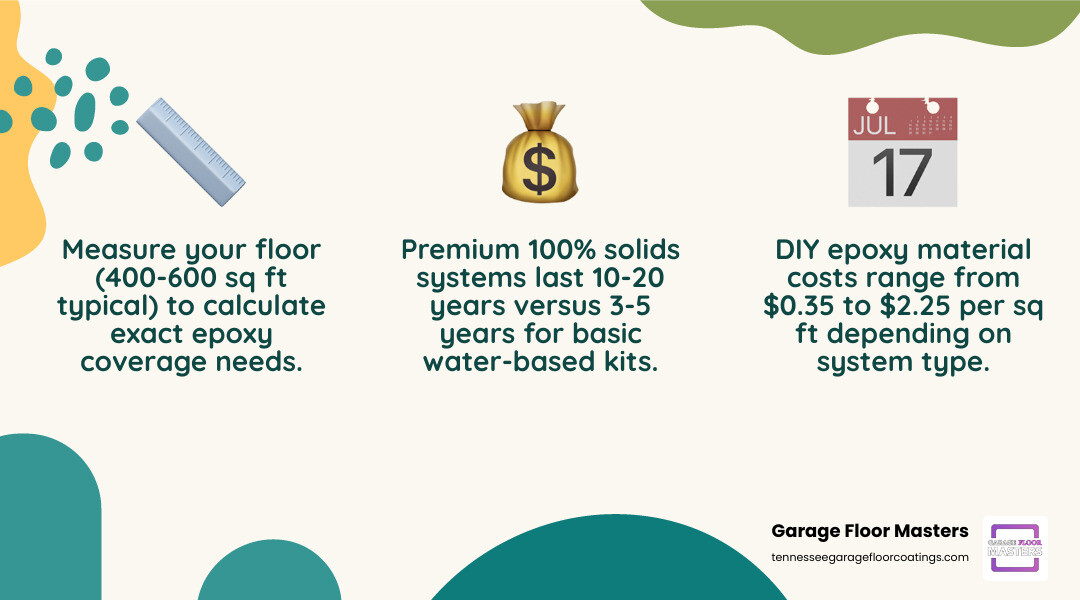
For a standard two-car garage (400-600 sq ft), DIY material costs typically run $200 to $500 depending on the system you choose. That said, every project is different — the condition of your slab, the finish you want, and how many coats you apply all shift the number. That’s exactly why we offer a free on-site estimate.
Your garage floor takes a beating every day. Heavy vehicles, oil drips, road salt tracked in from Knoxville winters — it adds up fast. The good news is that choosing the right epoxy system upfront means you won’t be redoing the job in three years.
This guide walks you through exactly how to calculate what materials will cost before you spend a dollar, so you can roll on the savings with confidence.
How to Estimate Epoxy Flooring Material Cost Before You Buy
The easiest way to blow a DIY budget is to price only the epoxy and forget everything else. The smartest way is to treat the whole floor as a system: prep, coating, additives, and cleanup.
A simple formula helps:
- Measure square footage.
- Check coverage rates for each coat.
- Add 10% for waste and edges.
- Add prep and repair supplies.
- Add decorative and safety extras.
Measure your garage and calculate true coverage
Start with the actual floor size, not the size listed in your home paperwork. Most two-car garages fall in the 400 to 600 square foot range, but a few extra feet matter when you’re buying by the gallon.
Use this formula:
length x width = square footage
Examples:
- 20 x 20 garage = 400 square feet
- 22 x 22 garage = 484 square feet
- 24 x 24 garage = 576 square feet
Then add a waste factor. We usually suggest 10% extra for:
- roller and mixing waste
- rough concrete that absorbs more product
- cut-in work along walls
- touch-ups
- uneven porosity in older slabs
So if your garage is 500 square feet, budget materials for about 550 square feet of real coverage.
Coverage also changes by product. Many DIY epoxies cover about 200 to 250 square feet per gallon, but thicker 100% solids systems may cover less depending on mil thickness. Always check the manufacturer’s spread rate for the exact coat you are applying.
Decide between one-coat kits and full systems
Not all “epoxy floors” are built the same. Some DIY kits are basically one thin coat plus a little color. Others are full systems with a primer, body coat, flakes, and a protective topcoat.
That difference has a huge impact on epoxy flooring material cost and lifespan.
A one-coat or basic kit is usually:
- cheaper upfront
- faster to apply
- thinner
- less forgiving on stained or porous concrete
- more likely to wear faster under hot tires and traffic
A fuller system usually includes:
- primer
- epoxy base coat
- optional flake broadcast
- clear topcoat
- optional anti-slip additive
That costs more at the start, but it usually delivers better adhesion, better thickness, and a longer service life.
If you’re comparing options, don’t just ask “How much is the kit?” Ask:
- How many coats does it include?
- Is it water-based, solvent-based, or 100% solids?
- Does it include primer?
- Does it include topcoat?
- Is decorative flake included or extra?
Add the overlooked supplies to your budget
This is where DIY estimates go sideways. Homeowners often price the resin and forget the tools and prep products.
Must-have materials and supplies:
- concrete cleaner or degreaser
- crack filler or patch compound
- etching solution or grinder rental supplies
- mixing buckets
- drill mixer paddle
- rollers and roller covers
- roller frame and extension pole
- squeegee
- paint brushes for edges
- painter’s tape
- spiked shoes if needed
- gloves
- respirator or ventilation gear, depending on product
- anti-slip grit
- cleanup solvent or disposable liners
For many DIY jobs, these extras can add a meaningful amount to the budget even before the first coat goes down. And if the slab has oil spots, old paint, moisture issues, or spalling, the prep bill rises fast.
Epoxy Flooring Material Cost by Type and Price Per Square Foot
Different systems have very different price points. The cheapest material is not always the cheapest floor in the long run.

Average epoxy flooring material cost per square foot by system
Based on 2026 pricing, here is a practical material-only range for common systems:
| System Type | Typical Material Cost Per Sq Ft | Typical Resin Cost |
|---|---|---|
| Water-based epoxy | $0.35 – $0.55 | $30 – $50 per gallon |
| Solvent-based epoxy | $0.55 – $0.85 | $40 – $55 per gallon |
| 100% solids epoxy | $0.85 – $1.40 | $45 – $150 per gallon |
| Flake epoxy system | $1.00 – $2.00 | Varies by base coat + flakes + clear coat |
| Metallic epoxy | $1.50 – $2.25 | Higher due to pigments and clear coats |
Water-based products are usually the entry-level choice. They are easier on the budget and often lower in VOCs, but they are thinner and generally last only 3 to 5 years.
Solvent-based products usually cost a bit more and can last longer, often around 5 to 7 years, though availability may vary because some formulas face VOC restrictions.
100% solids epoxy is thicker and more durable. Since it contains no evaporating solvents, more of what you pour stays on the floor. That helps explain why it lasts longer and costs more.
Basic solid-color vs flake vs metallic material pricing
A solid-color floor is the most budget-friendly “real system” look. Once you start adding decorative elements, the price climbs.
Basic solid-color epoxy:
- lowest decorative cost
- clean, simple look
- usually needs fewer specialty materials
Flake system:
- adds vinyl flakes
- usually includes a clear topcoat
- improves appearance and helps hide dirt and minor slab blemishes
- often costs more than solid color because you’re adding two materials, not one
Metallic epoxy:
- uses metallic pigments and often more involved layering
- can require extra clear coats
- costs the most in materials among common residential finishes
- looks dramatic, but also demands more planning and a better slab condition
In many projects, decorative finishes raise material costs by roughly 20% to 60% compared with a plain solid-color system.
What a 400- to 600-square-foot garage costs in materials
For a typical two-car garage, here’s a useful DIY material snapshot:
| Garage Size | Basic DIY Kit | Mid-Range Flake System | Premium Metallic/High-Build |
|---|---|---|---|
| 400 sq ft | $200 – $300 | $350 – $550 | $600 – $900 |
| 500 sq ft | $250 – $375 | $425 – $700 | $750 – $1,100 |
| 600 sq ft | $300 – $450 | $500 – $850 | $900 – $1,300 |
These numbers can move up if you need:
- crack repair
- moisture-blocking primer
- heavy grinding prep
- multiple topcoats
- custom colors or heavier flake broadcast
DIY Epoxy Kits vs Professional-Grade Materials
A cheap kit and a professional-grade system may both say “epoxy,” but they are not the same animal. One is more like a weekend project. The other is a flooring system.
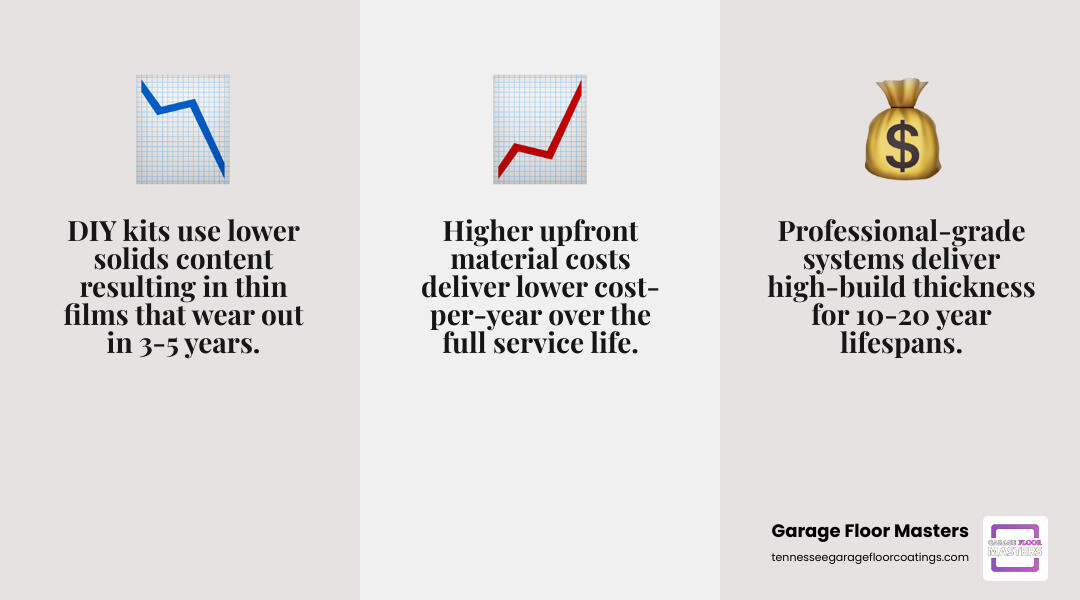
| Feature | DIY Kit | Professional-Grade System |
|---|---|---|
| Upfront material cost | Lower | Higher |
| Solids content | Often lower | Usually higher |
| Film thickness | Thin | High-build |
| Prep tolerance | Less forgiving | Better performance when installed correctly |
| Lifespan | Often shorter | Usually longer |
| Topcoat quality | Basic or none | Often premium protective coat |
Why cheap DIY kits cost less upfront but wear out faster
Many budget kits are water-based or closer to epoxy paint than a thick coating system. That keeps the shelf price low, but it usually means:
- less build thickness
- lower impact resistance
- more wear from turning tires
- more risk of hot-tire pickup
- faster dulling and recoat needs
Research consistently puts water-based systems around 3 to 5 years in many garage settings. If your garage sees daily driving, moisture, and temperature swings, that lifespan can feel even shorter.
So yes, a cheap kit saves money at checkout. But if you recoat twice while a thicker system is still going strong, the “cheap” option becomes a little less charming.
When professional-grade epoxy materials are worth the upgrade
Professional-grade materials make the most sense when you want:
- thicker coverage
- stronger chemical resistance
- better adhesion
- a longer life cycle
- better performance under vehicle traffic
100% solids epoxy is the best example. Material costs are higher, but service life often runs 10 to 20 years when the slab is properly prepared and the product is applied correctly.
If you want a deeper look at installed system pricing, this garage epoxy installation cost guide is worth reviewing.
At Garage Floor Masters, we also help homeowners compare epoxy against higher-performance options. In many Knoxville-area garages, especially those with sunlight exposure or homeowners who want faster return to service, a professionally installed coating system may be the better fit than a DIY epoxy kit.
Material cost per year of service life
This is one of the smartest ways to compare systems.
Example annualized material value:
- Water-based epoxy at $0.45 per square foot lasting 4 years = about $0.11 per square foot per year
- 100% solids epoxy at $1.10 per square foot lasting 15 years = about $0.07 per square foot per year
- Metallic epoxy at $1.90 per square foot lasting 18 years = about $0.11 per square foot per year
That math is not perfect, because prep and recoat costs vary, but it shows the main point: better materials often cost less per year of use.
The Biggest Factors That Change Material Pricing
Two garages with the same square footage can have very different material budgets. That’s because the slab condition and the system design matter as much as the room size.

Thickness, solids content, and number of coats
More thickness means more resin. More resin means more money.
Typical installed system builds from the research look like this:
- thin-mil epoxy: about 20 mil
- self-leveling epoxy: about 40 to 60 mil
- decorative flake or quartz: about 60 to 80 mil
- high-build quartz: about 100 to 125 mil
For a DIY homeowner, the practical takeaway is simple:
- one thin coat is cheapest
- primer plus body coat costs more
- base coat plus full flake plus clear topcoat costs more still
- high-build and self-leveling systems require much more product
Higher solids content also increases price. Since 100% solids products do not evaporate off like water-based systems, they build thickness faster and usually perform better.
Decorative add-ons that raise the total
These upgrades are popular because they improve looks and, in some cases, traction.
Common add-ons:
- vinyl flakes
- quartz aggregate
- metallic pigments
- anti-slip grit
- UV-stable topcoat
- custom color blends
Typical budget effects:
- decorative flakes: moderate increase
- metallic pigments: larger increase
- clear topcoat: moderate increase, but often worth it
- anti-slip additive: small increase
- custom patterns or logos: premium increase
A plain floor is almost always the cheapest. A premium decorative system can cost much more, even before labor is involved.
Hidden material costs most homeowners miss
The “hidden” costs are usually just prep costs that people forgot to count.
Watch for:
- diamond grinder rental
- grinding wheels or abrasives
- patching compound
- oil spot treatment
- moisture-blocking primer
- crack chase products
- etching supplies
- replacement roller covers
- 10% overage for waste and touch-up
Moisture mitigation is a big one. If your slab has elevated moisture vapor, a standard epoxy may fail early. Moisture barrier products can add noticeably to the material bill, but skipping them can be far more expensive later.
For more ideas on avoiding budget surprises, this article on avoiding high epoxy rates covers several common cost traps.
Cost by Project Size and How Epoxy Compares to Other Coatings
Size matters, but not always the way homeowners think. Larger projects usually get a lower per-square-foot number, though total spend is obviously higher.
Do larger projects lower epoxy flooring material cost per square foot?
Usually, yes, at least a little.
Why:
- fixed tool costs are spread over more square footage
- waste percentages improve on larger pours
- larger kit bundles may cost less per unit
- setup materials go further
For example:
- a 250-square-foot project may need almost the same roller, tape, and bucket setup as a 500-square-foot project
- a 1,000-square-foot project often has a lower material cost per square foot than a 400-square-foot project
That said, slab condition can erase those savings quickly. If the bigger floor needs more repairs, more grinding, or moisture products, the unit cost can rise again.
Epoxy vs polyaspartic vs urethane cement material cost
If you’re comparing material families, epoxy is often the lower-cost entry point.
General comparison:
- Epoxy: lower upfront material cost, thicker build options, slower cure
- Polyaspartic: higher upfront cost, faster cure, better UV stability
- Urethane cement: highest cost in many cases, built for demanding industrial environments
Urethane cement systems are usually overkill for a standard residential garage. They make more sense in heavy-use commercial or industrial settings where heat, chemicals, and sanitation are major concerns.
Polyaspartic is worth mentioning because many homeowners cross-shop it with epoxy. It usually costs more, but it cures much faster and holds up better in UV exposure. If your garage gets strong sunlight, that can matter. This polyaspartic garage floor cost article gives a deeper cost comparison.
At Garage Floor Masters, we install both epoxy and high-performance polyaspartic systems. Our UV-stable coatings are built for daily use, installed in one day, and available in 140+ colors, so if you’re weighing DIY epoxy against a professional long-term upgrade, we can walk you through both options.
Best material choice for garages, basements, and heavy-use spaces
The best choice depends on the environment.
For garages:
- epoxy can be a strong value if the slab is dry and properly prepped
- flake systems are popular for traction and appearance
- UV-stable topcoats help if sunlight reaches the floor
For basements:
- moisture is the big concern
- epoxy should not go over a damp slab without proper testing and mitigation
- if moisture is persistent, another coating system may be smarter
For heavy-use spaces:
- thicker systems perform better
- chemical resistance matters
- impact and abrasion resistance matter more than just color
In short, there is no universal “best” coating. There is only the best fit for the slab, the traffic, the sunlight, and the budget.
Frequently Asked Questions About Epoxy Flooring Material Cost
How much epoxy material do I need for a standard two-car garage?
For a 500-square-foot garage, many DIY projects need roughly:
- primer: 2 to 3 gallons, depending on coverage
- base coat epoxy: 2 to 3 gallons
- flakes: enough for your chosen broadcast rate
- clear topcoat: 2 to 3 gallons if included
Exact quantities depend on:
- porosity of the slab
- whether the product covers 200, 250, or more square feet per gallon
- whether you’re doing one coat or a full system
- how heavy the flake broadcast is
A good rule is to calculate for your actual square footage, then add 10% overage.
How much do primers, topcoats, flakes, and anti-slip additives add?
These extras can move the total more than people expect.
Typical effects on the budget:
- primer: adds a base-layer cost but often improves adhesion and consistency
- clear topcoat: adds protection and wear resistance
- decorative flakes: adds style and can help hide dust and imperfections
- anti-slip grit: low-cost add-on for better traction
- moisture barrier primer: can be one of the most expensive add-ons if needed
For many DIY garages, these extras are what separate a bare-bones kit from a system that actually lasts.
Is epoxy still the best value in 2026?
For many homeowners, yes, epoxy is still a strong value in 2026, especially when:
- the slab is dry and sound
- the floor is prepped correctly
- the right resin type is used
- expectations match the product
But “best value” does not always mean “lowest shelf price.” A cheap coating that fails early is not a bargain. A better material with a longer life often wins on cost per year.
If you want a broader overview of current pricing, this epoxy flooring price guide is a helpful companion read.
Conclusion
When you break it down step by step, epoxy flooring material cost is not hard to estimate. Measure carefully, use real coverage rates, add your prep supplies, and give yourself a waste margin. That simple process will get you much closer to the real number than just grabbing a kit and hoping for the best.
The short version:
- basic DIY materials for a two-car garage often land around $200 to $500
- better systems cost more but usually last longer
- decorative upgrades raise the budget
- prep products and repair materials are often the hidden costs
- larger projects can lower per-square-foot material cost
If you’re comparing DIY against professional installation in Knoxville, Oak Ridge, Maryville, Sevierville, Crossville, Lenoir City, and nearby East Tennessee areas we serve, we’re happy to help you make sense of the numbers. Because pricing always depends on slab condition and the finish you choose, we recommend getting a free on-site estimate before you commit.
For another helpful pricing resource, see this guide on garage floor coating cost.
And if you decide you’d rather skip the buckets, rollers, and surprise crack repair receipts, Garage Floor Masters is here to help with durable, low-maintenance garage floor coatings built for everyday use.