
Understanding Non-Slip Epoxy Floor Paint and Its Benefits
Non-slip epoxy floor paint is a two-part coating system that bonds directly to concrete, wood, or metal surfaces and creates a tough, textured finish that dramatically reduces slip-and-fall risk — even when wet.
Here’s what you need to know at a glance:
| Feature | What to Expect |
|---|---|
| Best for | Garages, warehouses, ramps, pool decks, locker rooms |
| Slip resistance | Coefficients of friction up to 1.10 (dry) and 1.14 (wet) |
| Coverage | Roughly 75–300 sq ft per gallon depending on product and surface |
| Drying time | Touch-dry in 2–8 hours; light foot traffic in 10–24 hours |
| Full cure | 2–7 days depending on product |
| Texture options | Fine, medium, or coarse aggregates (silica sand, aluminum oxide, polybeads) |
| Key benefit | Chemical, abrasion, and slip resistance in one coat |
Slip-and-fall accidents are among the most common workplace injuries — and they happen on garage floors just as often as they do in factories. A standard smooth floor coating can become dangerously slick the moment oil, water, or even tire dust gets on it.
That’s where the right coating makes all the difference.
But here’s the thing: choosing the right product is only half the battle. How you apply it determines whether you get a floor that lasts years — or one that peels, bubbles, or loses its grip within months.
This guide walks you through every step of the process, from surface prep to final cure, so you get it right the first time.
Why Safety Coatings Matter in 2026
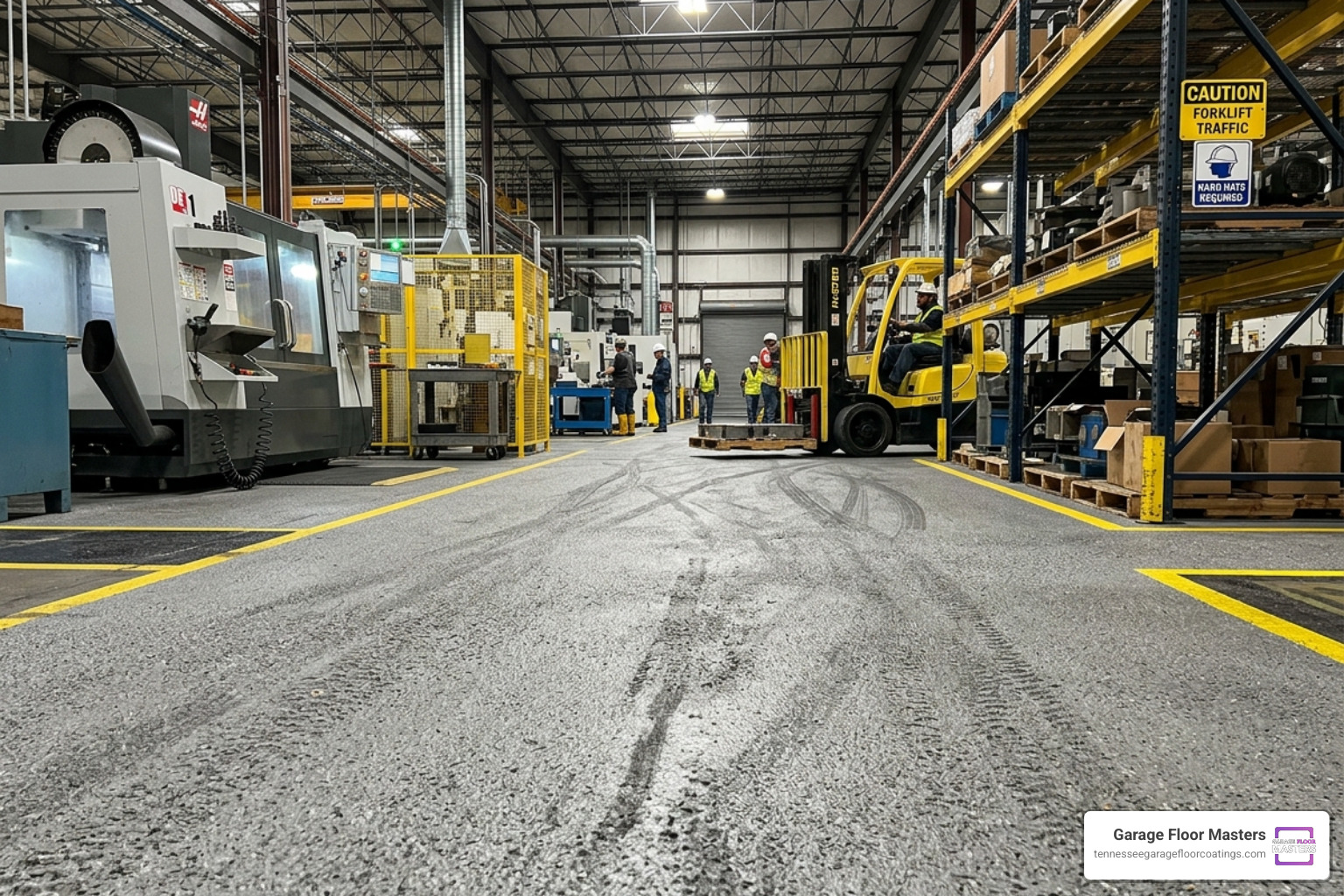
As we move through 2026, the emphasis on safety in both residential and commercial spaces has never been higher. Whether you are managing a busy warehouse in Oak Ridge or upgrading your home garage in Maryville, the risks of a slick floor are real. Slip-and-fall accidents are a primary driver of workers’ compensation claims and personal injuries.
By choosing a high-traction coating, you Enhance Workplace Safety by creating a surface that remains stable underfoot even when exposed to rainwater, grease, or spilled fluids. Modern non-slip epoxies are engineered to meet or exceed stringent standards, such as the Americans with Disabilities Act (ADA) requirements and OSHA safety guidelines. In fact, some military-grade coatings achieve a Coefficient of Friction (COF) of 1.10 (dry) and 1.14 (wet), far surpassing the baseline safety requirements for industrial environments.
Durability and Surface Protection
Beyond just keeping you upright, non slip epoxy floor paint serves as a sacrificial shield for your substrate. In East Tennessee, our floors deal with a lot—from the humidity of a Loudon summer to the road salt tracked in during a winter trip to Pigeon Forge.
A high-quality Epoxy Garage Floor Coating provides exceptional impact resistance. If you drop a heavy wrench or a floor jack, the coating absorbs the energy rather than letting the concrete crack. Furthermore, these coatings are designed to resist “hot tire pickup”—a common failure where hot tires from a recently driven car literally peel the paint off the floor as they cool. By using a chemically bonded epoxy or a superior polyaspartic system, you ensure the finish stays on the floor where it belongs.
Essential Surface Preparation for a Permanent Bond
We always tell our clients in Knoxville and Sevierville the same thing: A coating is only as good as the prep work beneath it. In fact, roughly 80% of all coating failures are caused by poor surface preparation. If you apply the best non slip epoxy floor paint in the world over a dirty or oily floor, it will eventually peel.
Testing for Hydrostatic Pressure
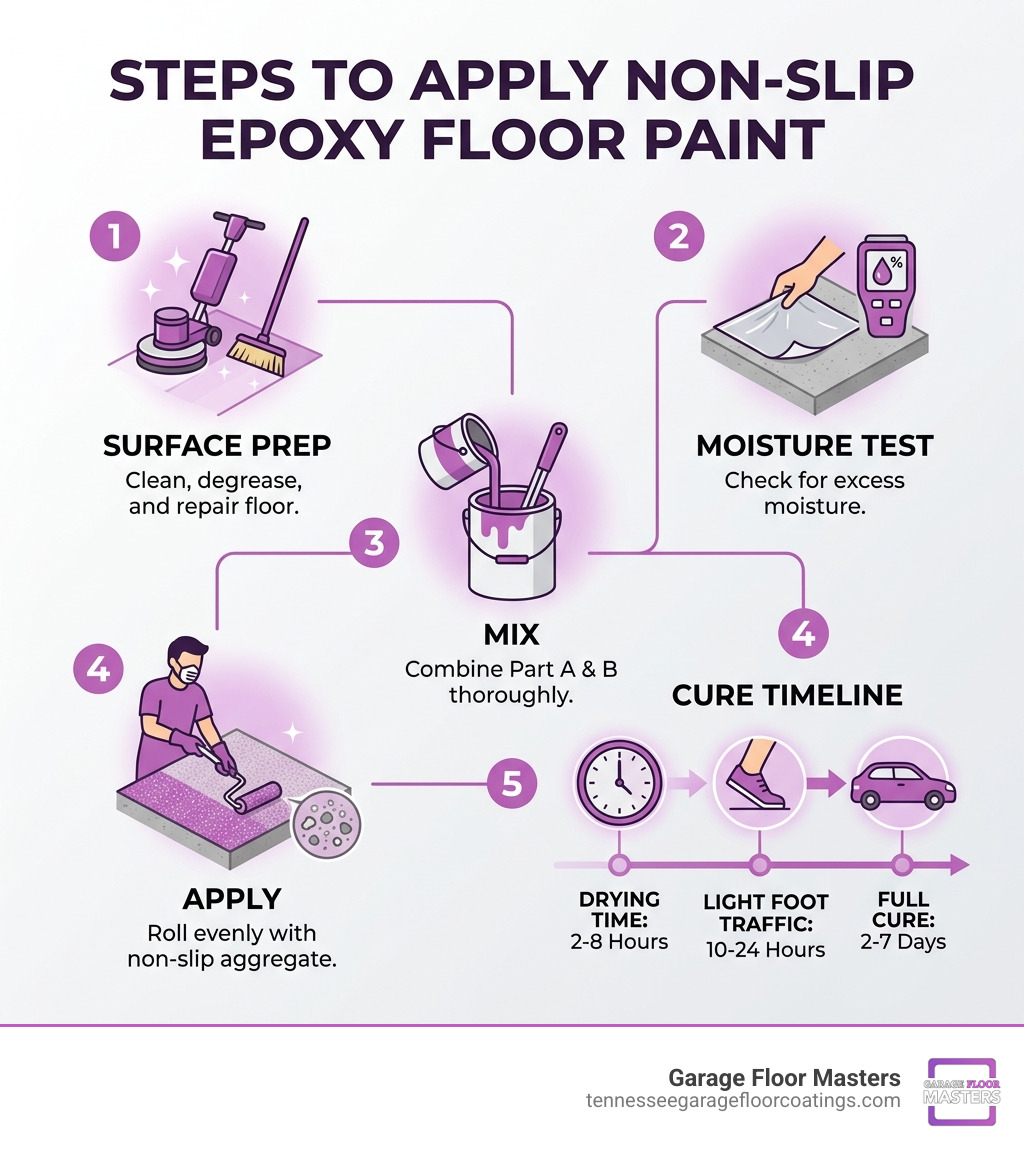
Before you even pick up a roller, you need to know if your concrete is “breathing” too much moisture. Hydrostatic pressure occurs when water vapor rises through the concrete slab and gets trapped under the non-porous epoxy. This leads to unsightly bubbles and delamination.
We recommend the 4’x4′ plastic sheet test. Tape a heavy-duty plastic sheet to your garage floor, sealing all edges with duct tape. Leave it for 24 hours. If you see condensation under the plastic or the concrete has turned dark, you have a moisture issue. In these cases, a specialized moisture vapor barrier or primer is required before the main coating goes down.
Profiling the Substrate
For the epoxy to “bite” into the concrete, the surface needs to have a texture similar to 80-grit sandpaper. This is known as the Concrete Surface Profile (CSP).
- Mechanical Scarification: For larger projects, using a diamond grinder is the gold standard. It removes the “laitance” (a weak, milky layer of cement dust on top) and opens the pores of the concrete.
- Acid Etching: If you don’t have access to a grinder, a self-etching cleaner like Cemtetch can be used. It reacts with the minerals in the concrete to create a porous profile. However, you must rinse the floor thoroughly and allow it to dry completely—usually at least 24 to 48 hours—before applying Garage Floor Paint.
- Degreasing: Any oil or grease spots must be scrubbed with a heavy-duty degreaser. Epoxy will not bond to oil.
Once the floor is clean, dry, and profiled, you’re ready for the Epoxy Floor Coatings.

How to Apply Non Slip Epoxy Floor Paint Like a Pro
Applying epoxy is a race against the clock. Once you mix the two components (the resin and the hardener), a chemical reaction begins. This “pot life” is the window of time you have to get the product on the floor before it hardens in the bucket. Depending on the temperature in places like Lenoir City or Powell, your pot life might range from 25 to 60 minutes.
Choosing the Right Aggregate for Non Slip Epoxy Floor Paint
The “non-slip” part of the paint comes from aggregates—tiny particles suspended in the coating or broadcast on top.
- Aluminum Oxide: Extremely hard and durable; best for industrial ramps and heavy vehicle traffic.
- Silica Sand: The most common choice; provides a “sandpaper” feel that is very effective but can be tough on bare feet.
- Polybeads: These are rounded plastic beads. They offer great traction but are much more “barefoot-friendly,” making them ideal for Chip and Flake Flooring in residential basements or pool decks.
Mastering the Roll-Down Technique for Non Slip Epoxy Floor Paint
To get a uniform finish, we use a specific sequence:
- Mixing: Use a Jiffy mixer attached to a slow-speed drill. Mix Part A and Part B for 2-3 minutes. Pro tip: Do not scrape the sides of the bucket when pouring the material onto the floor. Unmixed resin on the sides of the pail can cause “soft spots” that never cure.
- Sectioning: Mark your floor into sections (e.g., 100-150 sq. ft. per gallon) to ensure you are applying the material at the correct thickness.
- Application: Pour the mixed epoxy in a ribbon across the floor. Use a squeegee to spread it evenly, then follow up with a 3/8″ nap lint-free roller to “back-roll” the material. Back-rolling ensures a uniform texture and removes any bubbles.
- Maintaining a Wet Edge: Always work toward the exit and keep a “wet edge” between sections to avoid visible lap marks.
| Epoxy Type | Solids Content | VOC Level | Best Use |
|---|---|---|---|
| Water-Based | 40% – 50% | Low | DIY, light foot traffic, basements |
| 100% Solids | 100% | Low/Med | Industrial, heavy vehicles, maximum durability |
| Polyaspartic | High | Low | One-day install, UV stable, 4x stronger than epoxy |
Curing Times and Long-Term Maintenance
Patience is the final ingredient for a perfect floor. While it might look dry to the touch in a few hours, the chemical bond is still forming. In the humid climate of East Tennessee, curing times can vary.
Traffic Readiness Milestones
- Tack-Free (5–8 hours): The floor is no longer sticky, but don’t walk on it yet!
- Light Foot Traffic (10–24 hours): You can walk on the floor in clean socks or soft shoes.
- Vehicle Traffic (48–72 hours): You can finally pull the car back into the garage. In cooler temperatures (below 60°F), we recommend waiting the full 72 hours.
- Full Chemical Cure (7 days): This is when the floor reaches its maximum hardness. Avoid getting harsh chemicals or salt on the floor until this window has passed.
Maintaining the Anti-Slip Profile
To keep your Garage Floor Coatings looking and performing great, follow these Floor Care Instructions:
- Regular Cleaning: Use a soft-bristle broom or a leaf blower to remove dust and grit.
- Mopping: Use a pH-neutral cleaner. Avoid alcohol-based cleaners or citrus-based degreasers, as these can dull the finish over time.
- Pressure Rinsing: For stubborn dirt, a light pressure wash is usually sufficient.
- Re-coating: If the non-slip texture eventually wears down in high-traffic areas (like a commercial ramp in Clinton), you can lightly sand the surface and apply a fresh topcoat with new aggregate.
Frequently Asked Questions about Anti-Slip Coatings
How much coverage does a gallon of non-slip epoxy provide?
Coverage varies wildly based on the substrate’s porosity. A smooth, sealed floor might get 300 sq. ft. per gallon, while a rough, “thirsty” concrete floor in an old Jefferson City workshop might only get 150 sq. ft. On average, most kits cover about 250 sq. ft. per gallon for colors. Always buy about 10% more than you think you need to account for waste and thick spots.
What is the difference between water-based and solvent-based epoxies?
Water-based epoxies are popular for DIY projects because they have low VOCs (odors), are easy to clean up with soap and water, and are generally more “breathable.” However, they are thinner. Solvent-based or 100% solids epoxies are much thicker and more durable but require more skill to apply and often have stronger odors during the curing process.
What are common mistakes to avoid during application?
- Hand Mixing: Never mix by hand with a stick. You won’t get a complete chemical bond, leading to sticky spots.
- High Humidity: If the humidity is above 75-80%, the epoxy may “blush” (turn white) or fail to cure properly.
- Improper Etching: If water doesn’t soak into the concrete after you’ve etched it, the epoxy won’t either.
- Scraping the Bucket: As mentioned, avoid the temptation to scrape every last drop out of the mixing pail—that’s where the unmixed resin lives!
Conclusion: Achieving the Ultimate Safe Floor
Applying non slip epoxy floor paint is a rewarding project that adds value, beauty, and safety to your property. Whether you’re tackling a small laundry room in White Pine or a massive commercial space in Knoxville, following these professional steps will ensure a bond that lasts.
At Garage Floor Masters, we understand that a DIY project isn’t for everyone. That’s why we offer professional installation services across East Tennessee, including Oak Ridge, Crossville, and Maryville. Our high-performance polyaspartic and epoxy systems are 4x stronger than standard epoxy, UV stable (they won’t yellow in the sun!), and can be installed in just one day. With over 140 colors to choose from, you can get a floor that is as beautiful as it is safe.
Pricing for a professional installation depends on the condition of your concrete and the specific features you choose, which is why we offer a free on-site estimate to give you an accurate quote for your project.
Ready to transform your space? Get a professional Epoxy Garage Floor Coating today and enjoy a durable, low-maintenance floor built for everyday life.