
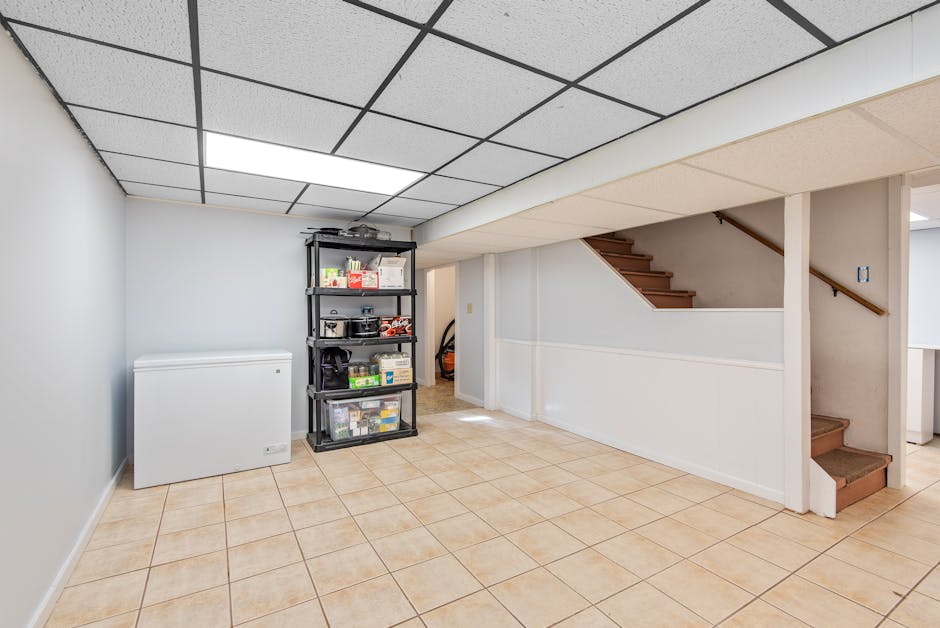
Why Finding the Right Expert Basement Coating Installer Matters More Than You Think
Expert basement coating installers do something most general contractors and DIYers simply can’t: they treat your basement floor as the complex, below-grade system it actually is — not just a slab that needs paint.
If you need a quick answer on what to look for, here it is:
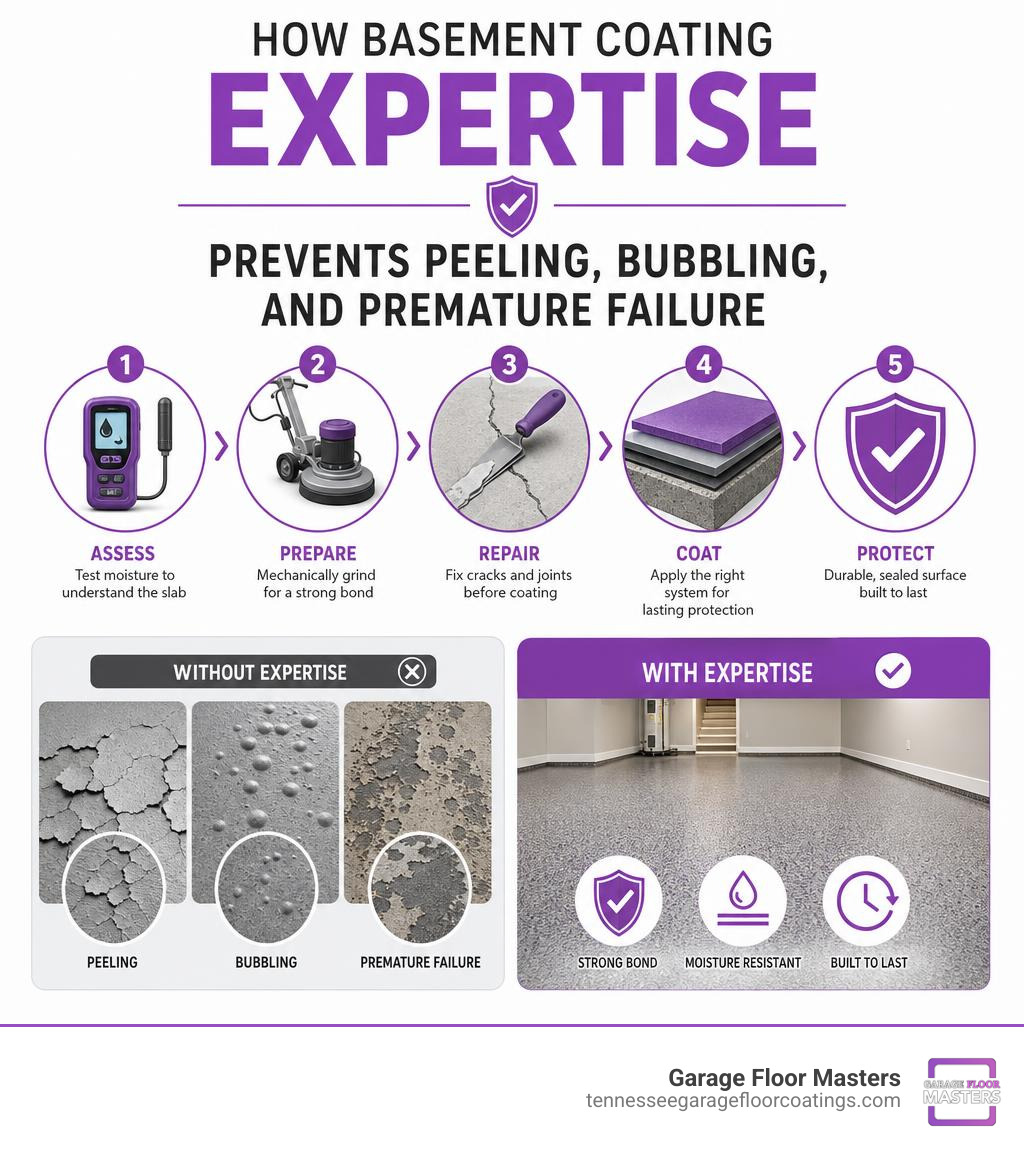
How to identify a qualified basement coating installer:
- They test for moisture before quoting — using ASTM-standard methods, not guesswork
- They use mechanical surface prep — diamond grinding, not power washing
- They repair cracks and joints before any coating touches the floor
- They recommend the right coating system for your specific slab conditions (polyurea basecoat + polyaspartic topcoat is the current professional standard)
- They carry insurance, offer a written warranty, and have local reviews you can verify
- They won’t start coating over active water intrusion — and they’ll tell you that upfront
Basements are uniquely challenging. They sit below grade, surrounded by soil that holds moisture, shifts with temperature, and pushes water upward through the slab. A coating installed without addressing vapor transmission or surface profile won’t just look bad — it will fail, often within two to four years.
That’s the difference between a fast quote and a real expert.
This guide breaks down exactly what separates skilled basement coating professionals from the rest, what the installation process should look like, and how to protect yourself when comparing contractors in Knoxville and the surrounding area.
Quick expert basement coating installers definitions:
What Separates Expert Basement Coating Installers From the Pretenders
When you start searching for someone to upgrade your below-grade concrete, you will find no shortage of handymen, general painters, and DIY kits claiming to offer the perfect solution. However, true expert basement coating installers operate on an entirely different level of technical knowledge and substrate science.
A basement is not just an indoor garage. Because it is surrounded by earth, it is subject to continuous environmental pressures that do not affect above-grade structures. An expert understands the delicate chemistry of concrete, how moisture vapor moves through porous materials, and how different coating systems bond to concrete at a molecular level.
| Feature | Expert Basement Coating Installers | Non-Specialized Installers / DIY |
|---|---|---|
| Surface Prep Method | Mechanical diamond grinding (ICRI CSP 2–4 standards) | Acid washing, power washing, or light sanding |
| Moisture Testing | Mandatory ASTM F1869 (Calcium Chloride) or ASTM F2170 (In-situ RH) | Visual inspection or no testing at all |
| Coating Chemistry | Industrial-grade polyurea/polyaspartic or vapor-barrier epoxy | Water-based epoxy paint or cheap hardware store kits |
| Bond Type | Deep chemical fusion with the concrete pores | Weak mechanical adhesion sitting on top of the surface |
| Crack & Joint Repair | Structural crack chasing, routing, and polyurea joint fillers | Latex caulk, basic spackle, or coating right over them |
| Cure Monitoring | Dew point, slab temperature, and humidity tracking | Ignored; applied regardless of climate conditions |
For a deeper look at the various options available for your home, explore our dedicated page on Basement Floor Coatings.
How expert basement coating installers evaluate a basement before quoting
A real expert will never give you a firm quote over the phone without looking at your slab first. When we walk into your basement, we are not just measuring square footage; we are performing a diagnostic evaluation of your home’s foundation.
During a professional site inspection, we look for several key indicators:
- Slab Age and Condition: Older concrete slabs often lack a sub-slab vapor barrier, which drastically changes how we must prime the floor.
- Active Leaks and Efflorescence: White, powdery residue (efflorescence) on the concrete indicates that water is actively traveling through the slab and evaporating, leaving salt minerals behind.
- Musty Odors and Humidity: High ambient humidity or a damp smell suggests that the basement is under constant vapor drive.
- Slab Cracks and Structural Clues: We map out vertical, horizontal, or step cracks to determine if they are static or active (moving) structural issues.
- Sump Pumps and Drainage: The presence of a sump pump or interior drain tile tells us how water is managed around your foundation.
- Wall-Floor Joints: The “cold joint” where your basement floor meets the wall is a prime candidate for moisture intrusion.
By examining these factors, we can provide transparent pricing and establish realistic expectations for your project before any work begins.
Why expert basement coating installers are different from non-specialized installers
Non-specialized contractors often treat basement concrete like drywall—assuming a quick sanding and a coat of paint will do the trick. True experts know that concrete is a highly porous, breathing medium.
Professional installers invest in heavy, specialized equipment. We use industrial walk-behind diamond grinders equipped with magnetic tooling to open up the concrete’s pores. We don’t guess at moisture; we use electronic concrete moisture meters and relative humidity probes.
Furthermore, we understand variables like dew point awareness. If the slab temperature is too close to the dew point, microscopic condensation will form on the concrete. Applying a coating over this invisible moisture layer guarantees adhesion failure. Experts calculate these numbers before mixing a single batch of product to ensure a perfect, long-lasting bond.
Credentials, training, and technical proof homeowners should ask for
Before hiring any contractor in East Tennessee to coat your basement, you should ask for proof of their technical capabilities and business standing:
- Licensing and Insurance: Ensure they are fully licensed to operate in Tennessee and carry comprehensive liability and workers’ compensation insurance.
- Manufacturer Certifications: Top-tier installers are factory-trained by the chemical manufacturers. This ensures they apply the products at the correct film thickness (typically 16 to 30+ mils) and within strict recoat windows.
- ASTM and ICRI Standards: Ask if they prepare floors to the International Concrete Repair Institute (ICRI) Concrete Surface Profile (CSP) standards (ideally CSP 2 to 4 for basement coatings).
- A Documented Process: A reputable company will outline exactly how they handle prep, repair, and application. You can read about our specific step-by-step approach by visiting Our Process.
The Basement Problems Only Real Pros Know How to Handle
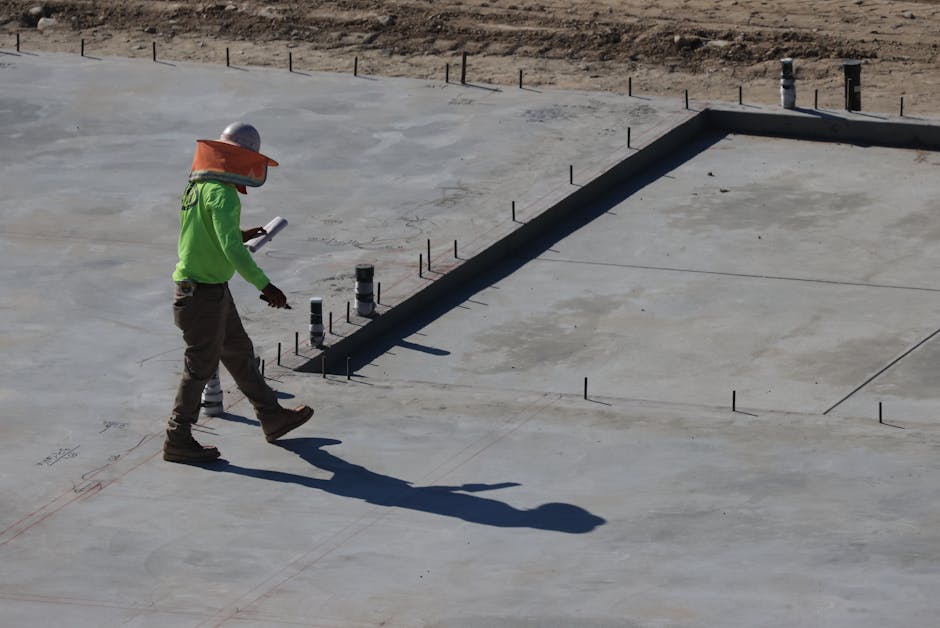
Basements live in a high-stakes environment. Because they are below grade, they are constantly subjected to hydrostatic pressure—the force exerted by groundwater against your concrete floor and walls.
In regions like East Tennessee, clay-heavy soils retain water for long periods. During seasonal rain or freeze-thaw cycles, this water expands and exerts massive upward pressure. This “negative-side” moisture pressure pushes upward through the microscopic capillaries of your concrete slab, carrying alkaline salts with it. If your floor coating cannot handle this vapor transmission, it will blister, bubble, and peel away.
To learn more about how we keep water from ruining your slab, check out our guide on Sealing Your Basement Floor.
Moisture, vapor pressure, and hydrostatic issues beneath basement slabs
Before applying any coating, we must understand the difference between minor vapor transmission and active hydrostatic pressure.
Moisture Vapor Emission Rate (MVER) measures how many pounds of water vapor are released from 1,000 square feet of concrete over a 24-hour period. An MVER exceeding 3 lbs/1,000 sq ft/24 hours, or an in-slab Relative Humidity (RH) exceeding 75%, indicates that the floor requires a specialized moisture vapor barrier primer before the decorative system is applied.
Without this vapor-mitigating step, the natural vapor drive will build up pressure beneath the impermeable coating, leading to rapid delamination.
How professionals test before coating and why skipping it is a red flag
If a contractor walks into your basement and says, “Yep, looks dry enough to coat,” without pulling out testing equipment, show them the door.
Professional installers use standardized scientific testing to verify the health of your concrete:
- ASTM F2170 (In-situ Relative Humidity Testing): We drill small holes into the slab, insert digital probes, and measure the relative humidity deep within the concrete.
- ASTM F1869 (Calcium Chloride Testing): We place a small dish of anhydrous calcium chloride under a sealed plastic dome on the concrete for 72 hours to measure the weight of the moisture absorbed.
- Electronic Moisture Mapping: Handheld impedance meters allow us to map out the dampest zones of your basement floor instantly.
- Slab Temperature & Dew Point Tracking: We verify that the concrete temperature is at least 5°F above the dew point to prevent micro-condensation.
Skipping these tests is the number one cause of failed basement floor projects.
When coating is not the first step
An expert basement coating installer is honest enough to tell you when your floor is not ready for a coating.
If your basement has active water leaks, water seeping through wall-floor joints, bowing foundation walls, or a failing sump pump system, a floor coating will not solve your problems. Coatings are designed to manage moisture vapor transmission, but they cannot stop active, pressurized water intrusion.
If we detect severe hydrostatic issues or structural foundation movement, we will refer you to a reputable local foundation repair or drainage specialist to correct the exterior grading or install interior drain tiles before we apply our high-performance floor systems.
The Expert Installation Process: Prep, Repair, Coat, Cure
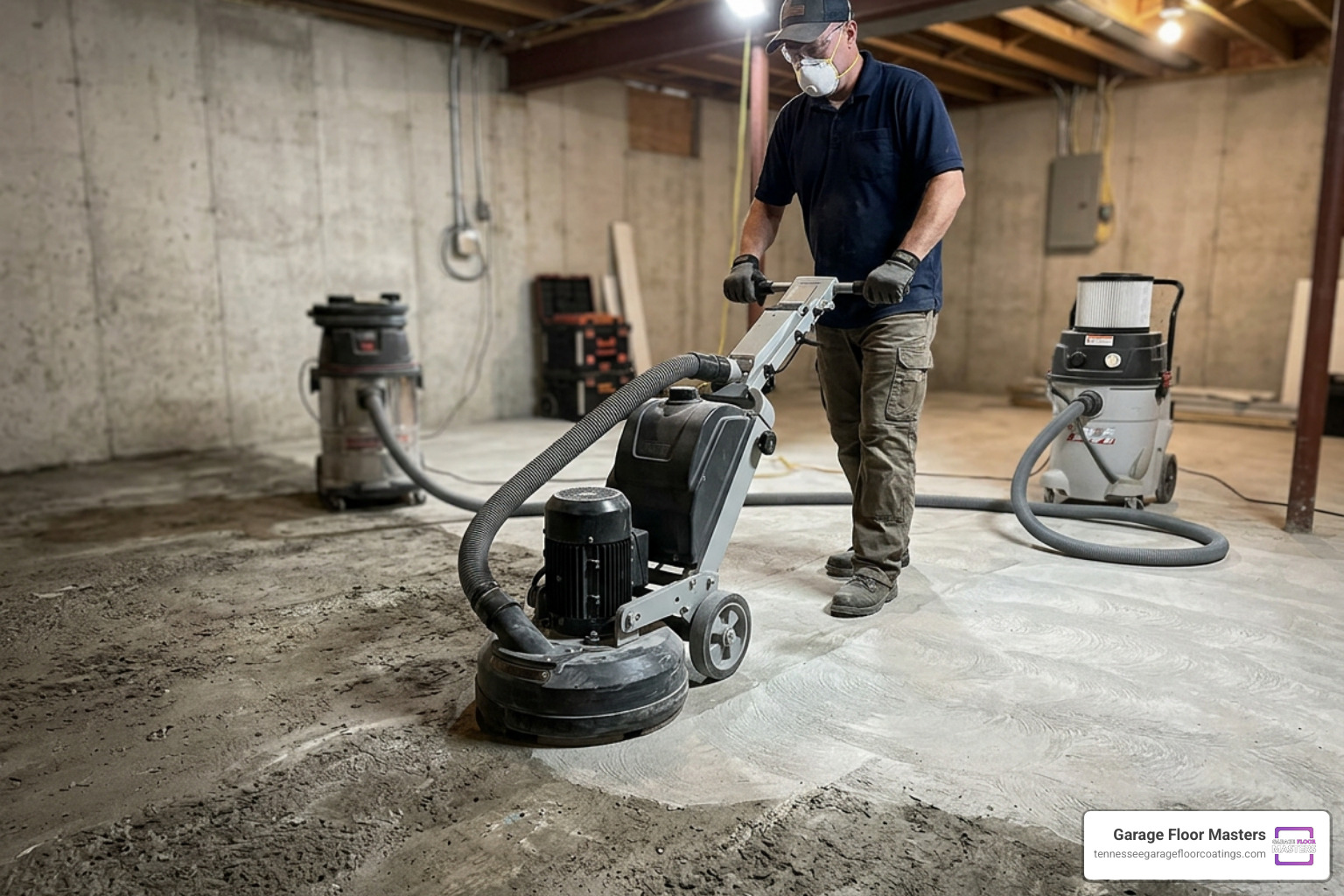
Applying a basement coating is a highly coordinated chemical and mechanical process. Industry data shows that 80% of basement floor coating success depends entirely on surface preparation.
If you want to avoid a peeling, flaking disaster, read The Professional Guide to Not Messing Up Your Basement Floor.
Surface preparation that beats power washing every time
Many low-cost contractors try to save time by power washing or acid etching the concrete. This is a massive mistake. Power washing introduces hundreds of gallons of water into a below-grade slab that already struggles to dry, while acid etching often fails to achieve the profile needed for industrial coatings.
Instead, we use heavy-duty walk-behind diamond grinders connected to industrial HEPA dust-collection systems. This mechanical grinding:
- Removes the weak, powdery top layer of concrete (known as laitance).
- Opens the tightly bound pores of the concrete.
- Achieves an ICRI Concrete Surface Profile of 2 to 4, which feels like medium-grit sandpaper.
- Strips away old paints, sealers, oil stains, and contaminants, creating a pristine substrate for maximum chemical adhesion.
Crack, joint, and slab repair before the first coat
Every concrete slab cracks eventually. Before we mix our basecoat, we must stabilize these imperfections:
- Crack Chasing: We use hand grinders with V-segment diamond blades to route out the cracks, removing loose debris and widening the channel so repair materials can penetrate deep.
- Polyurea Fillers: We inject rapid-cure, high-strength industrial polyurea fillers into the cracks and control joints. These materials cure harder than the concrete itself but retain slight flexibility.
- Slab Leveling & Spall Repair: If the slab has divots, spalling (surface flaking), or minor settlement, we patch these areas with polymer-modified concrete repair compounds to restore a flat, seamless surface.
Coating systems experts recommend for basements
While traditional epoxy has been the go-to for decades, modern coating science has introduced superior options. For most residential basements, we recommend a multi-layer hybrid system:
- Moisture-Vapor Barrier Primer (If Needed): If moisture testing shows high vapor levels, we apply a specialized epoxy primer designed to withstand negative hydrostatic pressure.
- Pure Polyurea Basecoat: Polyurea penetrates deep into the opened pores of the concrete, forming a chemical bond that is up to 4x stronger than traditional epoxy. It remains highly flexible, meaning it can stretch and flex with natural slab movement without cracking.
- Full Decorative Flake Broadcast: We broadcast your choice of decorative vinyl color flakes into the wet basecoat until the floor is completely saturated. This adds beautiful granite-like texture, hides minor concrete imperfections, and provides built-in slip resistance.
- Polyaspartic Topcoat: We seal the flakes with a high-performance polyaspartic clear coat. Polyaspartic is 100% UV-stable (meaning it will never yellow or fade), highly chemical-resistant, and incredibly easy to clean.
At Garage Floor Masters, we offer our high-performance polyaspartic and epoxy basement systems in over 140+ stunning colors to match any home design.
Cure control and return-to-service timing
One of the greatest benefits of modern polyurea/polyaspartic systems is their rapid cure time. Unlike traditional epoxies that can take 3 to 5 days to cure, our advanced systems allow for incredibly fast turnaround times:
- Walk-on Time: You can typically walk on your new basement floor in as little as 4 to 8 hours after the final topcoat is applied.
- Furniture Return: You can safely move your heavy storage, gym equipment, or furniture back into the space within 24 to 48 hours.
To keep your new floor looking flawless for decades, make sure to follow our official Floor Care Instructions.
How to Compare Quotes, Warranties, and Red Flags Like a Pro
When evaluating quotes from different basement coating installers in East Tennessee, it is easy to get distracted by the bottom-line number. However, a cheaper quote usually means the contractor is cutting corners on surface preparation, using inferior materials, or offering a warranty that isn’t worth the paper it’s printed on.
Warranty terms that actually matter
A reputable basement coating company should back their work with a strong, written guarantee. When reviewing a warranty, look closely at the fine print:
- Peeling and Delamination Coverage: Does the warranty cover adhesion failure? This is the most common issue with basement coatings.
- Moisture Exclusions: Many standard warranties are completely voided if the floor fails due to moisture vapor pressure. A true expert who performs proper moisture mitigation should stand behind their system, even in below-grade environments.
- Transferability: If you sell your home, does the warranty transfer to the next owner? A transferable warranty is a fantastic selling point that adds real value to your property.
- Workmanship vs. Product Warranty: Ensure the warranty covers both the quality of the installation (workmanship) and the performance of the chemical products.
To see what a comprehensive guarantee looks like, review the Garage Floor Masters Warranty.
Red flags when evaluating basement coating contractors
Protect your home and your wallet by watching out for these common industry warning signs:
- No Moisture Testing: If they don’t test your slab’s moisture levels before quoting, they are guessing with your money.
- Power-Wash-Only Prep: Any contractor who claims power washing or acid etching is “good enough” for a professional basement coating is cutting critical corners.
- Vague Product Names: Beware of contractors who use generic “epoxy paint” or refuse to provide technical data sheets for their products.
- High-Pressure Sales Tactics: Avoid companies that pressure you to sign a contract on the spot or offer massive, unrealistic discounts if you “buy today.”
- One-Price-Fits-All Quotes: Every concrete slab is different. A flat-rate quote given without a physical inspection of your floor’s condition and crack density is a major red flag.
Value beyond appearance: home value, cleaner storage, and usability
A professionally installed basement floor coating is an investment that pays dividends far beyond aesthetics.
First, it eliminates concrete dusting. Bare concrete constantly sheds fine silicate dust, which settles on your stored belongings and gets pulled into your HVAC system, degrading your indoor air quality. Our non-porous, seamless coatings lock down this dust permanently.
Second, it creates a highly hygienic, antimicrobial surface. Unlike carpet or laminate, which trap moisture, mold spores, and musty odors in damp basement environments, a polyaspartic floor is completely seamless and easy to sanitize. This makes your basement a much healthier environment for kids, pets, and anyone with seasonal allergies.
Finally, it transforms dark, dingy storage areas into bright, usable square footage—perfect for a home gym, workshop, kids’ play area, or media room—instantly boosting your home’s resale value and appeal.
Frequently Asked Questions About Expert Basement Coating Installers
Do expert basement coating installers always use the same coating system?
No. A true expert matches the coating system to the specific condition of your slab and your lifestyle goals. While we highly recommend our 4x stronger polyurea/polyaspartic systems for most basements, we may utilize specialized moisture-barrier epoxy primers if your slab exhibits high vapor transmission rates. Your system’s design is fully customized based on our scientific pre-tests.
How long should a professional basement coating installation take?
When slab conditions are ideal, our high-performance polyaspartic systems can be installed in as little as one day. However, if your concrete requires intensive crack repairs, extensive leveling, or a multi-stage moisture vapor barrier primer, the project may take two days to ensure chemical integrity and proper curing.
What should I do before scheduling an estimate?
Before our specialist arrives, it helps to:
- Note any history of dampness, musty smells, or past water leaks.
- Locate your sump pump and check if it is functioning properly.
- Clear a small path so we can easily inspect the concrete slab and the wall-floor joints.
- Think about how you plan to use the space (e.g., storage, home gym, living room) so we can recommend the perfect texture and color blend.
Ready to get started? You can request a free, no-obligation on-site evaluation by visiting Get a Quote.
Conclusion: Choose Skill Over Speed When Your Basement Floor Is on the Line
Your basement floor is a critical structural element of your home. Cutting corners with cheap DIY paints or hiring an uncertified contractor who skips moisture testing and proper diamond grinding will only lead to peeling, bubbling, and costly repairs down the road.
At Garage Floor Masters, we bring years of specialized concrete science, advanced mechanical preparation, and industry-leading polyurea/polyaspartic formulas to every project. We proudly serve homeowners across East Tennessee, including:
- Knoxville, TN
- Oak Ridge, TN
- Maryville, TN
- Sevierville, TN
- Lenoir City, TN
- Farragut, TN
- …and many more! To see if we service your neighborhood, check out our full list of Service Areas.
Let’s turn your damp, dusty basement floor into a beautiful, waterproof, and durable space built to handle everyday life.
Contact us today, or schedule your basement floor coating consultation to experience the peace of mind that comes with hiring true concrete flooring experts!