
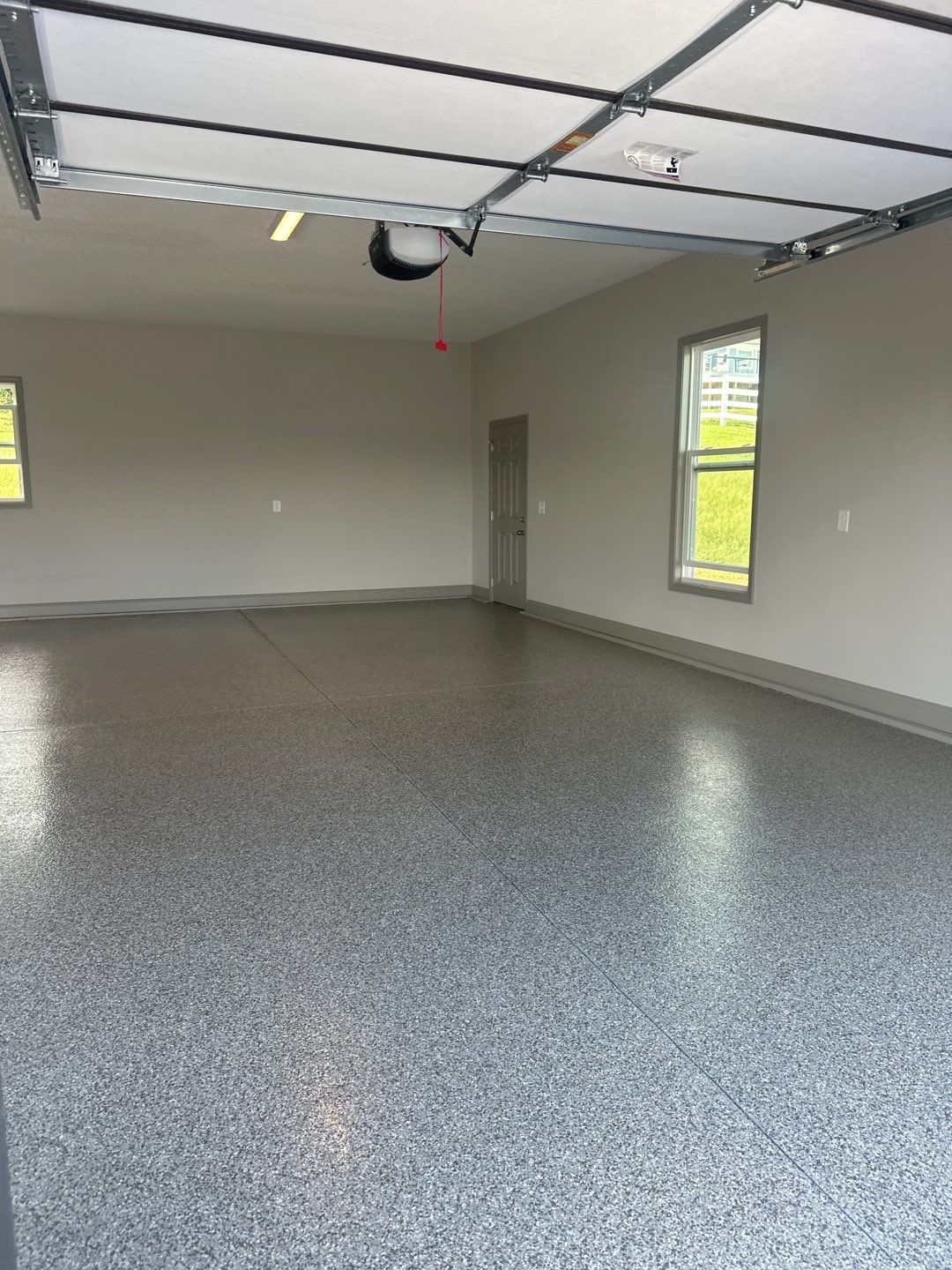
Why a Polyaspartic Top Coat Makes or Breaks Your Garage Floor
A polyaspartic top coat is the final protective layer applied over a flake or epoxy floor system — and it’s the layer that determines how long your floor looks great and holds up to daily abuse.
Here’s a quick summary of what you need to know:
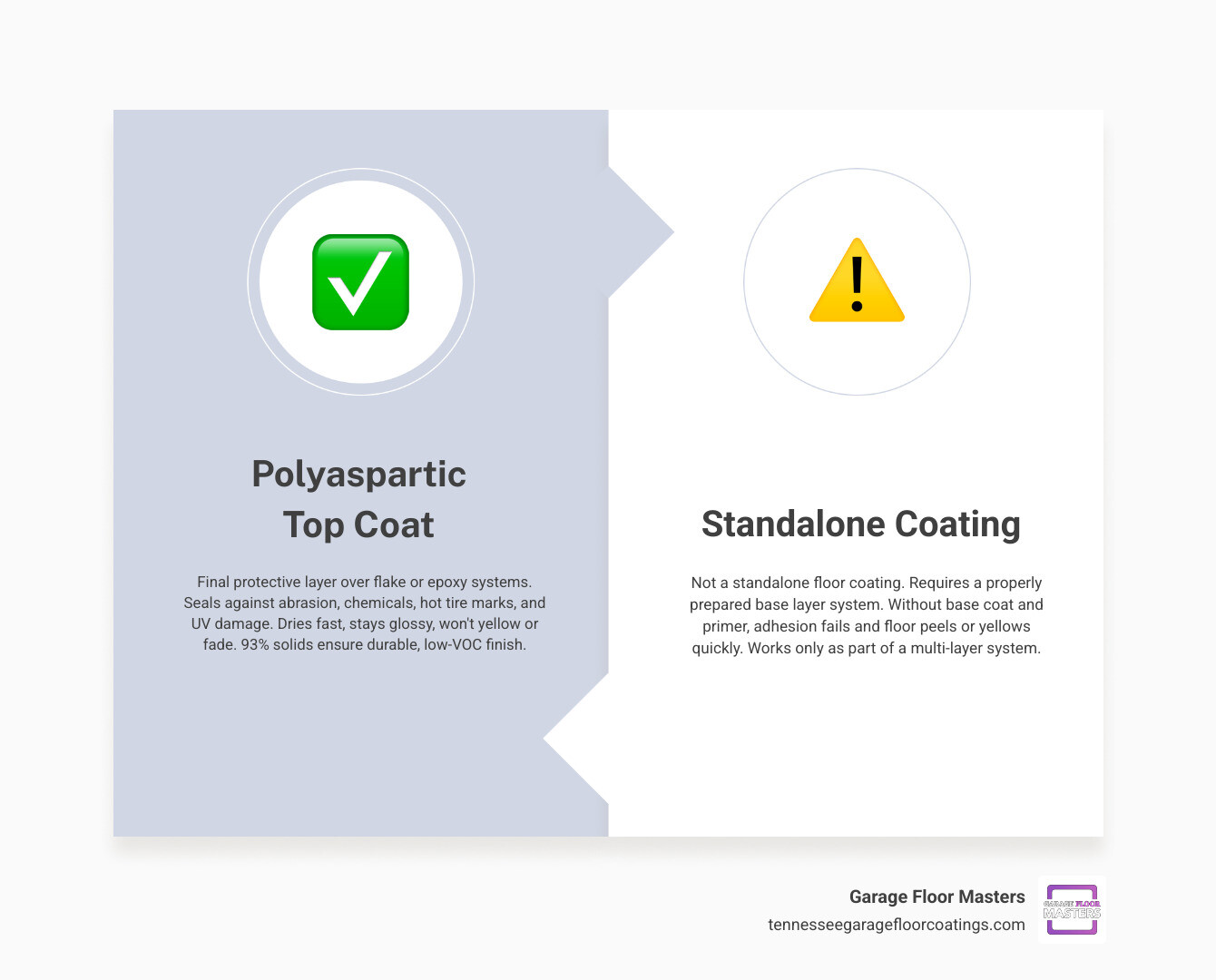
- What it does: Seals and protects the layers beneath from abrasion, chemicals, hot tire marks, and UV damage
- Where it’s used: Garage floors, shop floors, and warehouse floors with a full broadcast flake system underneath
- Key advantage: Dries fast, stays glossy, and won’t yellow or fade over time
- Solids content: High-performance formulas reach 93% solids — meaning more protective material stays on the floor, not in the air
- What it’s not: A standalone floor coating — it works as a system over a properly prepared base
If your garage floor is stained, cracking, or just plain embarrassing, the coating system you choose matters a lot. And the top coat is the part that faces the world every single day — your car tires, spilled oil, the Tennessee summer sun beating through the door.
Get it right, and your floor stays clean, tough, and sharp-looking for years. Get it wrong, and you’re back to peeling, yellowing, or chalky concrete within a season or two.
I’m Lev Golosov, and in this guide I’ll walk you through everything about polyaspartic coating layers — from what’s actually in the formula to how each layer works together to protect your floor.
Quick look at polyaspartic top coat:
- fast drying polyaspartic floors
- polyaspartic concrete floor coatings
- polyaspartic garage floor sealer
What is a Polyaspartic Top Coat?
To truly understand what a polyaspartic top coat is, we have to look past the marketing buzzwords and dive into the actual chemistry.
At its core, polyaspartic is an aliphatic polyurea. If that sounds like high school chemistry class, don’t panic! In simple terms, while traditional polyurea is incredibly strong but highly sensitive to sunlight (it yellows faster than cheap plastic in the sun), an aliphatic polyurea is chemically engineered to resist ultraviolet light. This means a polyaspartic coating will not yellow, fade, or chalk, even when subjected to intense sunlight through open garage doors or large shop windows.
When we talk about high-performance polyaspartic systems, we often look at the “solids content.” For example, standard DIY garage floor kits from big-box stores are often water-based or solvent-based with low solids content (sometimes as low as 30% to 50%). This means that as the coating dries, half of the liquid evaporates into the air as volatile organic compounds (VOCs), leaving a paper-thin layer on your floor.
A professional-grade polyaspartic top coat, such as Polyaspartic 930, features a 93% solids content formulation. When you apply a 93% solids coating, almost everything you roll onto the floor stays on the floor, curing into a thick, ultra-durable, and glass-like protective shield. This high-solids makeup ensures unmatched thickness, structural strength, and low VOC emissions during the installation process.
To understand how these formulations compare to other concrete sealers on the market, check out The Complete Guide to Polyaspartic Concrete Sealer and Coatings.
Understanding the Polyaspartic 930 Formulation
The magic behind a premium top coat like Polyaspartic 930 lies in modern nanotechnology. By manipulating the polymer structures at a molecular level, chemical engineers have built a coating that achieves a tight cross-linking density. This nanotechnology-driven design gives the cured film an “unmatched hardness” while maintaining enough long-term flexibility to move with the concrete substrate during natural temperature swings.
Polyaspartic 930 is a two-component system, meaning it consists of a Part A (resin) and a Part B (catalyst/hardener). Once mixed, a chemical reaction begins immediately. Unlike water-based products that rely on evaporation to dry, this chemical cure occurs rapidly, creating a high-build, high-gloss protective wear layer. Because of its 93% solids formulation, it emits very few VOCs, making it safer for indoor applications in residential garages and commercial facilities alike. You can explore more about these high-performance options on our Polyaspartic Floor Coatings page.
Key Benefits of a Polyaspartic Top Coat
Why are homeowners and business owners across East Tennessee upgrading from old-school epoxy to polyaspartic? It boils down to four major performance advantages:
- Extreme Abrasion Resistance: Whether it is heavy foot traffic, dragging toolboxes, or rolling floor jacks, a polyaspartic top coat resists scratches and physical wear far better than standard epoxy.
- Superior Chemical Resistance: From harsh automotive fluids like brake fluid, motor oil, and gasoline to household bleach and road salts, nothing penetrates this non-porous barrier.
- Hot Tire Rejection: Cheaper coatings suffer from “hot tire pickup,” where hot tires from a drive on the highway bond to the coating and peel it right off the concrete. Polyaspartic completely rejects hot tire marks.
- UV Stability and High Gloss: It delivers a brilliant, light-reflecting high-gloss finish that makes any garage look like a professional showroom. Best of all, it stays clear and glossy forever without yellowing.
For a deeper dive into how these coatings stand up to the elements, read about UV Resistant Polyaspartic Coatings for a Sunproof Garage.
Suitable Surfaces and Floor Systems
A high-solids polyaspartic top coat is highly specialized. It is not a cure-all paint that you can slap onto any surface. To get the legendary durability it promises, it must be paired with the right concrete substrates and floor systems.
The absolute gold standard for a polyaspartic top coat is a full broadcast flake floor system. In this setup, we prepare the concrete, apply a high-strength epoxy base coat (such as Epoxy Max 100), throw down a dense layer of decorative vinyl flakes until the floor is completely covered, scrape off the excess, and then seal everything in with the polyaspartic top coat. The top coat flows over and between the flakes, locking them into a monolithic, slip-resistant, and incredibly tough surface.
Whether you have a residential garage in Maryville, a busy auto shop in Oak Ridge, or a massive warehouse floor in Knoxville, this system thrives in high-traffic environments. You can learn more about local installations by visiting Polyaspartic Floor Coatings Knoxville Tennessee.
Where to Apply a Polyaspartic Top Coat
A polyaspartic top coat is highly versatile when applied to the correct systems:
- Residential Garages: Protects against hot tires, oil drips, and lawnmower traffic.
- Commercial Shop Floors & Warehouses: Withstands heavy forklift traffic, chemical spills, and constant cleaning.
- Showrooms and Retail Spaces: Enhances lighting with its high-gloss, reflective properties while handling heavy foot traffic.
- Unique Concrete Applications: Beyond floors, specialized polyaspartic sealers are even used to protect high-end concrete surfaces inside the home. To see how this chemistry applies to other areas, check out The Secret to Durable Concrete Countertops Is Polyaspartic.
Unsuitable Applications to Avoid
As incredible as Polyaspartic 930 is, there are places it simply does not belong.
First, it is not suitable for solid color floor systems or metallic color floor systems. Because of its unique chemistry and rapid curing properties, applying it directly as a clear coat over a solid color or metallic epoxy can cause visual imperfections, adhesion issues, or uneven gloss. It is engineered specifically to be used as a topcoat over a full broadcast flake floor system, where the texture of the flakes helps hide minor variations and ensures a perfect mechanical bond.
Second, avoid applying it to vertical surfaces without specialized thickening agents, as its self-leveling nature will cause it to sag and run. Finally, never apply a polyaspartic top coat to concrete with severe moisture-mitigation issues. If moisture vapor is constantly pushing up through your concrete slab from the ground below, it can build up enough pressure to delaminate any topical coating. A professional moisture test should always be performed first.
Technical Specifications and Performance Comparison
When choosing a floor coating, it helps to see how the different chemical families stack up against one another. Let’s look at how polyaspartic compares to traditional epoxy and polyurethane topcoats:
| Performance Metric | Polyaspartic Top Coat (e.g., Polyaspartic 930) | Traditional Epoxy Topcoat | Polyurethane Topcoat |
|---|---|---|---|
| Solids Content | High (93%) | Medium to High (50% – 100%) | Low to Medium (40% – 60%) |
| Cure Time (Walk-on) | 4 to 8 hours | 24 to 48 hours | 12 to 24 hours |
| Cure Time (Drive-on) | 24 hours | 5 to 7 days | 3 to 5 days |
| UV Resistance | Excellent (Aliphatic – Won’t Yellow) | Poor (Chalks & Yellows in Sun) | Good to Excellent |
| Flexibility | High (Resists Impact & Thermal Shock) | Low (Brittle, Can Crack) | High |
| Application Temp | Wide Range (-20°F to 120°F) | Narrow Range (50°F to 90°F) | Moderate Range (50°F to 90°F) |
To get a deeper understanding of the chemical differences between these coatings, check out our comparison guide on Polyurea vs Polyaspartic Coat.
Drying and Cure Times
If you have ever had your garage floor coated with epoxy, you know the waiting game is agonizing. You have to park your cars in the driveway or on the street for a week while the epoxy slowly cures.
With a polyaspartic top coat, the cure time is ultra-fast. The pot life (the time you have to work with the mixed product before it hardens in the bucket) is typically short—around 20 to 30 minutes. Once applied to the floor, it dries incredibly fast.
Under normal conditions, you can walk on a polyaspartic floor in just 4 to 8 hours, and you can drive your vehicles back onto it in 24 hours. This rapid turnaround time makes it ideal for businesses that cannot afford multi-day shutdowns, and for homeowners who want their garage back immediately. To learn more about this rapid-cure technology, read Blink and Its Dry With Fast Drying Polyaspartic Floors.
Chemical and Physical Resistance Properties
The physical properties of Polyaspartic 930 are highly impressive. It offers high tensile strength and impact resistance, meaning if you drop a heavy wrench or hammer, the coating is flexible enough to absorb the impact without cracking or chipping.
Additionally, it handles thermal shock beautifully. In places like Crossville or Sevierville, TN, where winters get cold and summers get hot, concrete expands and contracts. A brittle coating will crack under this stress, but polyaspartic’s inherent flexibility allows it to move with the concrete. It also boasts exceptional solvent resistance, protecting your floor from battery acid, gasoline, and harsh industrial cleaners. For a look at why this material has earned its crown in East Tennessee, read Why Polyaspartic Is the Knoxville King of Concrete Coatings.
Application Process and Surface Preparation
Even the most advanced, nanotechnology-infused polyaspartic top coat will fail if the concrete beneath it isn’t prepared correctly. In floor coatings, preparation is 90% of the job.

Before any coating touches the concrete, the surface must be mechanically prepared to open up the pores of the concrete. This is typically done using heavy walk-behind diamond grinders. The goal is to achieve a Concrete Surface Profile (CSP) of 2, which feels similar to medium-grit sandpaper. This profile gives the base coat a rough texture to grab onto, ensuring a permanent mechanical bond.
While some DIY kits suggest acid etching (using muriatic acid), we strongly advise against it. Acid etching often fails to open the pores evenly, leaves behind moisture that can ruin the coating, and doesn’t profile hard-troweled concrete effectively. Mechanical grinding is the only way to guarantee success. To understand why professional prep beats DIY shortcuts, check out Stop Waiting for Epoxy and Buy a Polyaspartic Garage Floor Sealer.
Step-by-Step Application Guide
Once the concrete is ground, vacuumed, repaired, and the base coat and full flake broadcast are complete, it’s time for the top coat. Here is how a professional polyaspartic top coat is applied:
- Sanding the Flakes: Before applying the top coat, we scrape the fully broadcast flake floor with a flat blade to knock down any sharp, vertical edges of the vinyl flakes. We then vacuum up the loose debris to ensure a smooth, uniform texture.
- Mixing the Components: Polyaspartic 930 is a two-component kit. We carefully measure and mix Part A and Part B using a low-speed drill mixer for exactly the time specified by the manufacturer. Mixing too fast can introduce air bubbles into the coating.
- Squeegee and Backroll: We pour the mixed polyaspartic onto the flake floor in ribbons. We then use a flat squeegee to spread the product evenly across the floor.
- Roll Out: Immediately behind the squeegee, a second installer uses a solvent-rated roller (typically a 3/8-inch nap, lint-free roller) to backroll the coating in a perpendicular direction. This eliminates squeegee lines and ensures a perfectly level, high-gloss finish.
- Monitoring Environment: We constantly monitor the ambient temperature and humidity levels. High humidity accelerates the curing of polyaspartic, which shortens the working time even further.
Maintenance and Long-Term Care
Once cured, maintaining your polyaspartic floor is incredibly easy. Because the top coat creates a completely non-porous, seamless surface, dirt and dust have nowhere to hide.
For routine cleaning, simply sweep or dust-mop the floor to remove loose dirt. For a deeper clean, mop the floor with warm water and a mild, non-filming detergent (like Simple Green or a few drops of dish soap). Avoid using harsh acids, citrus-based cleaners, or highly abrasive scrubbing pads, as these can dull the high-gloss finish over time.
Because of its extreme durability, a professionally installed polyaspartic floor can easily last decades in a residential setting without needing to be resealed. To learn more about the lifetime value and maintenance of these systems, read The Real Cost of Polyaspartic Garage Floors.
Frequently Asked Questions About Polyaspartic Coatings
Can you apply polyaspartic directly to concrete?
While you can apply certain polyaspartic sealers directly to bare concrete, it is generally not recommended for high-performance garage or commercial floors. Bare concrete is highly porous and can vary in moisture content.
For the ultimate bond, we prefer to use a high-penetration epoxy primer or base coat first (like Epoxy Max 100). Epoxy cures slightly slower, allowing it to sink deep into the concrete’s pores and lock onto the concrete fibers. We then apply the flake layer, followed by the polyaspartic top coat to seal it all in. This multi-layer system gives you the deep adhesion of epoxy and the extreme wear resistance of polyaspartic.
How long does a polyaspartic floor last?
When professionally installed over properly prepared concrete, a polyaspartic flake floor can easily last 15 to 20+ years in a residential garage. In demanding commercial and industrial environments with heavy forklift traffic and chemical exposure, you can expect 10 to 15 years of high-performance service before needing a fresh top coat.
Is polyaspartic better than epoxy?
Yes, in almost every category that matters for a top coat. Polyaspartic is up to 4 times stronger than standard epoxy, highly flexible (so it won’t crack or chip under impact), 100% UV stable (so it won’t yellow), and cures in a fraction of the time. While epoxy makes an excellent base coat due to its concrete-bonding capabilities, polyaspartic is the undisputed king of top coats.
Conclusion
When it comes to protecting your concrete, you shouldn’t settle for temporary fixes or cheap DIY paints that peel up after a single summer. A high-solids polyaspartic top coat is the ultimate way to lock in beauty, strength, and chemical resistance for your floors.
At Garage Floor Masters, we provide professional, industrial-grade garage floor coatings throughout East Tennessee, including Knoxville, Maryville, Oak Ridge, Sevierville, Lenoir City, Clinton, and the surrounding areas. Our UV-stable coatings are four times stronger than standard epoxy, can be installed in as little as one day, and are available in over 140 beautiful colors.
Because every concrete slab is unique, the exact cost of your project depends on the size of your space, the current condition of your concrete, and the specific design features you choose. That is why we make it completely risk-free by offering a free, on-site estimate where we can measure your floor, test for moisture, and give you an exact price.
Ready to transform your garage into a clean, durable, light-reflecting space? Visit our Polyaspartic Floor Coatings page to schedule your free consultation today!