
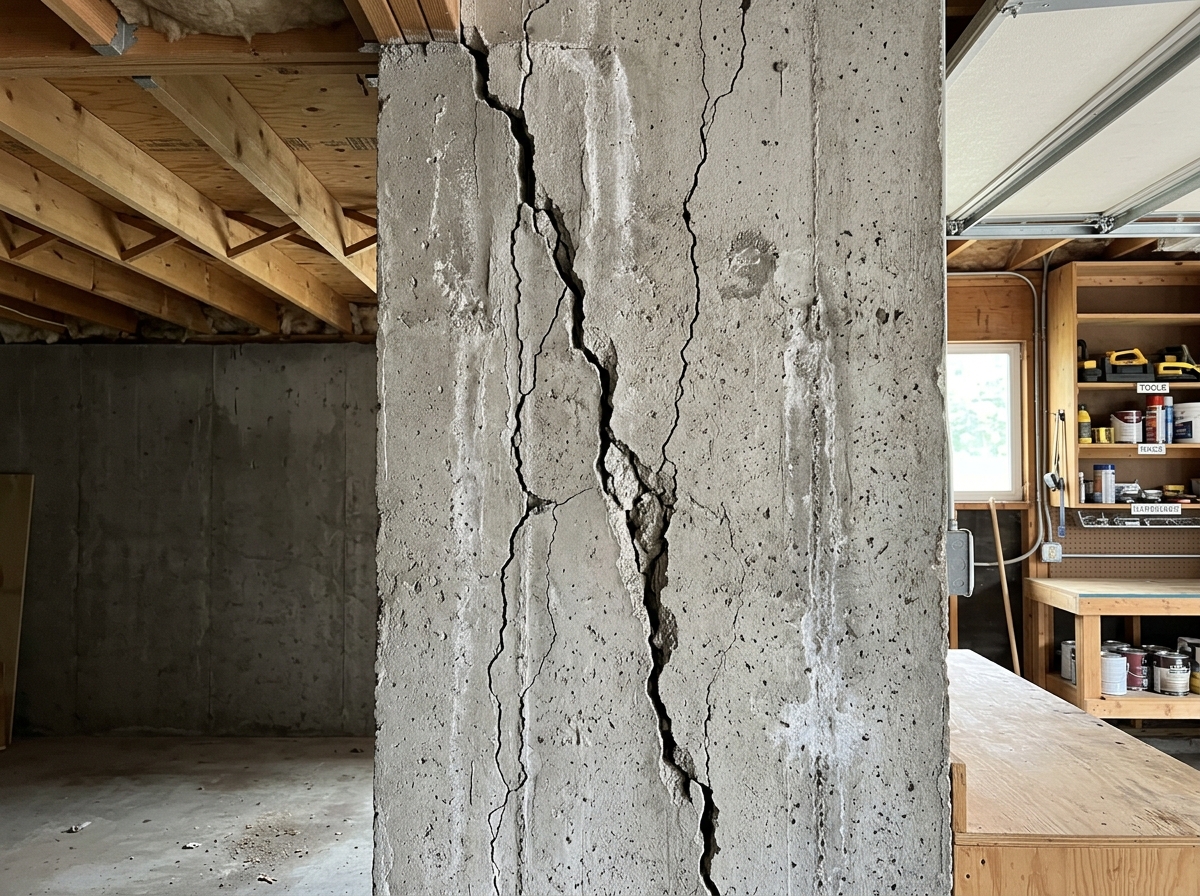
Why Garage Foundation Cracks Matter
Many homeowners worry when they spot foundation cracks in garage floors or walls. It’s common to see cracks in concrete. But knowing which ones are just cosmetic and which point to bigger problems is key. Ignoring serious cracks can lead to bigger issues down the road for your home’s structure and value.
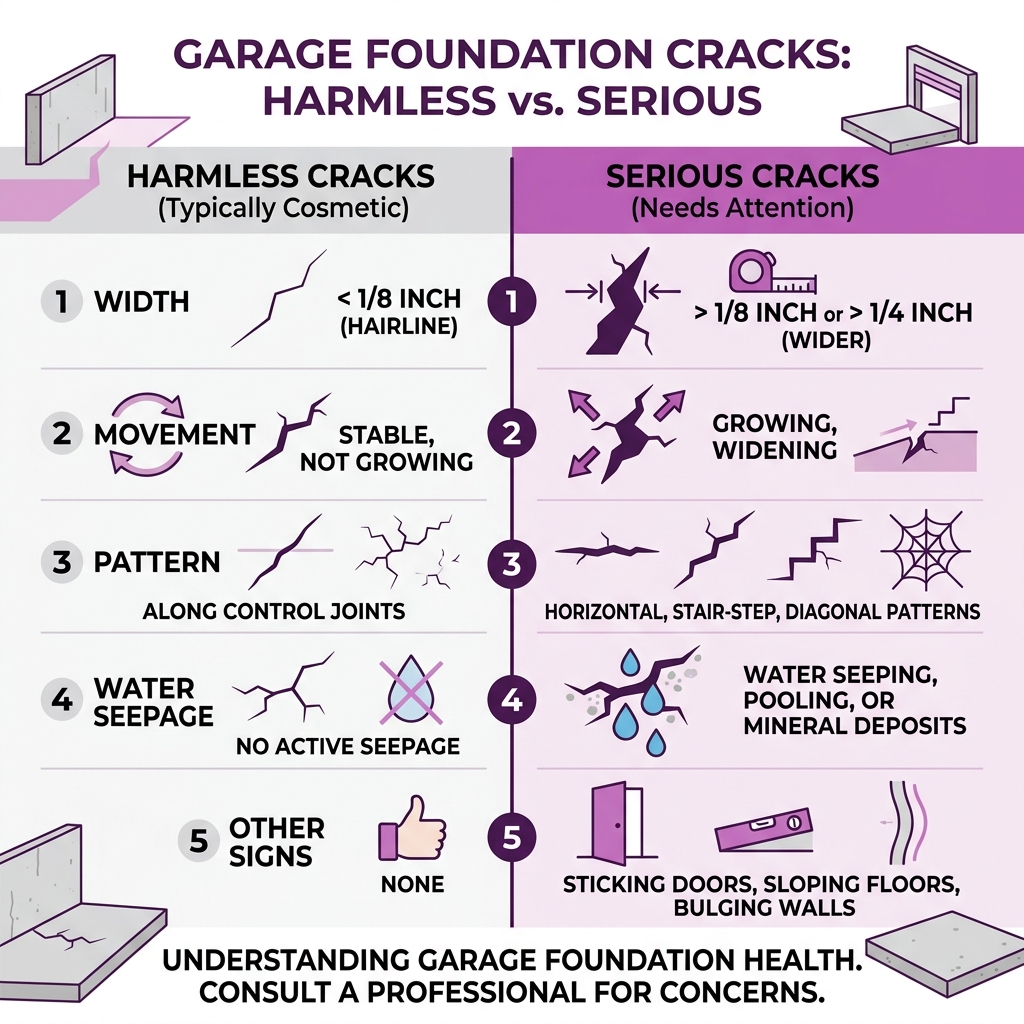
Here’s how to quickly tell if a garage crack is harmless or needs attention:
| Crack Characteristic | Harmless (Typically Cosmetic) | Serious (Needs Attention) |
|---|---|---|
| Width | Less than 1/8 inch | Wider than 1/8 inch or 1/4 inch |
| Movement | Stable, not growing | Growing, widening, or one side raised |
| Pattern | Hairline, random, or along control joints | Horizontal, stair-step, spider-web, or diagonal |
| Water | No active water seepage | Water seeping, pooling, or mineral deposits |
| Other Signs | None | Sticking doors, sloping floors, bulging walls |
This guide will help you understand garage cracks. We’ll show you what causes them. We’ll also explain how to tell a small issue from a major one. And we’ll talk about what you can do to fix or prevent them.
Identifying Types of Foundation Cracks
When we walk into a garage in Knoxville or Maryville, the first thing we look at isn’t just the crack itself, but the “personality” of that crack. Not all foundation cracks in garage settings are created equal. Some are simply the result of concrete doing what concrete does—shrinking as it dries—while others are a “silent alarm” for structural distress.
Understanding the difference starts with knowing how your garage was built. Most homes in East Tennessee feature one of two types of floors:
- Floating Slabs: These are concrete floors poured independently of the foundation walls. They “float” on the soil, which means a crack in the floor might not mean your house is falling down—it just means the slab moved.
- Monolithic Slabs: In this design, the floor and the foundation perimeter are poured as one single piece of concrete. Here, a crack in the floor is often directly tied to the structural health of the entire foundation.
Identifying Garage Floor Cracking early can save you thousands in future repairs.

Identifying Foundation Cracks in Garage by Direction
The direction of a crack is like a roadmap that tells us exactly what kind of pressure the concrete is under.
- Vertical Cracks: These are very common in newer homes. As concrete cures, it loses moisture and shrinks. If the crack is straight and thin (hairline), it’s likely just shrinkage. However, if a vertical crack is wider than 1/8 inch near a corner, it might indicate that the foundation is settling unevenly.
- Horizontal Cracks: These are the ones that make us sit up and take notice. Horizontal cracks in a foundation wall are usually caused by hydrostatic pressure. This happens when the clay-heavy soil around your garage becomes saturated with water, expands, and pushes inward against the wall. This can lead to bowing walls and eventually structural failure.
- Stair-Step Cracks: If your garage is built with concrete blocks (CMUs), you might see cracks that follow the mortar lines in a zig-zag pattern. This is a classic sign of differential settlement, meaning one corner of your garage is sinking faster than the rest.
- Diagonal Cracks: These typically occur when the foundation is shifting at an angle. If you see a diagonal crack that is wider at the top than the bottom, it’s a sign that the soil underneath is moving or “heaving.”
Surface Crazing vs. Structural Gaps
Sometimes, a garage floor looks like a dried-up lakebed with hundreds of tiny, shallow cracks. This is called crazing. It often creates a “honeycomb” or “map cracking” pattern on the surface.
Crazing is almost always cosmetic. It happens during the curing process, often because the top layer of concrete dried too quickly or was overworked with a trowel. While these aren’t structural threats, they do create tiny hiding spots for dirt and moisture. During Our Process, we carefully prep these surfaces to ensure our coatings bond deep into the concrete, sealing those tiny imperfections forever.
Common Causes of Foundation Cracks in Garage
In East Tennessee, we have a unique mix of weather and geology that keeps our foundations on their toes. From the humid summers in Sevierville to the freezing winters in Clinton, your garage concrete is constantly expanding and contracting.
Here are the most common culprits behind those cracks:
- Soil Settlement and Clay Soil: Much of the soil in the Tennessee Valley is rich in clay. Clay is “expansive,” meaning it acts like a sponge. It swells when wet and shrinks during dry spells. This constant “push and pull” can cause the soil to pull away from your foundation, leaving voids that lead to settlement.
- Poor Drainage: This is arguably the #1 cause of foundation trouble. If your gutters are clogged or your downspouts dump water right at the base of your garage, that water erodes the subgrade. We recommend extending downspouts at least 10 feet away from the structure.
- Freeze-Thaw Cycles: Water is powerful. When it gets into a tiny crack and freezes, it expands by about 9%. This acts like a slow-motion jackhammer, widening the crack every winter.
- Heavy Loads: Most residential garage floors are 4 inches thick. If you park a heavy dually truck or a piece of heavy machinery in the same spot every day, it can exceed the tension strength of the concrete, especially if the subgrade wasn’t properly compacted.
- Tree Roots: That beautiful oak tree 10 feet from your garage might be the enemy. Roots are incredibly strong and can exert thousands of pounds of pressure as they grow, literally lifting or cracking your foundation.
- Moisture Vapor: Concrete is porous. Moisture from the earth can travel upward through the slab (hydrostatic pressure). This vapor pressure can cause Epoxy Garage Floor Coatings from DIY kits to bubble and peel if the concrete wasn’t tested and prepped correctly.
Assessing Severity and Structural Risks
So, when should you actually worry? We tell our customers in Oak Ridge and Lenoir City to use the “Dime Test.” If you can fit a dime into a crack, it’s time to have it professionally looked at.
| Feature | Cosmetic (Don’t Panic) | Structural (Take Action) |
|---|---|---|
| Width | < 1/8 inch (thinner than a nickel) | > 1/4 inch (wider than a pencil) |
| Level | Both sides are even | One side is higher (trip hazard) |
| Location | Middle of the floor | Near corners or extending up walls |
| Growth | Stays the same for years | Widens after heavy rain or seasons |
Ignoring these signs can lead to differential settlement, where the building tilts or sinks unevenly. This doesn’t just look bad; it can significantly tank your property value. Most home inspectors will flag any crack wider than 1/4 inch, which can stall a home sale. Fortunately, our Garage Floor Masters Warranty gives you peace of mind that our surface repairs and coatings are built to last.
Monitoring Foundation Cracks in Garage Over Time
If you find a crack and aren’t sure if it’s “active,” you can monitor it yourself. Take a pencil and mark the very ends of the crack. Write the date next to the marks. Check back in three months. If the crack has grown past your marks, the foundation is still moving. You can also use “crack monitors” (small plastic gauges) for a more scientific approach. If you see rapid growth, it’s time to call a structural engineer.
Warning Signs of Foundation Failure
Sometimes the biggest signs of a foundation crack in garage aren’t even in the garage. Keep an eye out for these “red flags” around your home:
- Sticking Doors and Windows: If the door from your garage to your kitchen suddenly starts sticking or won’t latch, the frame may be out of square due to a shifting foundation.
- Sloping Floors: If you drop a marble on your garage floor and it consistently rolls toward one corner, you likely have a sinking slab.
- Bowing Walls: If you look down the length of your garage wall and see a “bulge” or curve, hydrostatic pressure is winning the battle against your masonry.
Our Garage Floor Installation Process involves a deep dive into the health of your concrete before we ever apply a drop of coating. We make sure the “canvas” is stable before we start the “painting.”
Professional Repair and Prevention Strategies
If you have structural issues, “patching” the crack with a hardware store filler is like putting a band-aid on a broken leg. You have to address the root cause.
Common Professional Solutions:
- Epoxy or Polyurethane Injection: For non-structural or minor structural cracks, pros inject high-strength resins that bond the concrete back together and seal out water.
- Slabjacking (Polyjacking): If your floor has sunk, professionals can inject high-density polyurethane foam under the slab to “lift” it back to its original height.
- Helical Piers: For serious foundation sinking, steel piers are screwed deep into the stable soil (or bedrock) to support the weight of the garage.
- Carbon Fiber Straps: These are used to reinforce bowing walls, providing incredible tensile strength to stop further movement.
Prevention is the Best Fix:
- Control Water: Clean your gutters twice a year. Ensure the ground slopes away from your foundation (at least 6 inches of drop over 10 feet).
- Maintain Soil Moisture: During our hot Tennessee summers, the clay can dry out and shrink. Using a soaker hose around the perimeter during droughts can keep the soil stable.
- Landscaping: Keep large trees and shrubs at least 10 to 15 feet away from the garage.
- Seal Your Floor: A professional polyaspartic coating doesn’t just look pretty; it creates a waterproof barrier that prevents freeze-thaw damage from starting in the first place.
Frequently Asked Questions about Garage Cracks
Are hairline cracks in garage floors normal?
Yes, absolutely. Almost every concrete floor will develop hairline cracks (less than 1/8 inch wide) due to the natural shrinkage that happens as concrete cures. If they aren’t growing and the floor is level, they are usually just a cosmetic nuisance.
When should I worry about a crack in my garage foundation?
You should seek a professional assessment if the crack is wider than 1/4 inch, if one side of the crack is higher than the other, or if the crack is horizontal. Also, watch for “active” signs like water seeping through or the crack lengthening over a few months.
Can I epoxy over a cracked garage floor?
You can, but you shouldn’t just “paint” over them. Any quality coating requires the cracks to be chased (opened up), cleaned, and filled with a rigid or semi-rigid filler first. If you use a DIY kit over a moving crack, the coating will simply “telegraph” the crack and peel. At Garage Floor Masters, we use specialized fillers that bond with the concrete before applying our 4x stronger polyaspartic topcoat.
Conclusion
At the end of the day, foundation cracks in garage floors are a common part of homeownership, especially here in East Tennessee. While many are harmless, staying vigilant about the “Bad Cracks” can save your home’s structural integrity.
At Garage Floor Masters, we specialize in transforming cracked, tired garage floors into durable, beautiful spaces. Serving Knoxville, TN, and surrounding areas like Maryville and Oak Ridge, we offer high-performance polyaspartic coatings that are 4x stronger than traditional epoxy. We can repair those unsightly surface cracks and provide a UV-stable, low-maintenance finish in just one day.
Our pricing is based on the specific condition of your concrete and the features you choose, which is why we always provide a transparent, free on-site estimate. Don’t let a small crack turn into a big headache.
Upgrade your garage with professional Garage Floor Coatings today and give your home the foundation protection it deserves!