
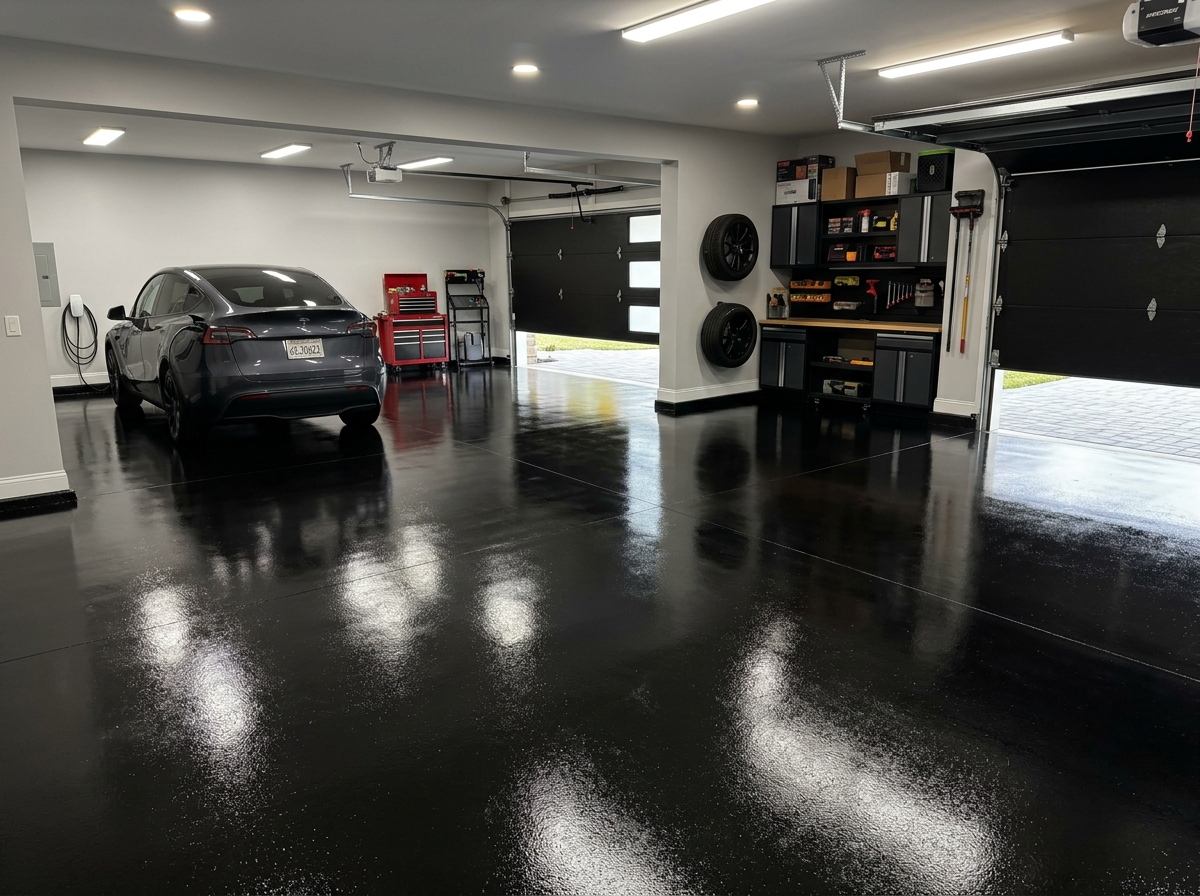
Why Black Floor Paint for Concrete Transforms Your Garage
Black floor paint for concrete is one of the most striking upgrades you can make to a garage, basement, or driveway.
Here’s a quick answer if you’re in a hurry:
Best options for painting concrete floors black:
| Coating Type | Best For | Durability | DIY Friendly? |
|---|---|---|---|
| 1-Part Epoxy (e.g., BEHR PREMIUM) | Basements, light garages | Good | Yes |
| 2-Part Epoxy (e.g., EPODEX 2K) | Garages, workshops | Very Good | Yes, with care |
| Polyaspartic Coating | High-traffic garages, commercial | Excellent | Best left to pros |
Key things to know before you start:
- Most coatings need at least two coats for full, opaque black coverage
- Surface prep (grinding, cleaning, moisture testing) is the most important step
- Polyaspartic coatings cure faster and resist UV fading better than standard epoxy
- Hot tire pickup is a real problem — not all black paints resist it equally
A cracked, oil-stained concrete floor doesn’t just look bad. It collects dirt, absorbs chemicals, and chips away year after year. Black is one of the most popular colors for concrete floor coatings because it hides imperfections, adds a sleek look, and makes a space feel intentional and finished.
But not all black concrete coatings are created equal. The wrong product — or the wrong prep — can mean peeling, fading, or hot tire damage within a season or two.
This guide walks you through everything: choosing the right product, preparing your surface correctly, and applying it for results that last.
Choosing the right black floor coating for concrete
When you decide to go “back in black,” the first hurdle is choosing the chemistry behind the color. Not all black floor paint for concrete is actually paint. In garage-floor-paint, we generally categorize products into three buckets: 1-part epoxies, 2-part epoxy systems, and high-performance polyaspartic coatings.
The Breakdown: Epoxy vs. Polyaspartic
For most homeowners in Knoxville or Maryville, the choice comes down to how much abuse the floor will take. 1-part epoxies (like BEHR PREMIUM) are essentially “super paints.” They are easy to apply and budget-friendly, often coming in “Space Black” or “Jet Black” with self-priming formulas. However, they sit on top of the concrete rather than bonding deep within the pores.
A 2-part epoxy system, such as EPODEX 2K, involves mixing a resin with a hardener. This creates a chemical reaction that results in a much harder, more “waterproof” surface. These are excellent for basements but can still struggle with UV yellowing if used near large windows or open garage doors.
Then there is the gold standard: Polyaspartic coatings. These are what we specialize in at Garage Floor Masters. They are UV stable, meaning your jet-black floor won’t turn a murky charcoal after a summer of Tennessee sun. They also cure incredibly fast—often allowing you to drive on the floor in just 24 hours.
| Feature | 1-Part Epoxy | 2-Part Epoxy | Polyaspartic |
|---|---|---|---|
| Durability | Moderate | High | Superior (4x Stronger) |
| UV Resistance | Low | Low/Moderate | Excellent |
| Cure Time | 72+ Hours | 3-7 Days | 24 Hours |
| Bonding | Surface Level | Penetrating | Deep Pore Fusion |
Water-Based vs. Solvent-Based
You’ll also need to consider the “smell factor.” Water-based black paints are low-odor and have low VOC (Volatile Organic Compounds) content, making them safer for indoor use in basements or laundry rooms. Solvent-based options often provide a glossier, more “industrial” finish but require heavy ventilation and safety gear during application.
Performance of black floor paint for concrete in high-traffic areas
If you are painting a garage floor black, you have to think about “hot tire pickup.” This happens when your tires get hot from driving on I-40, you pull into your garage, and the heat softens the paint. As the tires cool, they shrink slightly and literally “pick up” the paint right off the concrete.
High-quality epoxy-floor-coatings and polyaspartic systems are engineered to resist this. Industrial-strength black coatings also offer superior abrasion protection against dropped tools, floor jacks, and heavy foot traffic. If you’re looking for impact resistance—the ability for the floor to “bounce back” when something heavy hits it—a professional-grade coating is a must.
Satin vs gloss finishes for black floor paint for concrete
Choosing the finish is where the fun begins. Here is how to decide:
- Gloss Finish: This provides that “showroom” look. It reflects light beautifully, which is helpful because black floors can otherwise make a room feel dark. However, gloss shows every scuff and speck of dust.
- Satin Finish: A satin or low-lustre finish is much more forgiving. It conceals scratches and “dusting” better than gloss. Many homeowners prefer a satin black for a modern, matte aesthetic.
When exploring garage-floor-coating-colors, you can also add anti-slip additives (like “Tread-Tex”) to either finish to ensure your sleek black floor doesn’t become a skating rink when wet.
How to prepare and apply black concrete coatings
We cannot stress this enough: 80% of your success depends on what you do before you open the paint can. If you apply black floor paint for concrete over a dirty or sealed surface, it will peel.

The Pre-Game: Grinding and Testing
First, you must address concrete-floor-dusting and surface contaminants. While some DIY products claim you can apply them without etching, we always recommend mechanical grinding. Using a walk-behind concrete grinder removes the “laitance” (the weak top layer of concrete) and opens the pores so the coating can “root” itself into the slab.
Before you start, perform a moisture test. Tape a 2×2 foot piece of plastic to the floor for 24 hours. If there’s condensation under the plastic when you peel it up, you have a moisture problem that needs to be addressed before coating, or the vapor pressure will eventually pop your beautiful black finish right off.
Understanding the Professional Application Process
Once the floor is ground, vacuumed, and wiped clean, the application follows a strict rhythm:
- Crack Repair: Use a fortified filler to bridge any cracks or divots. If you don’t, the black paint will highlight them like a neon sign.
- Priming: Even “self-priming” paints often benefit from a dedicated primer on porous concrete to prevent “outgassing” (bubbles).
- Mixing: For 2-part systems, mixing ratios are critical. Use a power mixer and stir for the exact time recommended by the manufacturer.
- Cutting-In: Use a brush to “cut in” the edges along the walls and around pillars.
- Roller Application: Use a high-quality, lint-free roller. For black coatings, consistency is key—maintain a “wet edge” to avoid lap marks, which are very visible in dark colors.
Applying epoxy-garage-floor-coatings requires moving quickly, especially with 2-part systems that have a “pot life” (the time before the paint hardens in the bucket).
Coverage, curing, and maintenance tips
How much paint do you actually need? Most black floor paint for concrete (like Rust Bullet DuraGrade) covers about 350 square feet per gallon. However, black is notorious for requiring at least two coats to achieve a deep, opaque, uniform look. If you try to stretch one gallon too far, you’ll end up with “holidays”—thin spots where the grey concrete peeks through.
Curing Times
Patience is a virtue here.
- Dry to touch: 12–24 hours.
- Light foot traffic: 24–48 hours.
- Full cure (vehicle traffic): 7 days for most epoxies, but as little as 24 hours for our polyaspartic systems.
During the first 7 days, avoid washing the floor or exposing it to heavy chemicals. The coating is still “cross-linking” and is at its most vulnerable.
Long-Term Maintenance
Maintaining floor-coatings in black is easier than you think. Because the surface is non-porous, dirt sits on top. A simple soft-bristle broom or a microfiber mop with a pH-neutral cleaner (like a drop of Dawn in a bucket of water) is all you need. Avoid bleach or harsh citrus cleaners, which can dull the gloss over time.
Frequently Asked Questions about black concrete paint
Can I apply black paint without etching or grinding?
While some “self-priming” 1-part epoxies claim you can apply directly to clean concrete, it is a massive risk. If the concrete is “smooth-troweled” (like most garage floors), the paint has nothing to grab onto. At the very least, you must acid etch, but for a permanent bond, mechanical grinding is the only way to ensure your garage-floor-coatings don’t flake off under your car tires.
Is black paint suitable for outdoor driveways and patios?
Yes, but you must choose a UV-stable product. Standard epoxies will “chalk” and fade to a dull grey when exposed to the Tennessee sun. If you’re coating a driveway or patio in Knoxville or Sevierville, look for polyaspartic or UV-stabilized urethane coatings. These are designed to handle temperature fluctuations and won’t crack during our winter freeze-thaw cycles.
How do I prevent hot tire pickup on black floors?
The best defense is a high-quality 2-part system or a polyaspartic topcoat. These materials have a higher “cross-link density,” meaning they don’t soften under the heat of a tire. If you’re using a DIY 1-part epoxy, wait at least 7–10 days before parking your car on it, and consider using “parking mats” under the tires as a precaution.
Conclusion
Transforming your space with black floor paint for concrete is a bold move that pays off in both style and protection. Whether you’re looking for a sleek “Space Black” satin finish for your basement or a high-gloss, industrial-strength “Jet Black” for your garage, the key is in the preparation and the chemistry.
At Garage Floor Masters, we take the guesswork (and the back-breaking labor) out of the equation. We offer professional installation across East Tennessee, from Oak Ridge to Pigeon Forge and everywhere in between. Our polyaspartic coatings are 4x stronger than standard epoxy, UV stable, and can be installed in just one day.
Pricing for these projects varies based on the size of your floor and the current condition of your concrete (cracks, old paint, etc.), which is why we offer a free on-site estimate to give you an exact quote.
Ready to see how a black floor can change your home? Explore our garage floor coating colors or contact us today for your concrete-coating-knoxville-tennessee consultation. Let’s get your floor “back in black” the right way!