
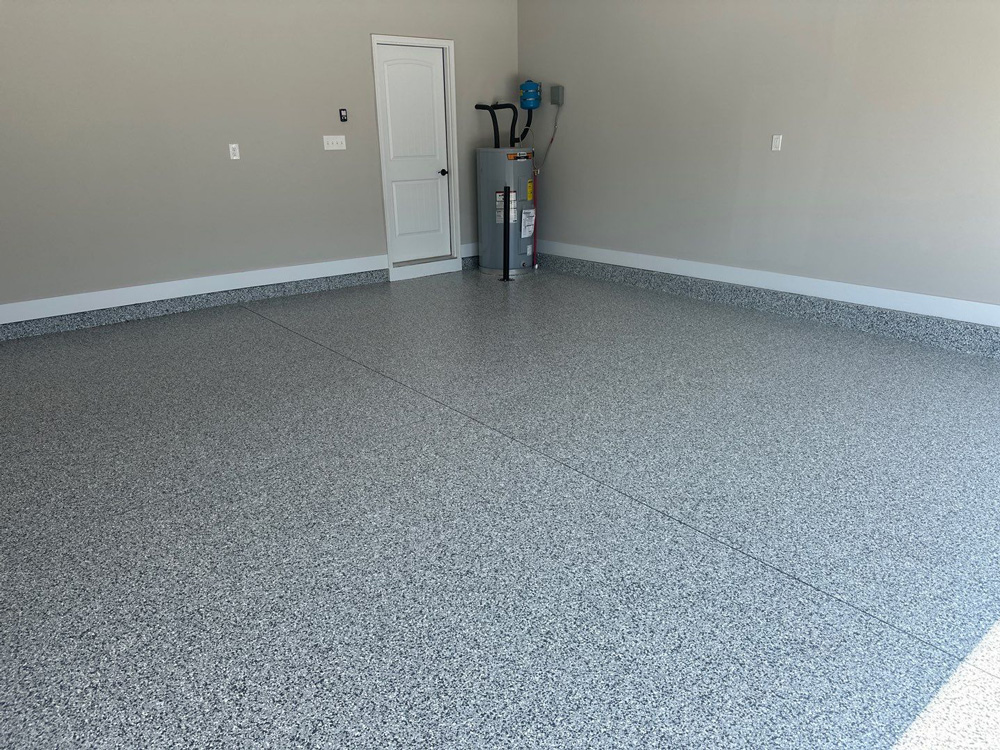
Your Garage Floor Deserves Better Than Epoxy
A polyaspartic garage floor sealer is a fast-curing, UV-stable concrete coating that outperforms traditional epoxy in almost every category that matters to homeowners — cure speed, flexibility, UV resistance, and long-term durability.
Quick answer: Top reasons homeowners choose polyaspartic over epoxy:
- Cures in hours, not days — tack-free in 2–6 hours, vehicle-ready in 24–48 hours
- Won’t yellow — UV-stable formula holds its color even with the garage door open all day
- Resists hot tire pickup — no peeling when hot tires cool down on the surface
- Lasts 15–20+ years with proper installation and basic maintenance
- Works indoors and outdoors — garages, patios, balconies, and more
- One-day installation — most professional jobs are done start to finish in a single day
If your Knoxville garage floor is stained, cracked, or just plain embarrassing, you’ve probably looked at epoxy. Maybe you’ve even tried a DIY epoxy kit from the hardware store. And if you have, you already know the frustration — days of waiting, a finish that yellows within a season, and the sinking feeling when you pull your car in and watch the coating peel right up with your tires.
That’s not a you problem. That’s an epoxy problem.
Polyaspartic technology was originally developed for heavy industrial use — think petrochemical plants, marine barges, and aircraft hangars. Today, it’s available as a professional-grade garage floor coating that goes down fast, bonds deep into the concrete, and holds up to everything a Knoxville garage can throw at it: summer heat, road salt, oil drips, and dropped tools.
This guide covers the best polyaspartic floor coating kits and systems available, so you can understand exactly what you’re buying and what to expect before the first coat ever hits your floor.
Polyaspartic garage floor sealer vocabulary:
What is a Polyaspartic Garage Floor Sealer?
To understand why a polyaspartic garage floor sealer is so effective, we have to look slightly beneath the surface—chemically speaking.
Polyaspartic is actually a type of aliphatic polyurea. In plain English, it is derived from polyurethane chemistry, specifically engineered to overcome the common installation headaches of traditional polyureas. The key ingredient is polyaspartic ester. This compound acts as a built-in “brake” on the curing process. While standard polyurea cures almost instantly, polyaspartic esters slow the chemical reaction down just enough to allow installers to apply it smoothly by hand.
When we mix the two parts of a polyaspartic kit together, a chemical reaction occurs that creates an incredibly tight, cross-linked polymer chain. This chain is highly resistant to heat, impacts, scratches, and aggressive chemicals. To dive deeper into the chemistry, check out The Complete Guide to Polyaspartic Concrete Sealer and Coatings.
Polyaspartic vs. Traditional Epoxy
If you’ve spent any time researching garage floor coatings, you’ve likely seen epoxy and polyaspartic pitted against each other. While epoxy has been the default standard for decades, polyaspartic is rapidly replacing it for residential garages.
Here is a side-by-side comparison of how these two materials match up:
| Feature | Traditional Epoxy | Polyaspartic Sealer |
|---|---|---|
| Cure Time (Foot Traffic) | 24 to 48 hours | 2 to 5 hours |
| Cure Time (Vehicle Traffic) | 5 to 7 days | 24 to 48 hours |
| UV Stability | Poor (Yellows and chalks in sunlight) | Excellent (100% UV stable, aliphatic) |
| Flexibility | Rigid (Can crack under impact/stress) | Highly Flexible (Moves with concrete) |
| Adhesion Mechanism | Sits on top of the concrete slab | Penetrates deep into concrete pores |
| Hot Tire Resistance | Prone to peeling (Hot tire pickup) | Completely impervious |
| Temperature Application | Requires 50°F to 90°F | Extreme range (-40°F to 90°F) |
As you can see, epoxy is a slower, more rigid material. While it is excellent at building up thickness on a budget, it behaves like a hard plastic shell sitting on top of your floor. Polyaspartic, on the other hand, acts more like a flexible, armor-like shield that fuses with the concrete itself. For a detailed breakdown of how to budget for these options in your workshop, see our guide on Top Budget-Friendly Polyaspartic and Epoxy Coatings for Your Workshop.
Polyaspartic vs. Pure Polyurea Coatings
It is also common to see the terms “polyurea” and “polyaspartic” used interchangeably online, which causes plenty of confusion.
The main difference comes down to pot life (the amount of time you have to apply the product once mixed) and the application method.
- Pure Polyurea: This material has an incredibly fast reaction time—often curing in as little as 2 to 5 minutes. Because it cures almost instantly, it cannot be rolled onto a floor by hand. It requires specialized, high-pressure plural-component spray equipment that only highly trained professionals can operate.
- Polyaspartic: Because polyaspartic is a modified polyurea, its working time is extended to anywhere from 10 to 45 minutes (and up to an hour for specialized medium-cure formulas). This extended pot life allows installers to roll the product onto the concrete using squeegees and nap rollers, ensuring a perfectly even, level finish.
To learn more about how these sister chemicals compare, read our technical breakdown on Polyurea vs Polyaspartic Coat.
The Pros and Cons of Polyaspartic Floor Coatings
No floor coating is perfect for every single scenario. While we love polyaspartic for its incredible strength and speed, we believe in giving our customers in Knoxville and the surrounding areas the complete, honest picture. Let’s look at why it reigns supreme, as well as the challenges that come with it. For local context on why this material is so highly valued in East Tennessee, see Why Polyaspartic is the Knoxville King of Concrete Coatings.
Key Benefits of a Polyaspartic Garage Floor Sealer
The advantages of choosing a polyaspartic system are hard to overstate. If you use your garage for parking heavy vehicles, working on cars, or as a home workshop, polyaspartic delivers peace of mind that other coatings simply cannot match.
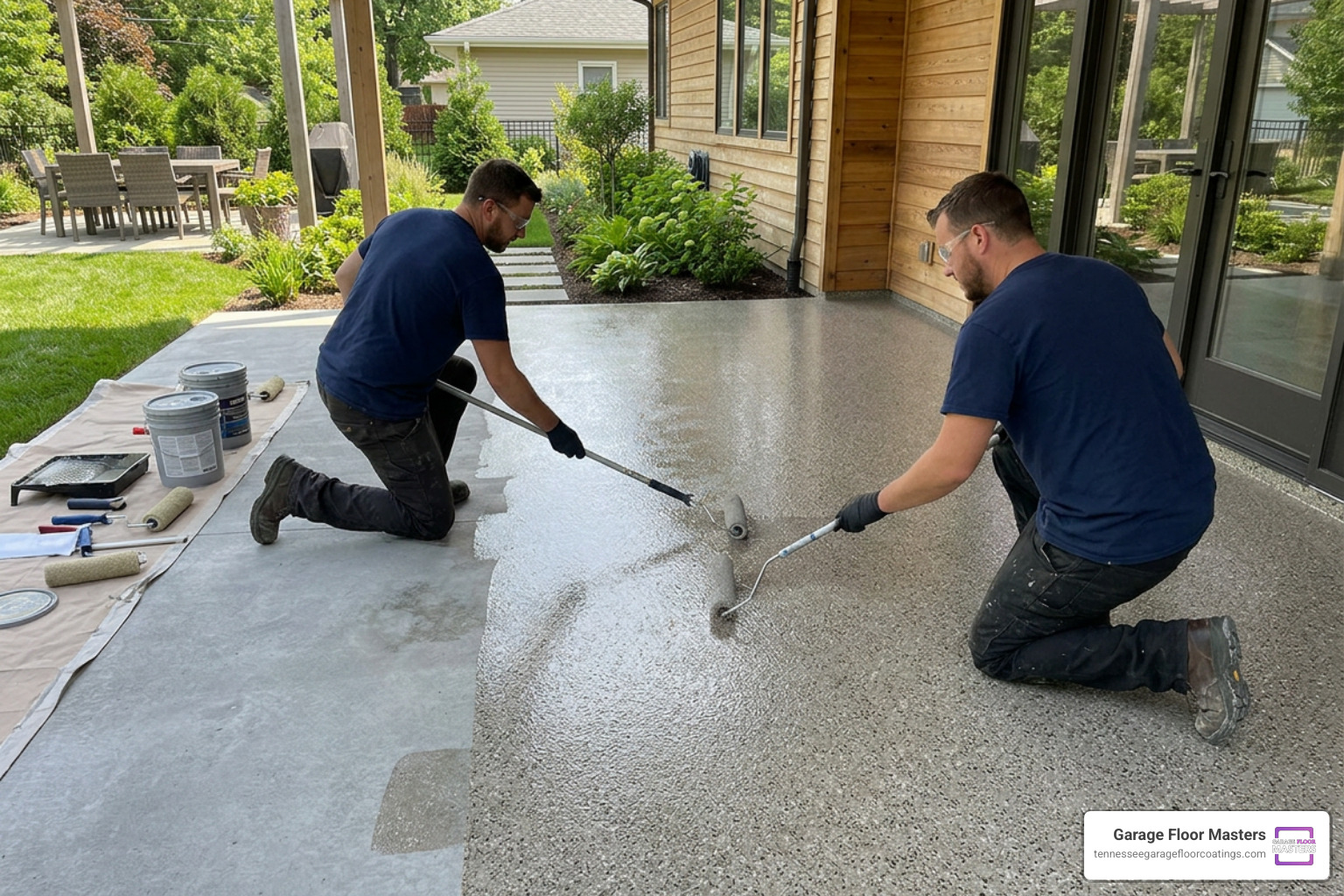
- 100% UV Stability: Unlike epoxy, which degrades and turns an ugly amber color when exposed to direct sunlight, aliphatic polyaspartic is completely UV stable. You can leave your garage doors open all day, or even apply it to outdoor patios and pool decks, without worrying about yellowing, fading, or chalking. Discover more about this in UV Resistant Polyaspartic Coatings for a Sunproof Garage.
- Zero Hot Tire Pickup: When you drive your car on a hot summer afternoon, your tires expand. When you park in the garage, those tires cool down and contract, creating a vacuum effect. This physical contraction literally pulls up weak coatings like DIY epoxy or garage floor paint. Polyaspartic’s high heat resistance and deep bond mean it never peels under hot tires.
- Incredible Flexibility: Concrete expands and contracts with changes in temperature. Because polyaspartic retains its flexibility over its entire lifespan, it moves with the concrete rather than cracking under thermal stress.
- Rapid Return to Service: Instead of parking your cars in the driveway for a week while waiting for epoxy to cure, a polyaspartic floor allows you to walk on it in 4 to 5 hours and park your vehicles back inside in 24 to 48 hours.
Potential Drawbacks and Installation Challenges
So, what is the catch? The very characteristics that make polyaspartic an incredible protective coating also make it notoriously difficult to install.
- Extremely Short Working Window: Depending on the specific formula and the humidity levels in East Tennessee, the pot life of mixed polyaspartic can be as short as 10 to 15 minutes. If you do not apply it rapidly and with absolute precision, the material will cure in the bucket or leave permanent roller marks on your floor.
- Strong Odor and VOCs during Application: Some high-solids polyaspartic coatings emit a strong chemical odor during the application and curing process. This is due to solvents and compounds like isocyanates, which can cause respiratory irritation if proper personal protective equipment (PPE) and ventilation are not used.
- High Skill Requirement: Because of the rapid cure speed, there is zero margin for error. If you make a mistake, you cannot simply roll back over it to smooth it out. This is why attempting a DIY polyaspartic installation is highly risky and often leads to costly floor failures.
Choosing Your System: Broadcast Flake vs. Solid Color Systems
One of the best parts of upgrading your garage floor is choosing the style that fits your home. Whether you want a clean, minimalist look or a heavy-duty textured surface, there is a polyaspartic system for you. You can explore the full range of design options available locally at Polyaspartic Floor Coatings Knoxville Tennessee.
Medium Broadcast and Full Broadcast Flake Systems
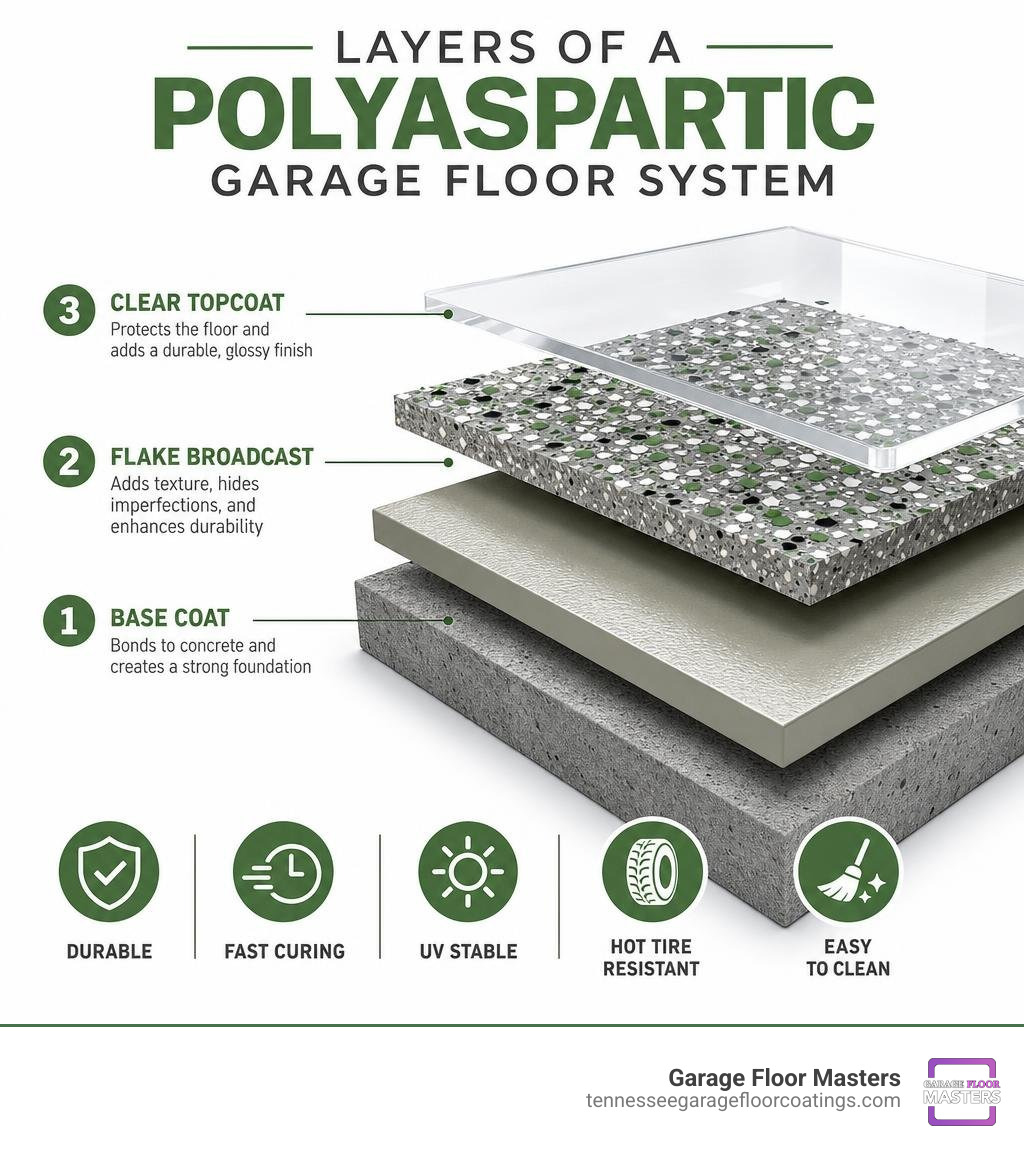
Flake flooring systems are the most popular choice for residential garages. They consist of a colored base coat, decorative vinyl chips (flakes) scattered into the wet base, and a clear polyaspartic topcoat to seal everything in.
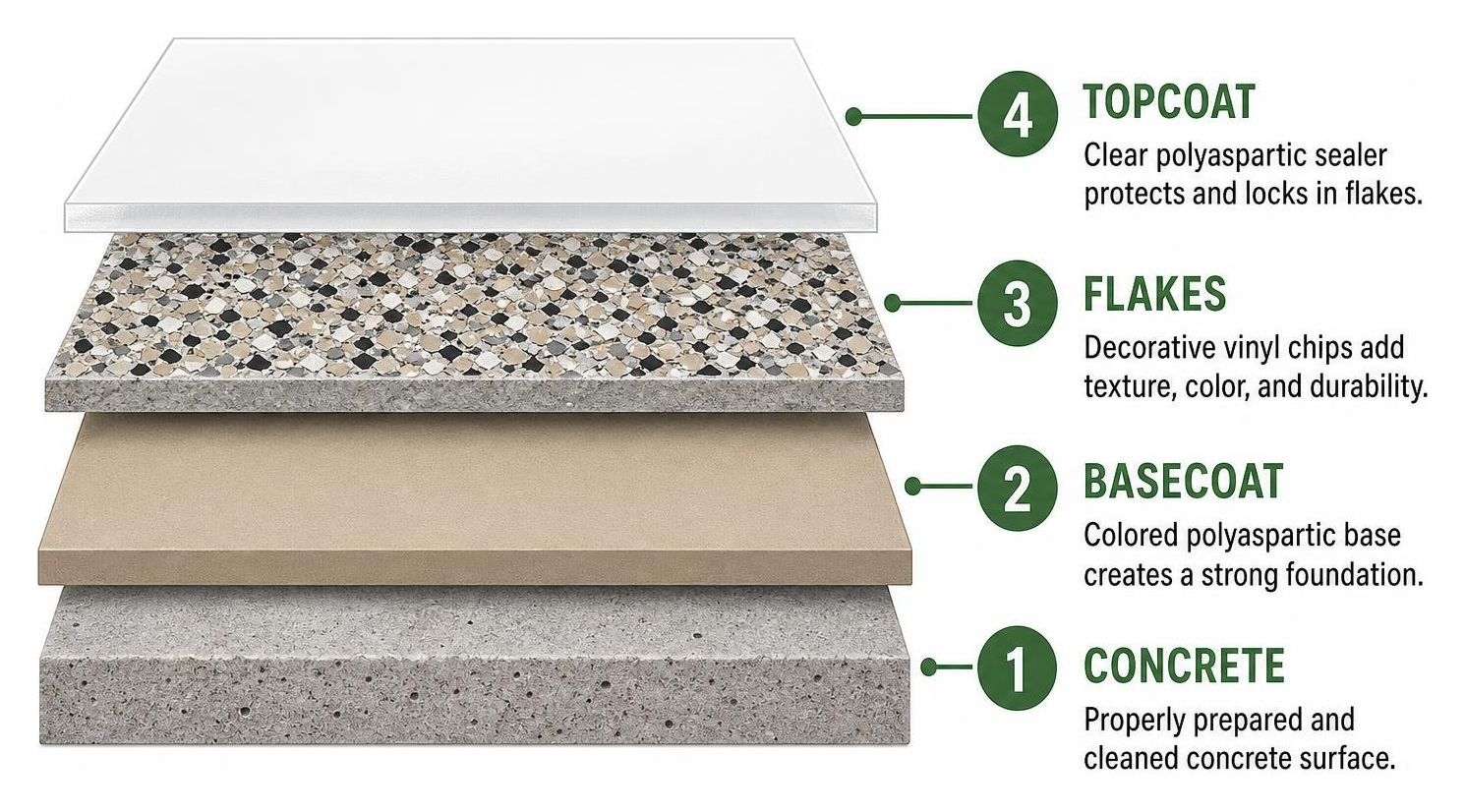
- Medium Broadcast: In this system, flakes are scattered lightly to moderately across the floor, leaving portions of the solid-color base coat visible. It offers a subtle texture and speckle.
- Full Broadcast: This is the gold standard for durability and aesthetics. Flakes are thrown by hand until the base coat is completely saturated (broadcast to rejection). This creates a floor that looks like natural granite or terrazzo.
- Why Flakes Matter: Beyond looking beautiful, a full broadcast of vinyl chips adds physical thickness to the floor, dramatically improves impact resistance, hides concrete imperfections, and provides built-in slip resistance so your floor isn’t slick when wet.
A professional 1,000-square-foot full broadcast kit typically requires about 160 pounds of decorative flakes to ensure 100% coverage, sealed under a high-solids clear polyaspartic topcoat.
Solid Color Polyaspartic Garage Floor Coatings
If you prefer a sleek, modern, industrial aesthetic, a solid color polyaspartic system is an excellent choice.
- The Clean Look: Solid color floors use a pigmented polyaspartic base coat followed by a clear, high-gloss topcoat. This finish is highly reflective, brightens up dark garages, and is incredibly easy to sweep and mop.
- Commercial Appeal: You will often see solid color systems in professional automotive showrooms, cleanrooms, and commercial aircraft hangars.
- Slip Warning: Because solid color floors are perfectly smooth, they can become very slippery when wet with rainwater or melted snow. We always recommend broadcasting an anti-slip grit additive (such as aluminum oxide) into the final topcoat to provide traction.
Surface Preparation and Application Process
Here is an industry secret: 80% of a floor coating’s success or failure is determined before the product is ever mixed. If you do not prepare the concrete correctly, even the most expensive polyaspartic sealer in the world will peel right off. Learn more about our professional prep standards at Concrete Coating Knoxville Tennessee.
Concrete Surface Profile (CSP-3) and Moisture Testing
To create a permanent, mechanical bond, the polyaspartic must be able to sink deep into the concrete pores.
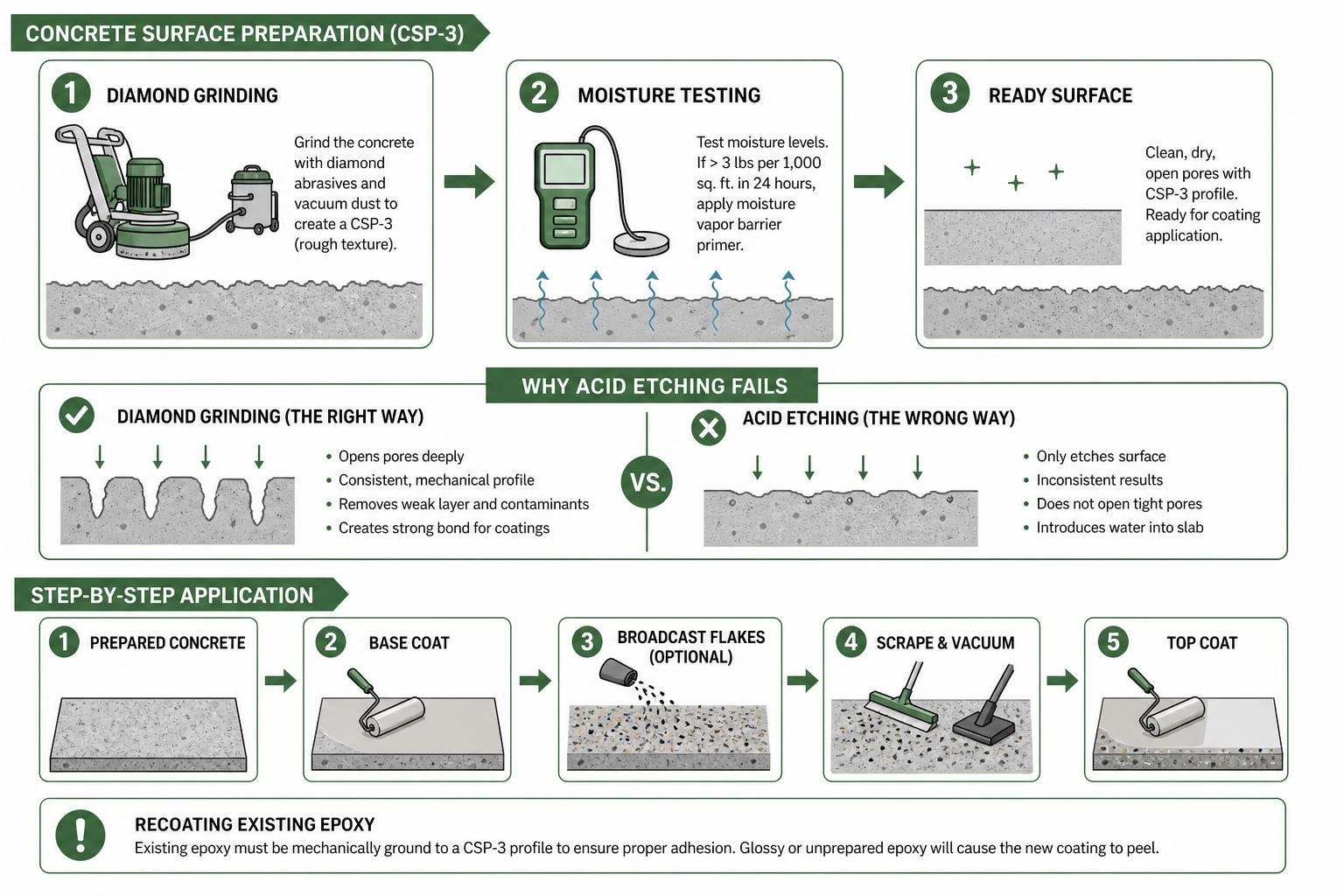
- Diamond Grinding: We use heavy, walk-behind planetary diamond grinding machines equipped with dustless vacuum systems to grind away the top layer of weak concrete, laitance, and old sealers. This opens up the concrete pores and creates a rough texture similar to 80-grit sandpaper—known in the industry as a Concrete Surface Profile of 3 (CSP-3).
- Why Acid Etching Fails: Many DIY kits tell you to prep your floor using muriatic acid. Acid etching is highly inconsistent, does not open up tight concrete pores effectively, and introduces massive amounts of water into the slab, which can ruin the subsequent coating.
- Moisture Testing: Concrete is highly porous and acts like a sponge, drawing moisture up from the earth. If there is too much moisture vapor transmitting through your slab (exceeding 3 lbs per 1,000 sq. ft. over 24 hours), it will push the coating off the floor. We always test moisture levels first and apply a specialized moisture vapor barrier primer if necessary.
Step-by-Step Application and Recoating Existing Epoxy
Once the concrete is ground, vacuumed, repaired, and tested, the application process moves rapidly. For a look at how fast this process moves, see Blink and It’s Dry with Fast Drying Polyaspartic Floors.
- Step 1: Mixing: Part A (resin) and Part B (catalyst) are mixed at a precise ratio (usually 1:1 or 2:1 depending on the system) using a low-speed drill and mixing paddle for 2 to 3 minutes.
- Step 2: The Ribbon Method: Because polyaspartic has a short pot life, we do not work out of a paint tray. We pour the mixed material directly onto the floor in long, 12-inch ribbons.
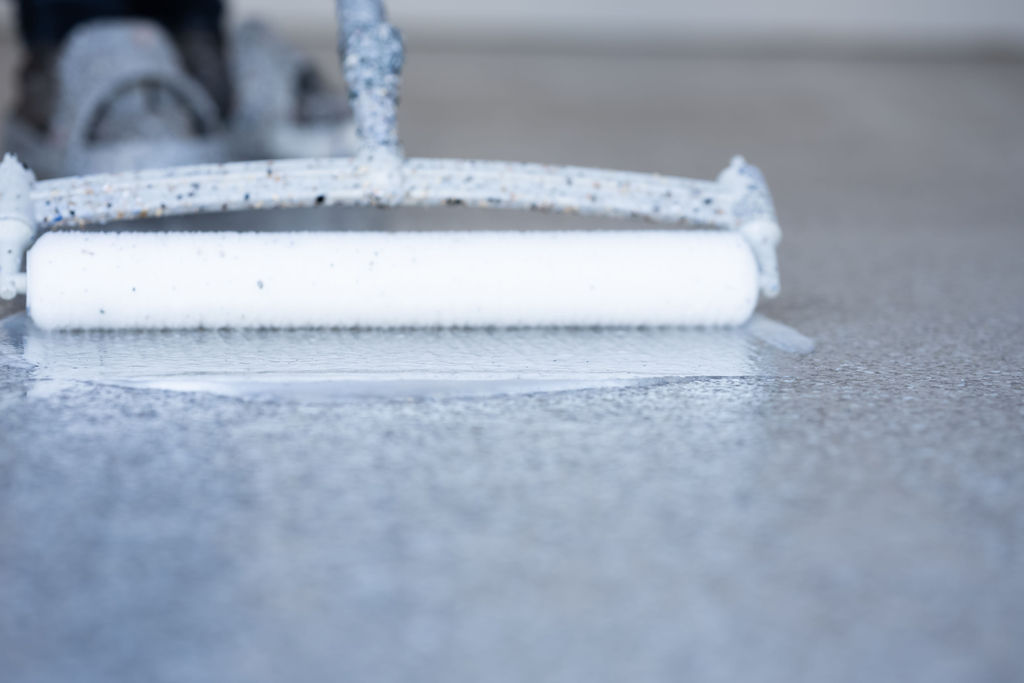
- Step 3: Squeegee & Back-Roll: While wearing spiked shoes (which allow us to walk on the wet floor without leaving marks), one installer pulls the ribbon of material flat using a squeegee, while a second installer immediately back-rolls it with a lint-free roller to ensure a perfectly uniform thickness.
- Step 4: Flake Broadcast: If installing a flake system, the vinyl chips are immediately thrown high into the air, allowing them to rain down evenly into the wet base coat until the floor is fully saturated.
- Step 5: Scrape and Seal: Once the base coat is dry (usually 2 to 4 hours), we scrape away the loose, standing flakes, vacuum the floor clean, and apply the final clear polyaspartic topcoat using the same squeegee and back-roll technique.
Can you apply polyaspartic over existing epoxy? Yes! If your old epoxy floor is structurally sound but looks worn or yellowed, we can revitalize it. We mechanically sand the old epoxy to scratch up the surface and create a physical profile, vacuum the dust, wipe it down with a solvent like denatured alcohol, and roll a fresh polyaspartic topcoat directly over it.
Frequently Asked Questions about Polyaspartic Sealers
How long does a polyaspartic garage floor last and how do you maintain it?
A professionally installed polyaspartic garage floor is designed to last 15 to 20+ years under residential conditions. Because the chemical bond is so strong and the material stays flexible, it will not chip, peel, or delaminate over time.
Maintaining your new floor is incredibly simple:
- Regular Cleaning: Sweep up loose dirt or dust. Because the floor is completely non-porous, dirt cannot stick to it.
- Washing: For a deeper clean, simply spray the floor down with a garden hose and pull the water out with a foam squeegee.
- Soaps to Avoid: If you have stubborn grime, use a mild, pH-neutral soap like Dawn dish soap mixed with warm water. Avoid using harsh acids, citrus-based cleaners, or highly concentrated vinegar, as these can dull the high-gloss finish over time.
Can polyaspartic be used for both indoor and outdoor concrete?
Absolutely! Polyaspartic is highly versatile. Because it is completely UV stable, it is the premier choice for outdoor concrete surfaces like patios, pool decks, walkways, and balconies.
However, there is one important caveat: polyaspartic is a non-breathable sealer. This means it blocks moisture vapor from escaping. If you have an outdoor slab on grade (like a driveway or sidewalk) that does not have a vapor barrier underneath, moisture rising from the ground can build up under the coating and cause it to blister. For outdoor slabs with high moisture potential, a breathable penetrating sealer is often a safer choice.
Interestingly, this material is so durable and safe once cured that it is even used to protect high-end concrete countertops! Read more about this unique application in The Secret to Durable Concrete Countertops is Polyaspartic.
How much does a polyaspartic garage floor cost per square foot?
When calculating the cost of a polyaspartic garage floor, it is important to understand that pricing is not one-size-fits-all.
The total cost of your project depends on several key variables:
- The Size of the Space: Larger garages often benefit from economies of scale regarding material and setup costs.
- The Condition of the Concrete: If your slab has extensive cracking, pitting, spalling, or an old epoxy coating that must be ground off, the extra preparation work will influence the final price.
- The System Features: A full-broadcast flake system requires significantly more materials (and a thicker topcoat) than a simple solid-color system.
Because every garage floor has a unique history and set of needs, we do not believe in giving blind, inaccurate estimates over the phone. Instead, we provide a free, no-obligation, on-site estimate where we can test your concrete’s moisture levels, inspect its condition, and help you choose the perfect colors and finishes for your home. To learn more about how we price our projects, check out The Real Cost of Polyaspartic Garage Floors.
Conclusion
At the end of the day, your garage is more than just a place to park your car—it is an extension of your home, a workshop for your hobbies, and a high-traffic entryway for your family. Investing in a cheap, slow-curing epoxy or a DIY paint kit almost always leads to a disappointing cycle of peeling, yellowing, and re-coating.
By choosing a high-performance polyaspartic garage floor sealer, you are choosing a floor that is installed in a single day, cures in hours, and stands up to the toughest demands of daily life without fading or peeling.
If you are ready to stop waiting for epoxy and transform your concrete, the team at Garage Floor Masters is here to help. We provide professional, industrial-grade polyaspartic and epoxy garage floor coatings across East Tennessee, including Knoxville, Oak Ridge, Sevierville, Lenoir City, Maryville, Powell, and Loudon. Our UV-stable coatings are four times stronger than traditional epoxy, low-maintenance, and available in over 140 beautiful colors.
Let us handle the heavy lifting, the diamond grinding, and the chemical mixing so you can enjoy a flawless, lifetime floor. Find out what makes us the premier choice in the region by reading Finding the Best Polyaspartic Floor Specialists in Tennessee, or head over to our Polyaspartic Floor Coatings page to schedule your free on-site estimate today!