
Why Your Concrete Countertops Need a Polyaspartic Sealer
A polyaspartic concrete countertop sealer is one of the most durable, fast-curing, and food-safe ways to protect concrete surfaces in your kitchen or outdoor space. Here’s a quick answer to what most people want to know:
What polyaspartic concrete countertop sealer does:
- Seals and protects concrete from stains, chemicals, and abrasion
- Cures tack-free in as little as 3–7 hours
- Reaches food-safe status after a full 7-day cure
- Resists heat up to 300°F (149°C)
- Stays clear and gloss-bright without yellowing over time
Unsealed concrete countertops are a magnet for trouble. Wine spills, cooking oil, and acidic foods like lemon juice can etch and stain the surface permanently — often within minutes of contact.
Most homeowners try acrylic or polyurethane sealers first. They’re cheaper and easier to find. But they tend to scratch, dull, and break down faster than you’d hope — leaving you resealing every year or dealing with a surface that looks tired and worn.
Polyaspartic changes that equation entirely.
This coating technology — originally developed for heavy-duty industrial floors — has made its way into kitchen countertops, and for good reason. It’s harder, faster-curing, and more UV-stable than epoxy or urethane. And once it fully cures, it’s completely safe for food contact.
In this guide, we’ll walk you through exactly how polyaspartic sealer works, how to apply it, and what to watch out for before you start.
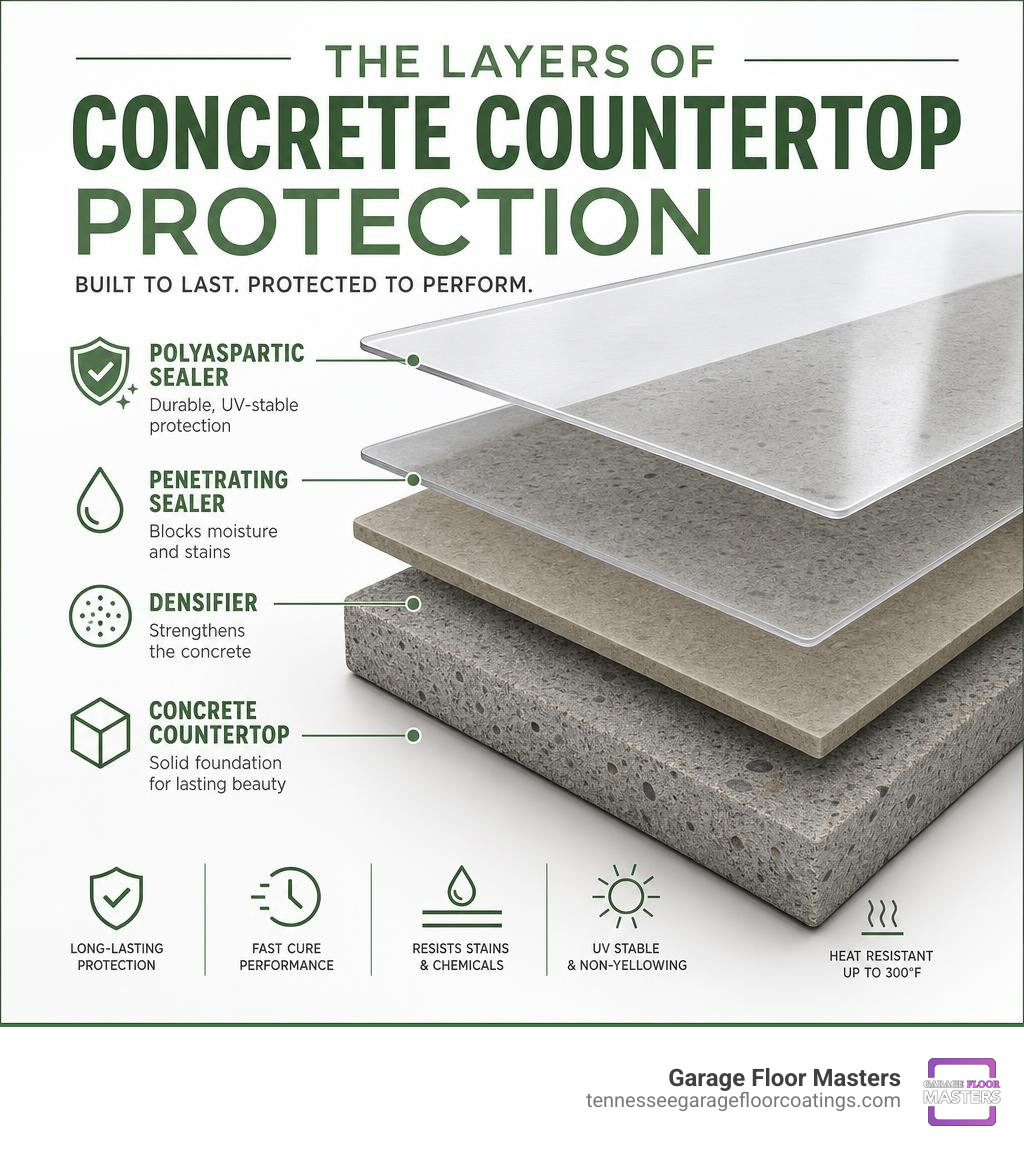
Simple guide to polyaspartic concrete countertop sealer terms:
What is a Polyaspartic Concrete Countertop Sealer?
To understand why this sealer is such a game-changer, we first have to look at what it actually is. A polyaspartic sealer is an aliphatic polyurea. While that sounds like a tongue-twister from a high school chemistry textbook, it simply means it belongs to a family of high-performance, light-stable polymers.
Unlike penetrating sealers that soak deep into the concrete pores to repel water from within, a polyaspartic sealer is a film-forming topical coating. It sits on top of the concrete, creating an incredibly dense, completely non-porous barrier. This barrier is what prevents liquids, oils, and bacteria from ever touching your concrete.
If you have ever researched heavy-duty floor coatings, you might have run into the debate of Polyurea vs Polyaspartic Coat. In short, polyaspartic is a specialized, slower-setting type of polyurea. It is engineered to give installers enough “wet edge” time to apply the product smoothly while still curing dramatically faster than traditional urethanes or epoxies.
How Polyaspartic Chemistry Works
Let’s look under the hood. Polyaspartic coatings are typically two-component systems (Part A and Part B). When you mix these two parts together, a rapid chemical cross-linking process begins.
Because many premium polyaspartic sealers feature a high solids content—often ranging from 60% up to 90% solids—there are very few solvents to evaporate. What you mix and apply is almost exactly what stays on the surface. The aliphatic chemistry means the backbone of the molecular chain is highly resistant to ultraviolet light. This cross-linked polymer network is incredibly tight, giving the cured film its signature glass-like hardness and flexibility.
Polyaspartic vs. Epoxy, Urethane, and Acrylic
When sealing concrete countertops, you will generally choose between four primary materials. Here is how they stack up against each other:
- Acrylic Sealers: These are budget-friendly and easy to apply but offer very thin protection. They scratch easily and require frequent reapplication.
- Epoxy Coatings: Epoxy creates a thick, beautiful protective barrier. However, traditional epoxies take up to 16 hours or more to dry and are notoriously sensitive to UV light, turning a nasty shade of yellow when exposed to sunlight over time.
- Polyurethane: Urethanes are highly scratch-resistant but often require a primer, have long dry times, and can be difficult for DIYers to apply without leaving roller marks.
- Polyaspartic: This combines the best of all worlds. It offers the thick, impermeable barrier of epoxy, the scratch resistance of polyurethane, and a tack-free dry time of just 3 to 7 hours—all while remaining completely UV-stable.
| Sealer Type | Cure Time | UV Stability | Scratch Resistance | Thickness |
|---|---|---|---|---|
| Acrylic | Fast (1-2 hrs) | Moderate | Low | Thin |
| Epoxy | Slow (12-24 hrs) | Poor (Yellows) | High | Thick |
| Urethane | Moderate (6-12 hrs) | High | Very High | Medium |
| Polyaspartic | Rapid (3-7 hrs) | Excellent (No Yellowing) | Extreme | Medium to Thick |
Key Benefits of Polyaspartic on Concrete Countertops
If you are investing time and money into crafting beautiful concrete countertops, you want a sealer that can handle real life. Whether you are wiping up spilled red wine, prepping acidic citrus fruits, or scrubbing away grease, a polyaspartic sealer acts as an invisible suit of armor. You can learn more about how these coatings protect surfaces in The Complete Guide to Polyaspartic Concrete Sealer and Coatings.
Unmatched Durability of a Polyaspartic Concrete Countertop Sealer
The primary job of any topical sealer is to serve as a sacrificial wear surface. A polyaspartic concrete countertop sealer excels here because of its extreme abrasion and impact resistance.
In a busy kitchen, heavy pots get slid across the island, knives occasionally slip, and coffee mugs get slammed down. Polyaspartic coatings resist scratches and impact far better than acrylics. They do not easily peel, flake, or delaminate from the concrete because the chemical bond formed during application is incredibly tenacious.
Heat Resistance and Food Safety
Kitchen counters are hot spots—literally. Fortunately, high-quality polyaspartics offer excellent heat resistance up to 300°F (149°C) once they are fully cured. While we still do not recommend placing a red-hot cast-iron skillet directly onto the sealed surface, it easily handles hot coffee mugs, warm plates, and accidental brief contact with hot cooking tools.
Furthermore, once a polyaspartic sealer has completed its full 7-day cure window, it becomes 100% food-safe and non-toxic. Its non-porous nature means it won’t harbor bacteria, mold, or food particles, making your kitchen prep surfaces hygienic and incredibly easy to clean with mild soap and water. For outdoor setups, this UV-stable shield keeps your outdoor kitchen looking brand new, which you can read about in UV Resistant Polyaspartic Coatings for a Sunproof Garage.
Step-by-Step Guide: How to Apply Polyaspartic Sealer
Applying a polyaspartic sealer is a precise process. Because of the fast-acting chemistry, preparation and timing are everything.
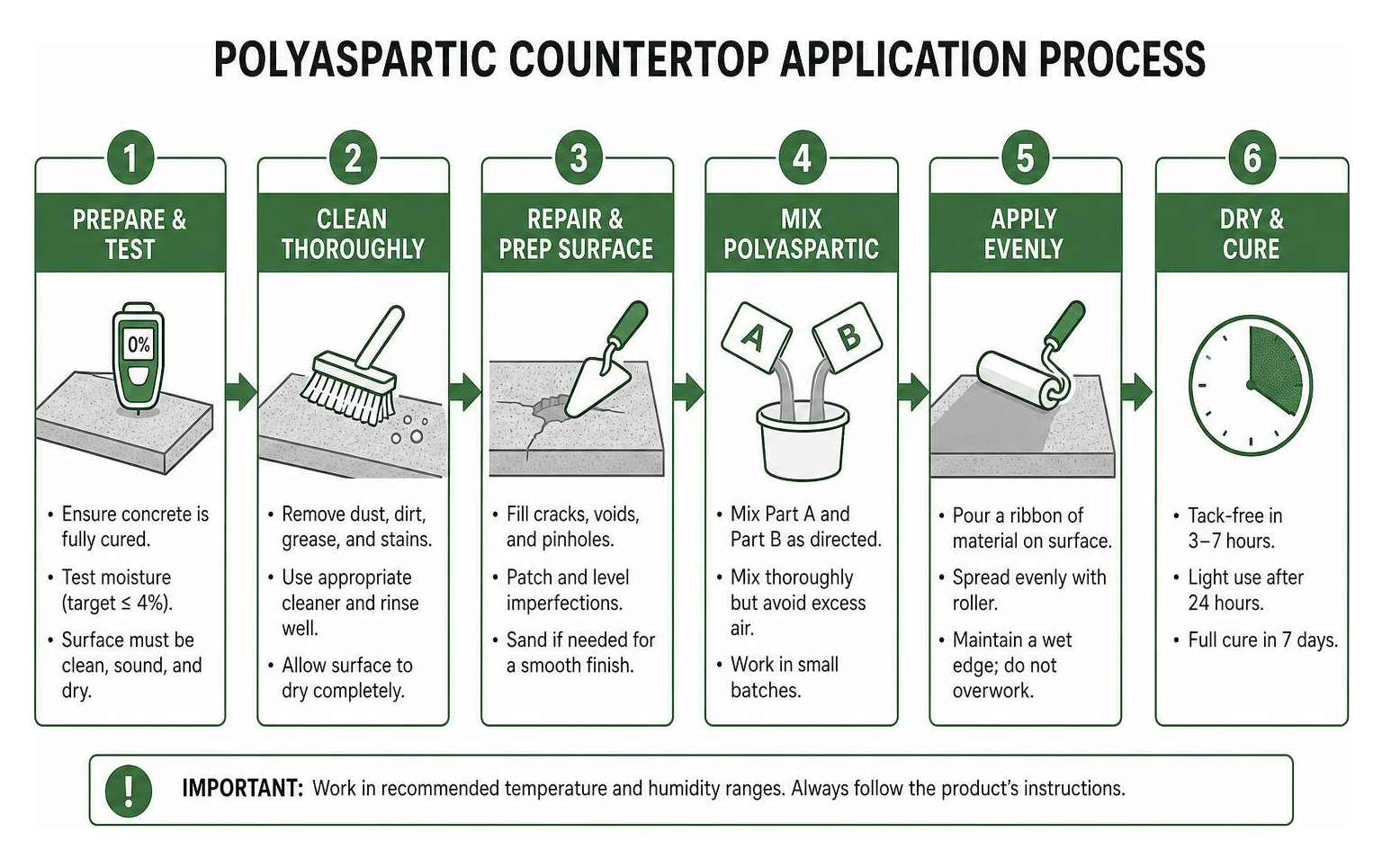
Surface Preparation and Moisture Testing
You can have the most expensive sealer on the market, but if your surface preparation is poor, the coating will fail.
- Curing Time: If you have just poured new concrete countertops, you must wait. New concrete should cure for at least 28 days (or a minimum of 8 days for specialized quick-cure countertop mixes) before you seal it.
- Profile the Surface: The concrete must be clean, dry, and profiled. Mechanical scarification using an 80-to-100-grit sanding pad or light acid etching is required to open up the concrete’s pores so the polyaspartic can grip the surface.
- Moisture Testing: Because polyaspartic is non-breathable, trapping moisture beneath it will cause bubbling or cloudiness. Perform a plastic sheet test (ASTM-D-4263) or use a calcium chloride test to ensure the moisture vapor emission rate is below 3 lbs per 1,000 square feet over 24 hours.
Essential Tools Checklist:
- High-density foam rollers or short-nap (3/8″) lint-free phenolic-core rollers
- Clean mixing containers and paint stirrers
- A slow-speed drill mixer
- Personal protective equipment (nitrile gloves, safety glasses, and a NIOSH-approved respirator)
- Painter’s tape to protect surrounding walls and cabinetry
Mixing and Applying Your Polyaspartic Concrete Countertop Sealer
Once your prep is complete, you are ready to mix. That polyaspartic sealers have a very short pot life—usually between 20 to 30 minutes at room temperature. For a deeper look at fast-curing properties, check out Blink and It’s Dry with Fast Drying Polyaspartic Floors.
- Mix Carefully: Measure your components according to the manufacturer’s exact mixing ratio (often 1:1, 2:1, or 3:1). Mix mechanically with a slow-speed drill for about two minutes. Avoid mixing at high speeds, which whips air bubbles into the material.
- Apply in Sections: Pour the mixed sealer onto the countertop in small ribbons. Use your roller to spread the material evenly. Work in small, manageable sections, finishing each within 4 to 5 minutes.
- Watch Your Thickness: Aim for a wet film thickness of 3 to 5 mils per coat. Applying it too thick can trap solvent bubbles and cause cloudiness.
- Recoating: If you are applying a second coat for maximum commercial-grade protection, apply it when the first coat is dry to the touch but no longer tacky (usually within 2 to 12 hours). If you wait longer than 12 hours, you must lightly sand the surface with 220-grit sandpaper to ensure the second coat bonds properly.
Limitations and Drawbacks of Polyaspartic Sealers
While we love polyaspartic for its incredible strength, no sealer is absolutely perfect. It is important to understand its limitations before diving into a project.
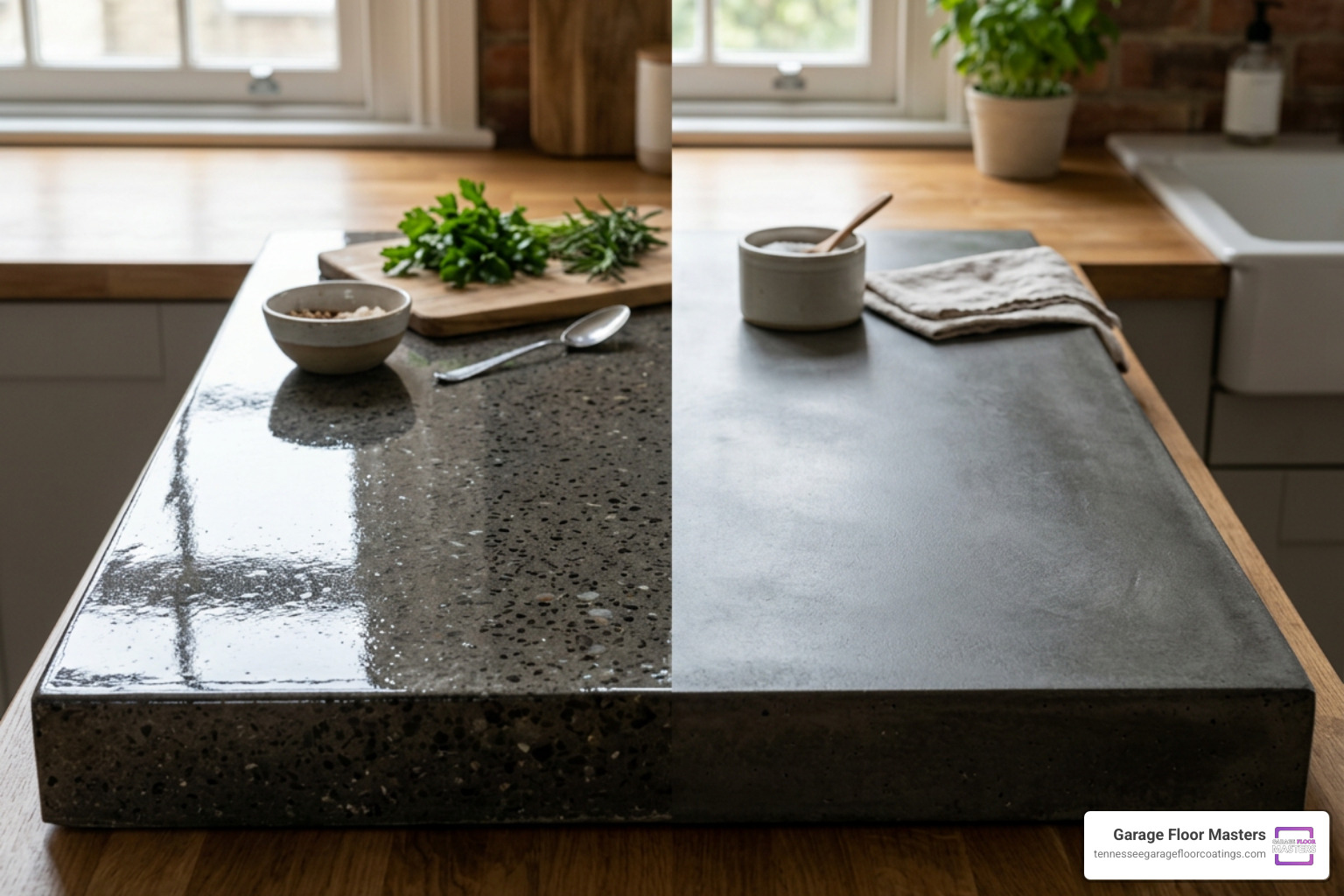
First, polyaspartics are non-breathable. If moisture rises through the concrete substrate from underneath, it can build up vapor pressure and cause the sealer to blister or peel.
Additionally, most standard polyaspartics cure to an ultra-shiny, high-gloss finish. If you want a natural, matte, or zero-sheen look, you will need to search for specialized satin additives or use a different type of sealer entirely.
Fast Pot Life and Application Difficulty
The rapid dry time of polyaspartic is a double-edged sword. While it is great that you can use your kitchen sooner, the 20-to-30-minute pot life means you cannot afford to make mistakes.
If you work too slowly, the product will begin to gel in the bucket or on your roller, leading to sticky roller marks, uneven thickness, and unsightly bubbling. This fast-acting nature makes professional installation highly recommended for large, complex, or multi-tiered countertop layouts.
Cost and Gloss Level Considerations
Polyaspartic is a premium product. Compared to basic acrylic sealers or standard DIY epoxy kits, the upfront material cost of a high-solids polyaspartic is notably higher.
However, because it lasts for years without needing to be stripped and reapplied, the long-term value is exceptional. If you do not want a mirror-like high-gloss finish, achieving a satin or semi-gloss look requires careful product sourcing or light post-cure sanding, which adds to the overall installation difficulty and prep cost.
Frequently Asked Questions about Polyaspartic Countertop Sealers
Is polyaspartic sealer food-safe for kitchen countertops?
Yes! Once a high-solids polyaspartic sealer completes its full 7-day cure window, it is completely non-toxic and food-safe. It creates an impermeable barrier that prevents food acids, bacteria, and moisture from penetrating the concrete, making it exceptionally hygienic.
Can I use polyaspartic sealer on outdoor concrete countertops?
Yes, but with caution. Because polyaspartic is highly UV-stable, it will not yellow or degrade under direct sunlight. However, because it is non-breathable, any moisture trapped in an outdoor concrete slab can cause the coating to bubble. Ensure your outdoor concrete countertop is fully cured, properly sealed from moisture underneath, and completely dry before application.
How long does polyaspartic sealer take to fully cure?
While it dries tack-free in 3 to 7 hours and can handle light use after 24 hours, a polyaspartic coating requires a full 3 to 7 days to reach its maximum hardness, chemical resistance, and food-safe status. Avoid placing heavy items or wet food on the surface during this cure window.
Conclusion
When it comes to protecting your home’s concrete surfaces, nothing beats the industrial-strength protection of polyaspartic technology. Whether you are sealing a custom kitchen island or looking to protect your garage, choosing the right material makes all the difference. To find out why this technology reigns supreme in East Tennessee, read Why Polyaspartic is the Knoxville King of Concrete Coatings.
At Garage Floor Masters, we specialize in high-performance polyaspartic applications. Serving Knoxville, TN, and surrounding areas like Oak Ridge, Maryville, Sevierville, and Lenoir City, we offer professional, one-day installations of UV-stable coatings that are 4 times stronger than standard epoxy.
While we are famous for our durable garage floor coatings, we bring that same commitment to strength, beauty, and longevity to every concrete project we touch. Because every project is unique, we base our pricing on the specific condition and features of your space. Contact us today to schedule your free on-site estimate!
To explore our durable residential and commercial services, check out our Polyaspartic Floor Coatings page.