
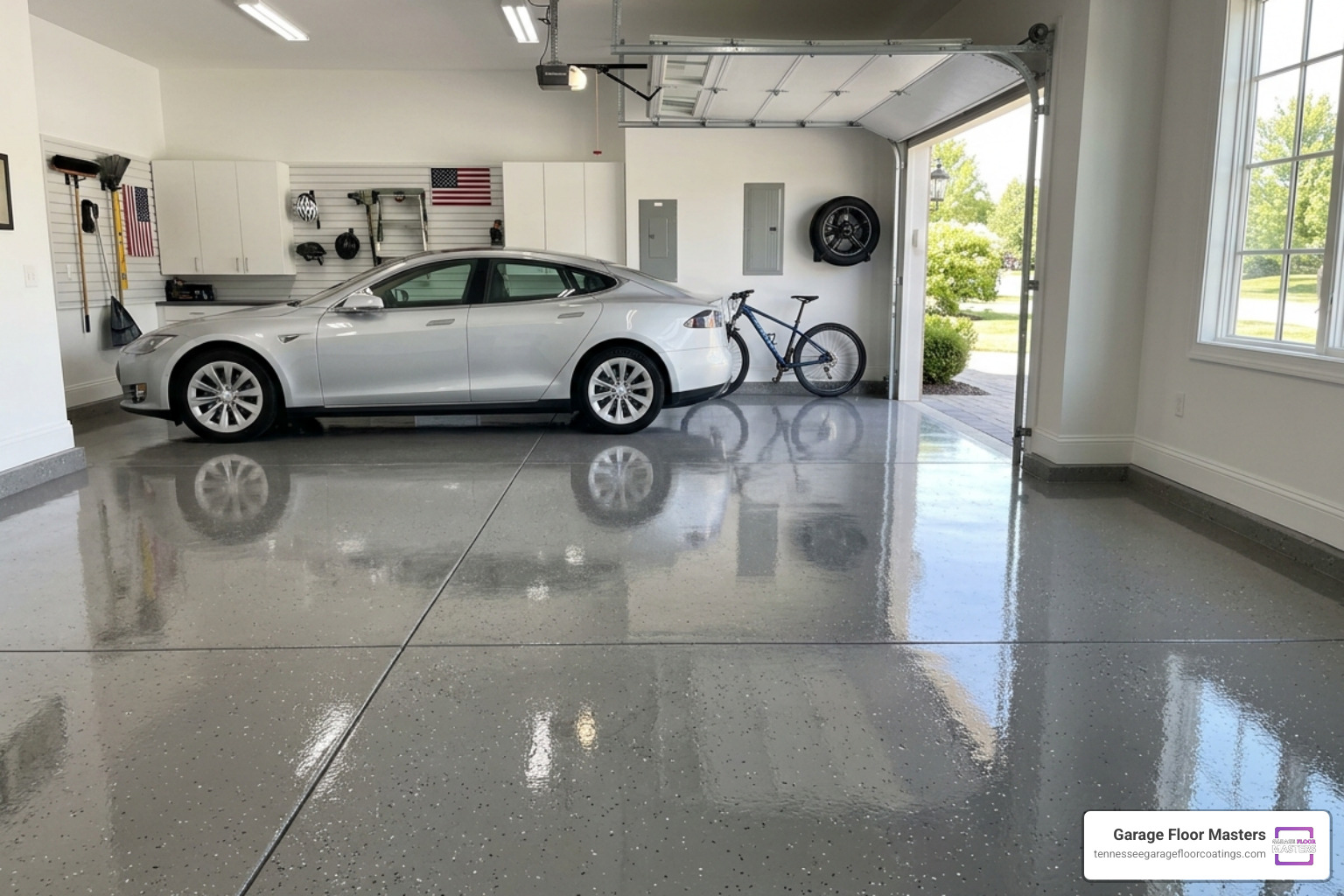
What Are Polyaspartic Concrete Floor Coatings — and Are They Right for Your Garage?
Polyaspartic concrete floor coatings are a type of high-performance, fast-curing floor finish applied directly to concrete surfaces — and they’re widely considered the most durable option available for garage and commercial floors today.
Quick answer for homeowners:
| Feature | What You Need to Know |
|---|---|
| What it is | A two-part aliphatic polyurea coating that bonds permanently into concrete |
| Cure time | Walk-on in 4-6 hours; vehicles in 24 hours; often done in one day |
| Durability | Resists hot tire pickup, chemicals, UV fading, abrasion, and impacts |
| Lifespan | 15-20+ years with basic maintenance |
| Best for | Garages, basements, commercial floors, patios, and high-traffic spaces |
| vs. Epoxy | Faster cure, better UV stability, more flexible, and longer-lasting |
| Professional install? | Strongly recommended — surface prep alone accounts for ~80% of coating success |
| Cost | Varies based on project condition and features selected; free on-site estimate available |
If your garage floor is stained, cracking, or just plain embarrassing — you’re not alone. Most concrete floors in Knoxville take a beating from vehicle traffic, oil spills, and Tennessee’s seasonal temperature swings. Standard paint peels. Basic epoxy yellows and chips. And bare concrete just keeps absorbing everything.
Polyaspartic coatings were originally developed for demanding industrial applications — think steel bridges, truck bed liners, and factory floors. Over the past two decades, the technology has made its way into residential garages, and it’s easy to see why. One properly installed polyaspartic coating can outlast multiple rounds of epoxy — with a high-gloss finish that still looks great years later.
This guide covers everything you need to know: how the coating works, how it’s installed, what it costs, and how it compares to other options.
Understanding Polyaspartic Concrete Floor Coatings
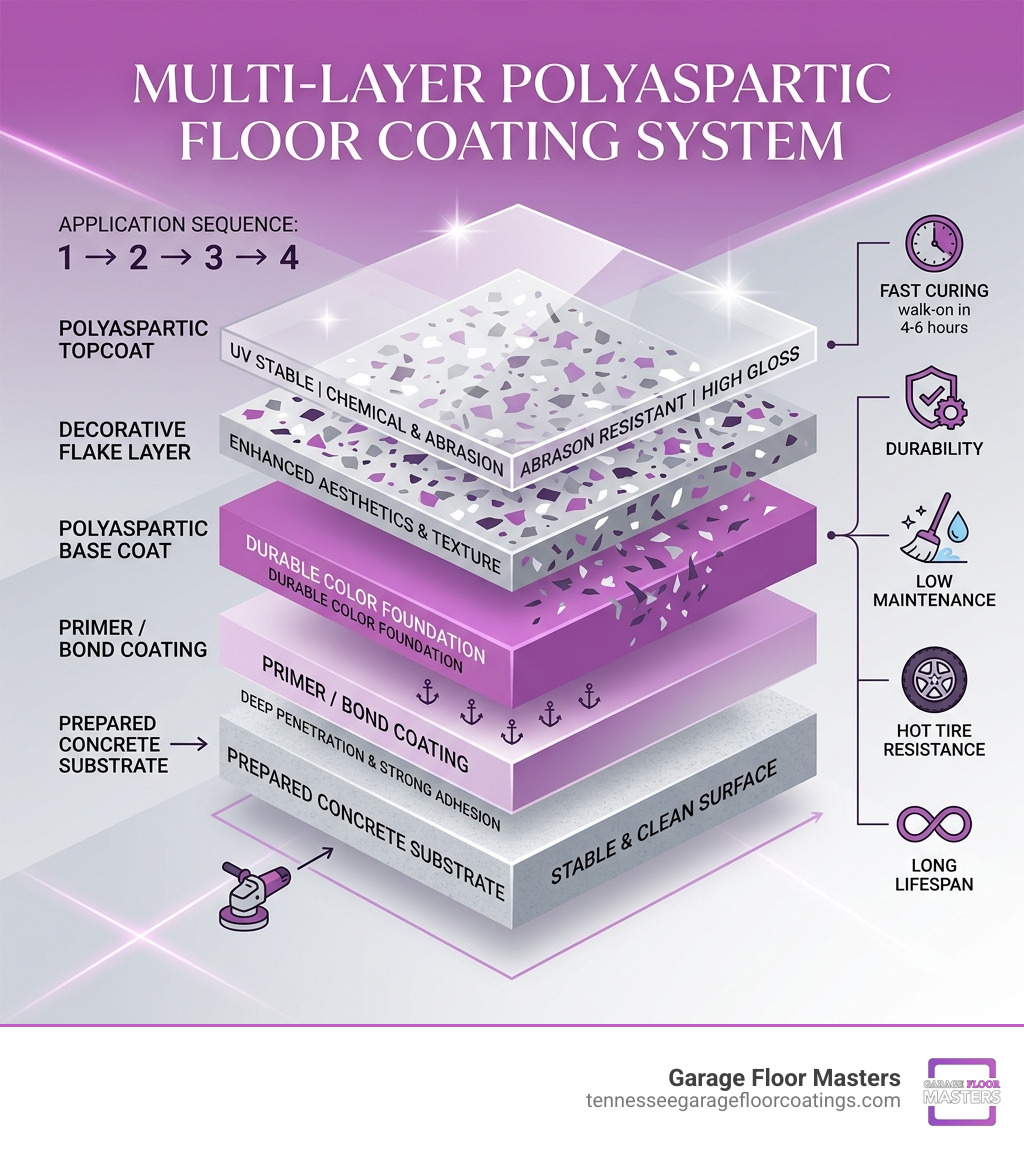
To understand why polyaspartic concrete floor coatings are so effective, we have to look at the science—but we promise to keep it simple! Polyaspartic is actually a subset of polyurea technology. Specifically, it is an aliphatic polyurea. While standard polyurea cures almost instantly (leaving no time for a smooth application), polyaspartic esters were developed to slow down that reaction just enough to allow professional installers to spread the material evenly across a floor.
Think of it as the “Goldilocks” of coatings: it cures fast enough to get you back in your garage in 24 hours, but slow enough to bond deeply with the concrete. Unlike epoxy, which sits on top of the surface like a hard plastic shell, polyaspartic has a water-like viscosity during application. This allows it to “wet out” the concrete, soaking into the pores to create a mechanical bond that is nearly impossible to peel.
At Garage Floor Masters, we use these advanced Polyaspartic Floor Coatings because they offer the best of both worlds: the strength of industrial liners and the beauty of a decorative showroom floor. If you’ve been researching Polyurea Vs Polyaspartic Coat, the main takeaway is that polyaspartic is the refined, floor-specific version of that technology.
Performance Specs of Polyaspartic Concrete Floor Coatings
When evaluating these coatings, “solids content” is a term you’ll hear often. High-quality polyaspartic concrete floor coatings typically feature a solids content between 80% and 90%. This refers to the amount of material left on the floor after the carriers evaporate. A higher solids content generally means a thicker, more durable film.
For our neighbors in Knoxville and the surrounding areas, we emphasize Epoxy Polyaspartic Garage Floor Coatings In Knoxville because they are formulated with low VOCs (Volatile Organic Compounds). This means fewer harsh odors during installation, which is a big deal if your garage is attached to your living space.
Chemical Composition and UV Stability
One of the biggest headaches with traditional epoxy is “ambering” or yellowing. If sun hits an epoxy floor through an open garage door, it will eventually turn a sickly shade of yellow. Polyaspartic coatings are “aliphatic,” a fancy chemistry term meaning they are inherently UV stable. They won’t yellow, fade, or chalk, even under the intense Tennessee sun.
This UV resistance also means incredible gloss retention. Research shows that high-end polyaspartics can retain more than 95% of their gloss even after 2,000 hours of intense UV exposure. Whether we are installing Epoxy Polyaspartic Garage Floor Coatings In Maryville or in the bright sun of Sevierville, the color you pick today is the color you’ll see ten years from now.
Key Advantages for Residential and Commercial Floors
Why settle for a coating that might peel in three years when you can have one that lasts twenty? The advantages of polyaspartic concrete floor coatings extend far beyond just looking pretty.
| Feature | Polyaspartic | Traditional Epoxy |
|---|---|---|
| Impact Resistance | High (Flexible) | Moderate (Brittle) |
| UV Stability | 100% Stable | Yellows over time |
| Installation Time | 1 Day | 3–5 Days |
| Bond Strength | Penetrates Pores | Sits on Surface |
| Temperature Range | -30°F to 140°F | 50°F to 90°F |
In places like Oak Ridge, homeowners often choose Epoxy Polyaspartic Garage Floor Coatings In Oak Ridge because the material is flexible. If you drop a heavy wrench on an epoxy floor, it might crack because epoxy is brittle. Polyaspartic has enough “give” to absorb the impact without chipping. We see similar demands for Epoxy Polyaspartic Garage Floor Coatings In Farragut, where high-end garages double as workshops and showrooms.
The Durability of Polyaspartic Concrete Floor Coatings
When we say these coatings are 4x stronger than epoxy, we aren’t just blowing smoke. It comes down to two main metrics: Taber Abrasion and Tensile Strength.
- Abrasion Resistance: Polyaspartic coatings typically show a weight loss of only 40-60 mg in Taber abrasion tests, making them incredibly difficult to scratch.
- Tensile Strength: With a tensile strength of nearly 4,000 psi, the coating is often stronger than the concrete it’s protecting!
This level of industrial-grade protection is why we are the top choice for Epoxy Polyaspartic Garage Floor Coatings In Lenoir City. Whether it’s a residential garage or a commercial warehouse, these floors are built to take a beating.
Resistance to Hot Tire Pickup and Chemicals
Have you ever seen a garage floor where the coating peeled up exactly where the car tires sit? That’s called “hot tire pickup.” It happens when hot tires from a long drive cool down on a floor coating, causing the rubber to contract and literally pull the coating off the concrete.
Polyaspartic concrete floor coatings are thermally stable, meaning they don’t soften under heat. They are also chemically “dense,” making them resistant to:
- Gasoline and diesel
- Motor oil and brake fluid
- Road salts and de-icing chemicals
- Battery acid
For residents looking for Epoxy Polyaspartic Garage Floor Coatings In Louisville, this chemical resistance is a game-changer. Spills that would permanently stain bare concrete or eat through cheap paint can be wiped right up with a paper towel.
The Professional Installation and Cure Timeline
We’ll be honest: polyaspartic is not a DIY-friendly material. Because it cures so quickly, you have a very narrow window to get it right. Professional installation is the only way to ensure the floor doesn’t end up with “roller marks” or bubbles.
Surface Preparation and the CSP-2 Profile
The secret to a floor that lasts 20 years isn’t just the liquid in the bucket—it’s the preparation. We don’t use acid etching, which often fails to open the concrete pores and adds unnecessary moisture. Instead, we use industrial diamond grinders to “profile” the floor.
Our goal is to achieve a Concrete Surface Profile (CSP) of 2, which feels roughly like 60-grit sandpaper. This mechanical grinding removes the “laitance” (the weak top layer of concrete) and opens up the pores so the polyaspartic can dive deep and lock in. Whether we are working on Epoxy Polyaspartic Garage Floor Coatings In Powell or Epoxy Polyaspartic Garage Floor Coatings In Seymour, we always start with a moisture test to ensure the slab is dry enough for a permanent bond.
Application Steps and Pot Life
Once the floor is prepped and the cracks are repaired, the clock starts ticking. Polyaspartic has a “pot life” (the time it stays liquid in the bucket) of anywhere from 10 to 45 minutes, depending on the specific formulation and the humidity.
We work in teams to ensure a seamless finish:
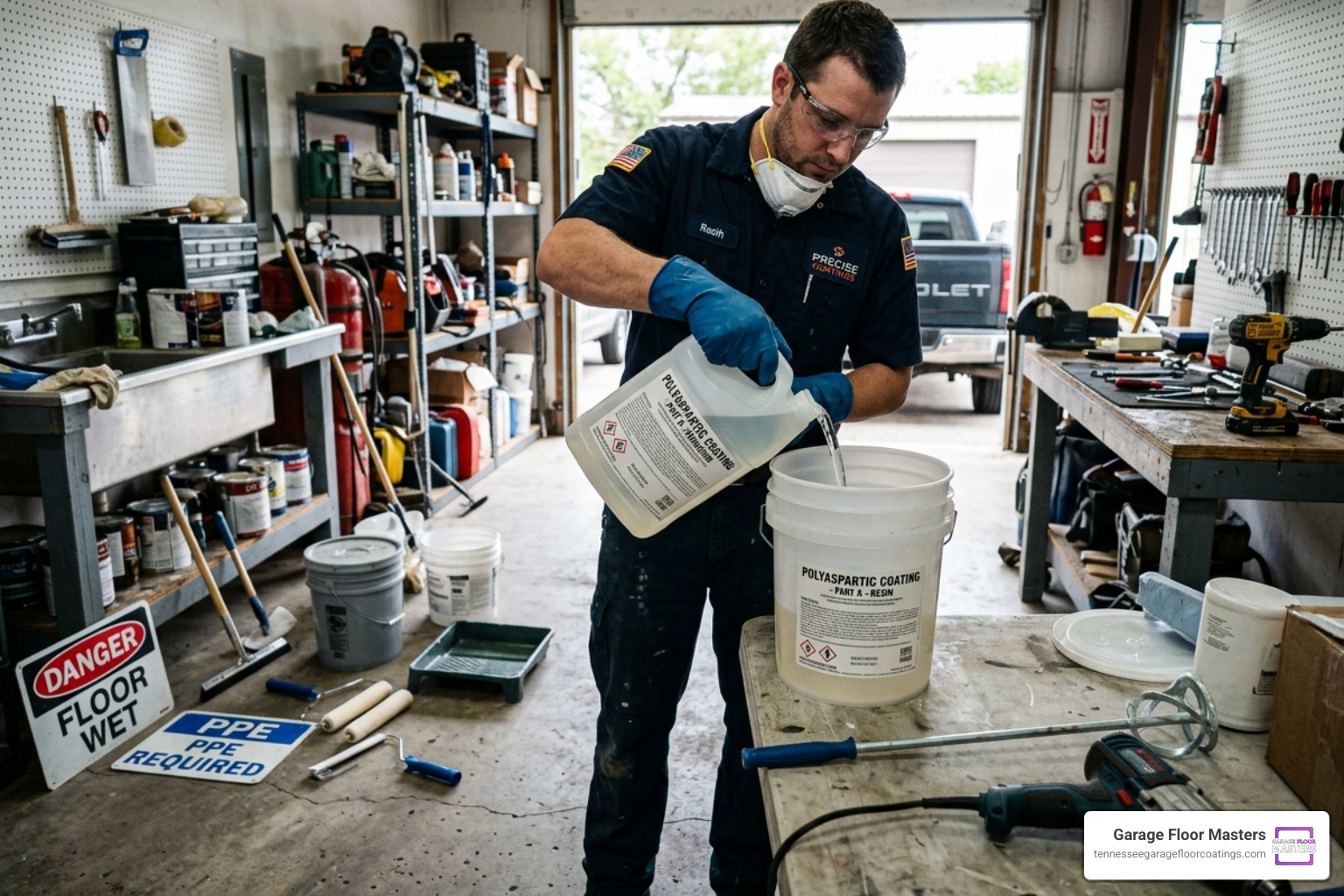
- Mixing: Parts A and B are mixed with a high-speed drill for exactly 90-120 seconds.
- The Ribbon Pour: We pour the material in ribbons across the floor.
- Squeegee and Back-roll: One pro spreads the material with a squeegee while another follows behind with a 3/8″ nap roller to ensure an even thickness.
- The Broadcast: If you’ve chosen a flake finish, we broadcast the decorative vinyl chips “to rejection,” meaning we cover every square inch of the wet base coat.
This dance is why Epoxy Polyaspartic Garage Floor Coatings In Morristown look so much better when done by a pro team versus a weekend warrior.
Return-to-Service and Cure Times
The “One-Day Floor” isn’t just a marketing slogan; it’s a reality with polyaspartic.
- Tack-free: 2–4 hours
- Foot traffic: 4–6 hours
- Vehicle traffic: 24 hours
- Full chemical cure: 48–72 hours
Compare that to epoxy, which often requires 3–5 days before you can even think about driving a car on it. For busy families in Epoxy Polyaspartic Garage Floor Coatings In Loudon, the ability to move the fridge and the cars back into the garage the very next day is a massive convenience.
Maintenance and Long-Term Care
One of the best things about your new floor is how little you have to do to keep it looking great. Because the surface is non-porous, dirt and grime have nowhere to hide.
How to Clean Your Polyaspartic Floor
- Weekly: Use a soft-bristle broom or a leaf blower to remove dust and grit. This prevents “micro-scratching” from dirt being ground into the surface by tires.
- Monthly: Mop the floor with a mixture of warm water and a pH-neutral cleaner (like Simple Green or Dawn). Avoid citrus-based cleaners or vinegar, as the acid can dull the gloss over many years.
- Spills: Wipe up oil or chemical spills when they happen. While the floor is resistant, leaving battery acid on any surface for weeks isn’t a great idea!
- Anti-Slip: We can add a slip-resistant additive (like aluminum oxide) to the final topcoat to ensure the floor isn’t like an ice rink when it gets wet from Tennessee rain.
With this basic care, a polyaspartic floor can easily last 15 to 20 years without needing a recoat.
Frequently Asked Questions
Can polyaspartic be used outdoors?
Absolutely. Because it is 100% UV stable, it is actually the preferred choice for outdoor concrete. We frequently apply these coatings to patios, pool decks, and walkways. It handles the freeze-thaw cycles of East Tennessee beautifully because it remains slightly flexible, allowing it to expand and contract with the concrete.
Is professional installation necessary?
We might be biased, but the data supports us: 80% of coating failures are due to poor surface preparation. DIY kits usually rely on acid etching, which doesn’t profile the concrete deeply enough for a permanent bond. Furthermore, the 15-20 minute working time of industrial polyaspartic is extremely difficult for an amateur to handle without leaving visible seams or “clumps” in the finish.
How does the cost compare to epoxy?
Initially, polyaspartic is more expensive than epoxy due to the high cost of the resins and the specialized equipment required for installation. However, when you consider that an epoxy floor may need to be replaced or repaired every 3-5 years due to yellowing or peeling, polyaspartic is significantly cheaper over the long run. It is a “one and done” investment.
Note: Our pricing is based on the square footage, the current condition of your concrete, and the specific flake or color features you select. We offer free on-site estimates to give you an exact quote for your project.
Conclusion
Your garage floor doesn’t have to be a dark, dusty, stained mess. With polyaspartic concrete floor coatings, you can transform your garage into a bright, clean, and durable extension of your home. Whether you’re in Knoxville, Maryville, or Oak Ridge, Garage Floor Masters is here to help you get the floor you deserve.
We offer over 140 colors and finishes, all installed by our professional teams in just one day. Our coatings are 4x stronger than epoxy and built to handle everything from hot tires to spilled oil.
Ready to stop apologizing for your garage floor? Schedule your professional installation with Polyaspartic Floor Coatings today and let us show you why we are the masters of Tennessee concrete!