
Why Your Basement Floor Coating Choice Matters More Than You Think
Basement floor coatings are protective and decorative layers applied directly to concrete that transform a dull, porous slab into a durable, easy-to-clean surface that resists moisture, stains, and daily wear.
Quick answer — the most common basement floor coating options:
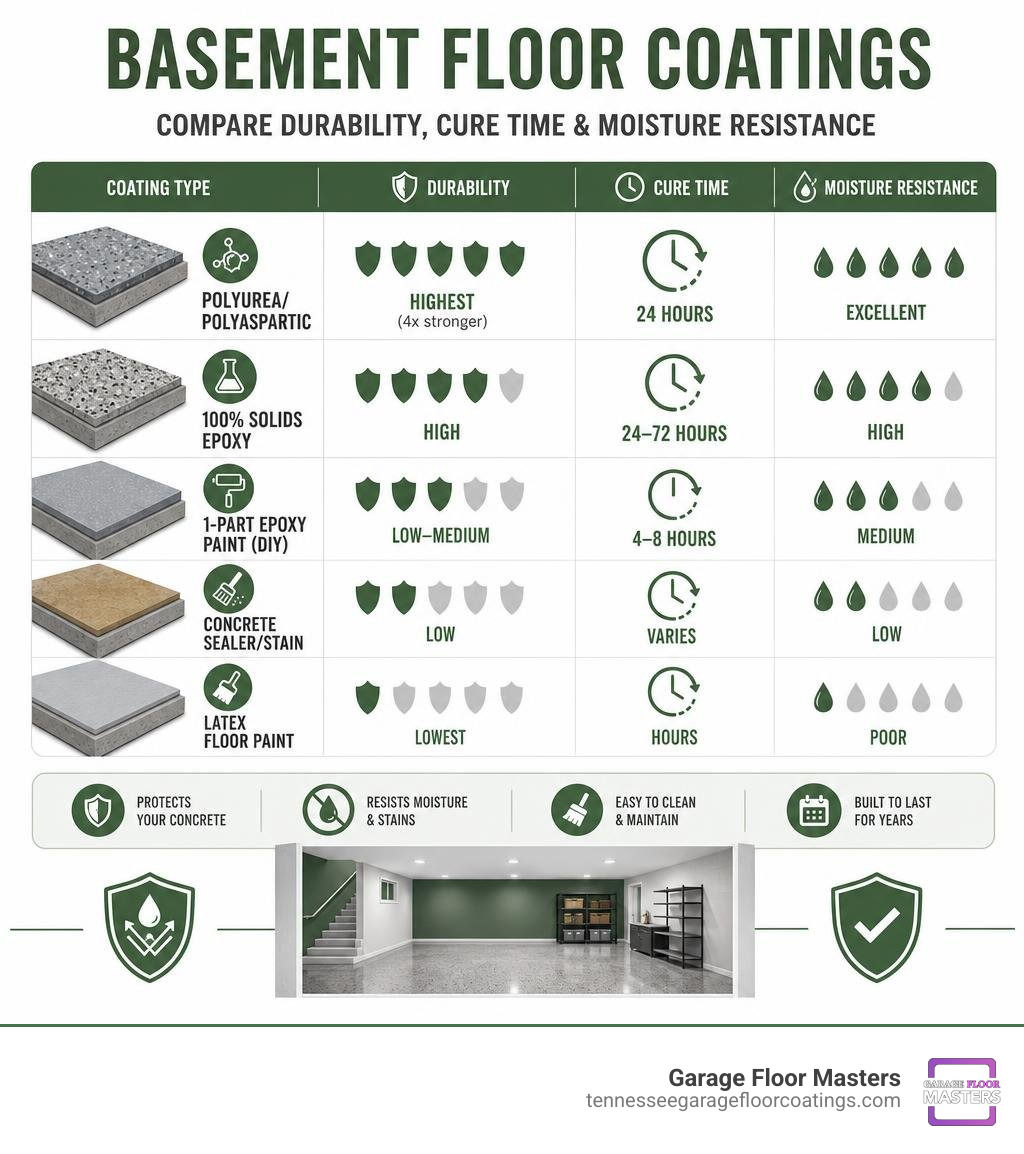
| Coating Type | Durability | Cure Time | Best For |
|---|---|---|---|
| Polyurea/Polyaspartic | Highest (4x stronger than epoxy) | 24 hours | Wet or dry basements, long-term value |
| 100% Solids Epoxy | High | 24-72 hours | Dry basements, budget-conscious installs |
| 1-Part Epoxy Paint (DIY) | Low-Medium | 4-8 hours | Light-use dry basements |
| Concrete Sealer/Stain | Low | Varies | Aesthetic upgrades, minimal protection |
| Latex Floor Paint | Lowest | Hours | Temporary fix only — not recommended |
Most homeowners searching for a basement floor coating are dealing with at least one of these problems:
- A concrete floor that looks cracked, stained, or just plain ugly
- Moisture creeping up through the slab or along the walls
- A previous coating that’s already peeling or flaking
- Uncertainty about which product will actually last
The good news? The right coating solves all of these — but only if you choose the correct system for your specific basement conditions.
The bad news? Not all coatings are created equal. Standard epoxy kits from the hardware store can fail in as little as one year on a damp basement floor. Meanwhile, a professionally installed polyaspartic system can last 10 to 20 years with minimal maintenance.
This guide covers everything you need to make a smart, informed decision — from coating types and moisture issues to surface prep, warranties, and how to spot a qualified installer.
Must-know basement floor coatings terms:
- expert basement coating installers
- expert polyaspartic installers Knoxville
- professional basement floor installers
Comparing the Main Types of Basement Floor Coatings
When evaluating how to finish your below-grade concrete, it is easy to get lost in a sea of product labels. To make an investment that stands the test of time, you need to understand how different materials stack up against each other.
Epoxy and Polyaspartic Basement Floor Coatings
If you are looking for long-term durability, professional-grade polymer coatings are the gold standard. However, the chemical makeup of these systems determines how they behave under your home.
Standard epoxies are two-part polymer systems consisting of a resin and a hardener. When mixed, they undergo a chemical reaction that bonds them to the concrete. A high-quality 100% solids epoxy is incredibly thick (often 10 to 20 mils dry film thickness) and provides excellent resistance to impact, stains, and household chemicals. It creates a beautiful, high-gloss finish that works exceptionally well in dry basements. However, standard epoxies are relatively rigid. If your concrete develops minor settling cracks, the epoxy can crack along with it. Additionally, traditional epoxies are prone to ambering or fading over time if they are exposed to UV light through basement windows.
Enter polyurea and polyaspartic coatings. Originally developed for industrial environments like manufacturing plants, airplane hangars, and truck bed liners, these advanced elastomers are now the premium choice for residential basements in 2026. Polyaspartic coatings are four times stronger than epoxy and highly resistant to abrasion, impacts, and heavy traffic.
Unlike epoxy, which sits on top of the concrete like a hard plastic shell, polyaspartic coatings flow like water into the microscopic pores of your concrete, creating a deep, indestructible chemical and mechanical bond. They remain highly flexible, allowing them to bridge hairline concrete cracks without peeling. They are also 100% UV stable, meaning they will never yellow, fade, or haze. For a detailed breakdown of how these high-performance options can elevate your home, explore our dedicated guide on Basement Floor Coatings.
Professional Concrete Sealers vs. DIY Paints
For homeowners on a tighter budget or those looking for a quick weekend project, concrete sealers and retail paints are common considerations.
Professional penetrating sealers work by reacting chemically with the minerals inside the concrete to block its pores. They do not create a topical film on top of the floor; instead, they work entirely below the surface. They are highly effective at dust-proofing your basement and preventing water from soaking into the concrete, but they do not hide stains, cracks, or color variations. They offer a very natural, matte appearance with minimal aesthetic enhancement.
On the other end of the spectrum are DIY retail paints, including latex floor paints and basic 1-part acrylic epoxies. While these products are cheap and easy to roll onto the floor, they are notorious for failing in basement environments. Unlike professional coatings, retail paints do not form a strong chemical bond with the concrete. They simply dry on top of it.
Because concrete is naturally porous and constantly breathes, moisture vapor rising from the earth underneath your home will easily push these thin paint films off the floor. Within a year or two, you will likely notice peeling, bubbling, and flaking in high-traffic areas. This forces you to scrape, sand, and repaint the floor every few years, which quickly erases any initial cost savings. If you want to understand the science of keeping water out of your concrete slab, check out our guide on Sealing Your Basement Floor.
Moisture Mitigation and Surface Preparation
Basements are unique because they are built directly into the earth. This means your concrete slab is in constant contact with soil that contains varying levels of water. Understanding how moisture interacts with your floor is the single most important factor in choosing a coating that will not peel.
Selecting Basement Floor Coatings for Damp Environments
Water moves through concrete in two ways: hydrostatic pressure and moisture vapor transmission. Hydrostatic pressure occurs when the water table rises, forcing liquid water up through the pores and cracks of your concrete slab. Moisture vapor transmission is a slower, constant process where water vapor migrates from the damp soil beneath your home toward the drier air inside your basement.
Standard epoxies and retail floor paints cannot handle this upward water pressure. When moisture gets trapped beneath an impermeable, standard coating, it builds pressure until the bond fails, causing the coating to bubble, crack, and peel. In fact, standard epoxies typically fail in as little as one year on wet basement floors.
If your basement has ongoing moisture issues, you must use specialized products designed to mitigate this vapor transmission. Specialized wet basement epoxy primers are engineered to tolerate damp concrete and create an incredibly strong, moisture-impervious barrier. These professional-grade moisture vapor barriers can withstand up to 15 to 20 pounds of hydrostatic pressure per 1,000 square feet. Because they are designed specifically for these harsh conditions, high-quality wet basement systems are often guaranteed for 5 years against moisture-related failures. To learn how to navigate these tricky damp environments successfully, read The Professional Guide to Not Messing Up Your Basement Floor.
To determine if your basement has a moisture problem before selecting a coating, you can perform a simple DIY plastic sheet test:
- Cut an 18×18-inch square of clear, 4-mil plastic sheet.
- Tape all four edges tightly to your bare concrete basement floor using heavy-duty duct tape.
- Leave the plastic in place for 24 to 48 hours.
- Peel the plastic back. If the concrete underneath looks dark or damp, or if you see condensation beads on the underside of the plastic, you have active moisture vapor transmission that requires a specialized moisture barrier primer.
The Critical Role of Concrete Profiling
Ask any professional installer, and they will tell you the same thing: 80% of floor coating success depends entirely on surface preparation. You can buy the most expensive, industrial-grade polyaspartic coating in the world, but if you apply it to a dirty, smooth, or improperly prepared concrete slab, it will peel off.
To achieve a permanent bond, the concrete surface must be opened up so the coating can penetrate its pores. This is called creating a Concrete Surface Profile (CSP). For most residential basement coatings, a CSP-2 or CSP-3 profile (which feels similar to medium-grit sandpaper) is required.
There are two primary ways to prepare concrete:
- Acid Etching: This involves applying a mixture of water and acid (such as muriatic acid) to the floor to eat away the top layer of concrete. While common in DIY kits, acid etching is highly inconsistent. It cannot remove old sealers, oil stains, or curing compounds. Furthermore, introducing gallons of water to a basement slab can trap moisture inside the concrete, leading to bonding failures later.
- Mechanical Diamond Grinding: This is the professional standard. Installers use heavy, walk-behind planetary grinders equipped with industrial diamond-segmented blades. Grinding completely removes old paint, glues, sealers, and weak surface concrete, leaving behind a perfectly textured, clean surface.
Best of all, when done by professionals using industrial dust-collection vacuums, diamond grinding is a virtually dust-free process. To learn more about how to identify a contractor who uses these advanced preparation methods, check out our guide on How to Spot a Real Expert in the Wild World of Basement Coatings.
Curing Timelines and Return-to-Service
Another major differentiator between coating types is how long they take to dry and cure.
- Traditional 100% Solids Epoxy: These systems typically have a “pot life” (the amount of time the mixed product remains workable in the bucket) of 30 to 40 minutes. Once applied, they take 12 to 24 hours to become tack-free. You can usually walk on them in 24 hours, but you must wait 48 to 72 hours before placing heavy furniture or appliances back in the basement.
- Polyurea and Polyaspartic Coatings: These systems are famous for their rapid curing times. They can often be installed in just one day, with floors ready for light foot traffic in a few hours and fully cured within 24 hours. This rapid return-to-service means you don’t have to leave your basement belongings piled up in your garage or living room for a week.
DIY Kits vs. Professional Installation
It is tempting to walk into a local big-box home improvement store, grab a DIY epoxy kit for a few hundred dollars, and plan a weekend project. However, understanding the stark differences in materials, tools, and results will save you from a costly headache down the road.

When you look at DIY kits, you are typically buying water-based epoxies or single-part acrylic paints. These products have low solids content (often around 40% to 50%), meaning that as the coating dries, the water or solvent evaporates into the air, leaving behind a very thin, fragile layer (often only 2 to 3 mils thick).
By comparison, professional installers use 100% solids epoxies and pure polyaspartic coatings that do not evaporate. What goes onto the floor stays on the floor, resulting in a thick, durable, impact-resistant barrier that is six times thicker than retail paint.
Furthermore, DIYers lack access to industrial diamond grinders. Relying on weak acid-etch kits included in retail boxes often leads to poor adhesion, causing the coating to peel up the first time you drag a heavy box or piece of furniture across the floor.
Evaluating Warranties and Installer Credentials
When you hire a professional, you are not just paying for high-grade materials; you are paying for peace of mind. Professional installations come with robust warranties that retail DIY kits simply cannot match.
A standard retail DIY kit offers a very limited product warranty that usually only covers replacing the can of paint if the product itself is defective. It will not cover the cost of your time, labor, or the immense effort required to scrape up a failed, peeling floor.
Conversely, professional warranties typically cover peeling, chipping, and delamination. Premium polyaspartic installations often come with a lifetime residential warranty against peeling and UV yellowing. When evaluating warranties, always ask if moisture-related failures are covered, as many standard warranties exclude damage caused by pre-existing hydrostatic pressure unless a specialized moisture barrier primer was applied.
At Garage Floor Masters, we proudly serve homeowners throughout East Tennessee, including:
- Knoxville, TN
- Oak Ridge, TN
- Crossville, TN
- Maryville, TN
- Sevierville, TN
- Lenoir City, TN
- …and all surrounding communities!
Our high-performance polyaspartic coatings are 4x stronger than epoxy, completely UV stable, and can be installed in as little as one day. We offer over 140 beautiful flake colors to match any home design.
If you are planning to upgrade other concrete areas of your home, such as an outdoor living space, you can read more about our exterior concrete solutions in our guide on Basement Patio Projects.
Regarding investment costs, professional basement floor coatings typically range from $5 to $12 per square foot. However, the exact pricing for your project depends entirely on the current condition of your concrete slab, any necessary crack repairs, moisture mitigation requirements, and the specific design features or flake colors you select. That is why we always provide a free, no-obligation, on-site estimate to give you an accurate quote tailored to your home.
Frequently Asked Questions
How do I clean and maintain my coated basement floor?
One of the greatest benefits of a professional polyaspartic or epoxy floor coating is how incredibly easy it is to maintain. Because the surface is completely non-porous, dust, dirt, mold, and mildew cannot penetrate or grip the floor.
For routine cleaning, a quick sweep or dust mop is all it takes to keep the floor looking pristine. For deeper cleans, simply use a mop with warm water and a mild, pH-neutral detergent (like a drop of Dawn dish soap). Avoid harsh abrasive cleaners, vinegar, or citrus-based cleaners, as these acids can dull the high-gloss finish over time. If your basement experiences occasional water intrusion, a quick swipe with a rubber squeegee will leave the floor completely dry and spotless.
Can I apply epoxy over a previously painted basement floor?
You should never apply a professional epoxy or polyaspartic coating directly over an existing paint or DIY sealer. The new coating is only as strong as what it is bonding to. If the old paint underneath begins to peel, your beautiful new coating will peel right along with it.
To ensure a successful installation, the old paint, glue, or sealer must be completely removed. We achieve this by diamond-grinding the concrete back down to its raw, porous state. If you are attempting a DIY touch-up, you must perform thorough scuff sanding with 80-grit sandpaper and conduct adhesion testing to ensure the new coating can bond properly to the clean, sound concrete underneath.
How long do professional floor coatings last?
With proper surface preparation and professional-grade materials, a residential basement floor coating can easily last 10 to 20 years—and often much longer. Because polyaspartic coatings penetrate deep into the concrete pores to create a permanent chemical and mechanical bond, they do not wear out or peel under normal household use. They easily withstand dropped tools, heavy storage racks, foot traffic, and moisture, making them one of the smartest long-term investments you can make for your home.
Conclusion
Upgrading your basement floor is about more than just aesthetics; it is about protecting your home’s foundation, eliminating musty concrete odors, and reclaiming valuable living space.
As we look at coating trends in 2026, homeowners are moving away from cheap, temporary DIY paints in favor of high-performance, long-lasting solutions. While standard epoxies still have their place in dry basements, 100% polyaspartic coatings have emerged as the premier choice due to their rapid one-day installation, extreme flexibility, and unmatched durability.
If you are ready to transform your cold, unfinished basement into a beautiful, seamless, and moisture-resistant space, we are here to help. Contact Garage Floor Masters today to schedule your free, on-site estimate and explore our wide range of custom colors and styles. For more information on our services, visit our main page on Basement Floor Coatings.