
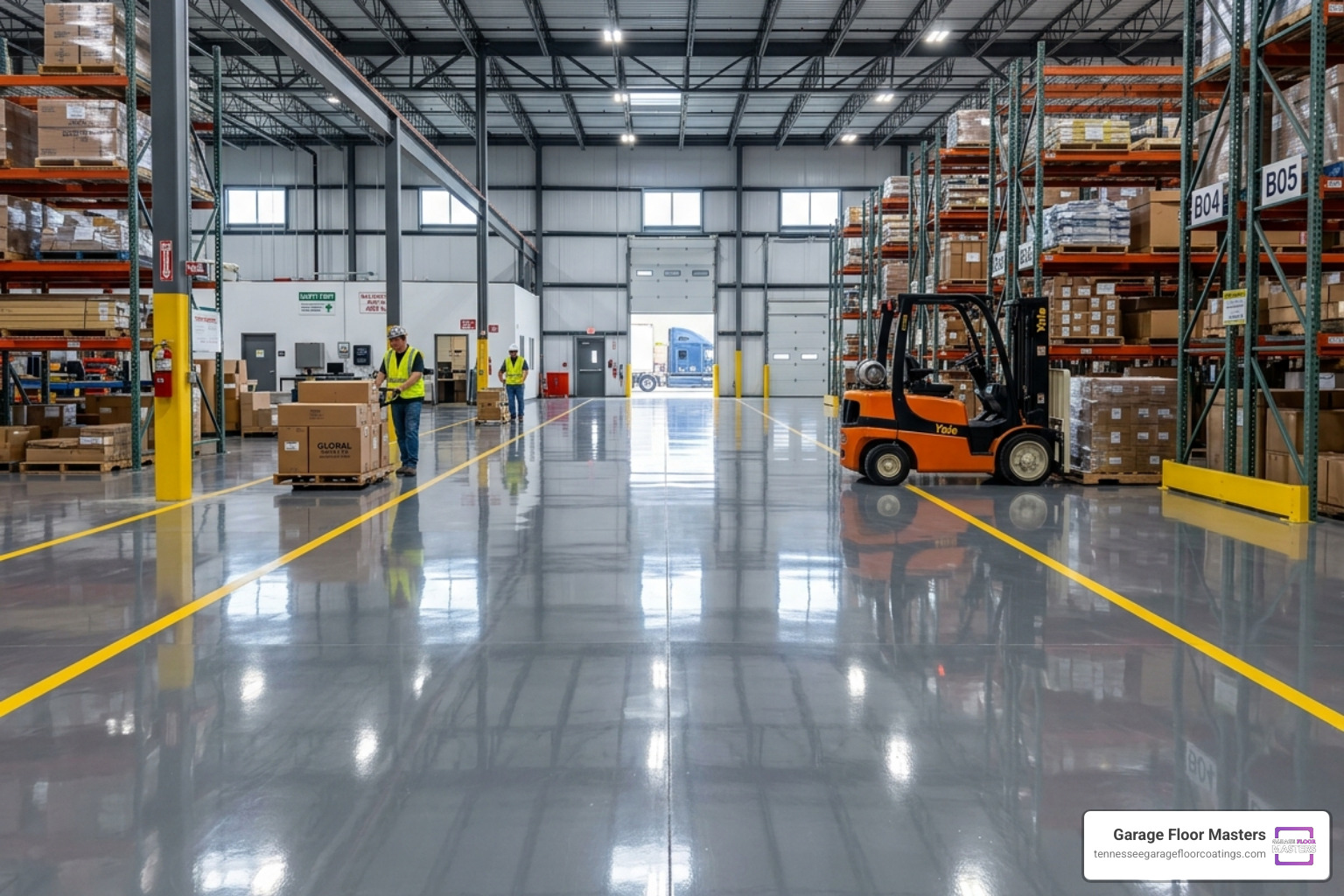
What Is Commercial Resin Flooring? A Quick Answer for Busy Facility Managers
Commercial resin flooring is a seamless, polymer-based surface system applied directly over concrete to protect it, improve its appearance, and make it far more durable than bare or painted concrete.
Here’s a fast breakdown of what you need to know:
| Feature | What It Means for You |
|---|---|
| Types | Epoxy, polyaspartic, urethane cement, MMA acrylic |
| Best for | Warehouses, kitchens, healthcare, retail, garages |
| Lifespan | 15-20 years with professional installation |
| Install time | As little as one day (polyaspartic systems) |
| Cost | Varies by project condition and features — get a free on-site estimate |
| Key benefits | Chemical resistance, slip resistance, easy cleaning, seamless hygiene |
Walk into almost any high-performing commercial facility today — a restaurant kitchen, a hospital corridor, a busy warehouse — and there’s a good chance the floor beneath your feet is a resin system.
And for good reason.
Concrete on its own is porous, brittle, and hard to clean. It absorbs oil, chemicals, and moisture. It cracks under heavy loads. It’s a liability in environments where hygiene or safety matters.
Resin flooring solves all of that. It bonds to the concrete, seals the surface completely, and creates a tough, non-porous shell that can handle heavy traffic, chemical spills, daily washdowns, and decades of use.
Whether you’re managing a commercial kitchen, a warehouse floor, or even a garage that takes a beating every day, the right resin coating system can transform a worn, stained surface into something that’s both functional and impressive — without the disruption of a full floor replacement.
Understanding the Benefits of Commercial Resin Flooring
When we talk about commercial resin flooring, we aren’t just talking about a bucket of paint from a big-box store. We are talking about engineered chemistry designed to survive the harshest environments in East Tennessee. From the humidity of Loudon to the heavy foot traffic in Pigeon Forge, these systems offer a level of protection that traditional flooring simply cannot match.
Impact and Abrasion Resistance
In a busy warehouse or an automotive shop, floors are constantly under assault. Dropped tools, heavy pallet jacks, and the constant movement of forklifts can turn bare concrete into a dusty, cracked mess. High-performance resin systems act like a suit of armor. For example, professional-grade topcoats often feature an abrasion loss rating as low as 8mgs, compared to 30mgs or more for standard off-the-shelf products. This means the floor stays smooth and intact even under extreme mechanical stress.
Chemical and Moisture Protection
Whether it’s harsh cleaning agents in a healthcare facility or oil spills in a maintenance hangar, commercial resin flooring provides a non-porous barrier. Unlike concrete, which “drinks” liquids and stains permanently, resin systems allow spills to sit on the surface for easy cleanup. This is especially critical for Floor Coatings for Warehouses where chemical containment is a regulatory requirement.
Hygiene and Antimicrobial Properties
For kitchens and medical offices, “clean” isn’t just an aesthetic—it’s a legal and safety requirement. Resin floors are seamless. There are no grout lines or joints where bacteria, mold, or odors can hide. Many systems even include antimicrobial additives to further inhibit the growth of pathogens.
Enhanced Safety and Visibility
Safety is paramount in any workplace. By choosing the right resin system, you can Enhance Workplace Safety through:
- Slip Resistance: Adding textures like quartz or aluminum oxide ensures traction even when floors are wet.
- Light Reflectivity: High-gloss finishes can increase the brightness of a room by up to 30%, reducing the need for extra lighting and helping employees see hazards more clearly.

Primary Types of Resinous Coating Systems
Choosing the right floor is like choosing the right tool for a job. You wouldn’t use a screwdriver to drive a nail, and you shouldn’t use a basic epoxy in a commercial kitchen that sees 400-degree grease spills. Here is how the main Floor Coatings stack up:
| System Type | Best Application | Key Strength |
|---|---|---|
| Epoxy | Warehouses, Basements, Retail | High-build, cost-effective, great adhesion |
| Polyaspartic | Garages, Showrooms, Rapid Turnaround | UV stable, 1-day install, 4x stronger than epoxy |
| Urethane Cement | Kitchens, Food Processing | Thermal shock resistance, handles moisture |
| MMA (Methyl Methacrylate) | Outdoor, Cold Storage | Cures in 1 hour, works in sub-zero temps |
The Role of Epoxy in Commercial Resin Flooring
For decades, epoxy has been the industry standard. Modern Epoxy Floor Coatings are typically “100% solids,” meaning they don’t contain water or solvents that evaporate away. What you apply is what stays on the floor, resulting in a thick, durable film.
Epoxy is incredibly versatile. It can be formulated for ESD (Electrostatic Dissipative) control to protect sensitive electronics or used as Basement Floor Coatings to keep moisture from seeping through concrete. However, traditional epoxy can be brittle and may yellow over time if exposed to the sun.
Why Polyaspartic is Revolutionizing Commercial Resin Flooring
If epoxy is the reliable sedan of the flooring world, polyaspartic is the high-performance off-road vehicle. Originally developed for industrial bridges and railcars, Polyaspartic Floor Coatings are now the preferred choice for business owners in Knoxville and Maryville who can’t afford days of downtime.
At Garage Floor Masters, our polyaspartic coatings are 4x stronger than epoxy. They are UV stable, meaning they won’t fade or yellow in the Tennessee sun, and they can be installed in as little as one day. Because they remain slightly flexible, they don’t crack when a heavy tool is dropped—they absorb the impact.
Key Applications Across Industrial Sectors
Every industry has unique demands, and commercial resin flooring can be engineered to meet them all.
- Warehouses and Logistics: These floors need to be flat, durable, and easy to navigate. Using Floor Coatings for Warehouses helps manage dust and provides the durability needed for constant forklift traffic.
- Commercial Kitchens: Between boiling water and walk-in freezers, these floors face “thermal shock.” Urethane cement is often the hero here, as it expands and contracts at the same rate as the concrete.
- Healthcare and Labs: Hygiene is the priority. Seamless, pinhole-free surfaces ensure that sterilization protocols are effective.
- Salons and Retail: Aesthetics matter just as much as durability. Floor Coatings for Salons often utilize decorative chips or metallic pigments to create a “wow” factor for customers.
- Aircraft Hangars: These floors must resist specialized aviation fluids (like Skydrol) and provide high light reflectivity for mechanics working under wings.
- General Business Spaces: For any local business, Commercial Floor Coatings offer a professional look that says you care about your facility.
Professional Installation and Surface Preparation
We have a saying in the flooring industry: “A coating is only as good as the prep.” In fact, roughly 80% of floor failures are caused by poor surface preparation. If you just pour resin over a dirty or smooth floor, it will eventually peel like a bad sunburn.
The Prep Process
We don’t use “acid etching” (which is often weak and messy). Instead, we use mechanical profiling. This involves heavy-duty diamond grinders that “open up” the pores of the concrete. This creates a rough surface—similar to sandpaper—that allows the resin to form a mechanical bond with the slab.
Testing for Success
Before the first drop of resin hits the floor, we perform moisture vapor testing. Concrete might look dry on top, but it can hold moisture deep inside. If that moisture tries to escape after the floor is sealed, it can create “osmotic blisters.” We ensure the slab is ready before we proceed.
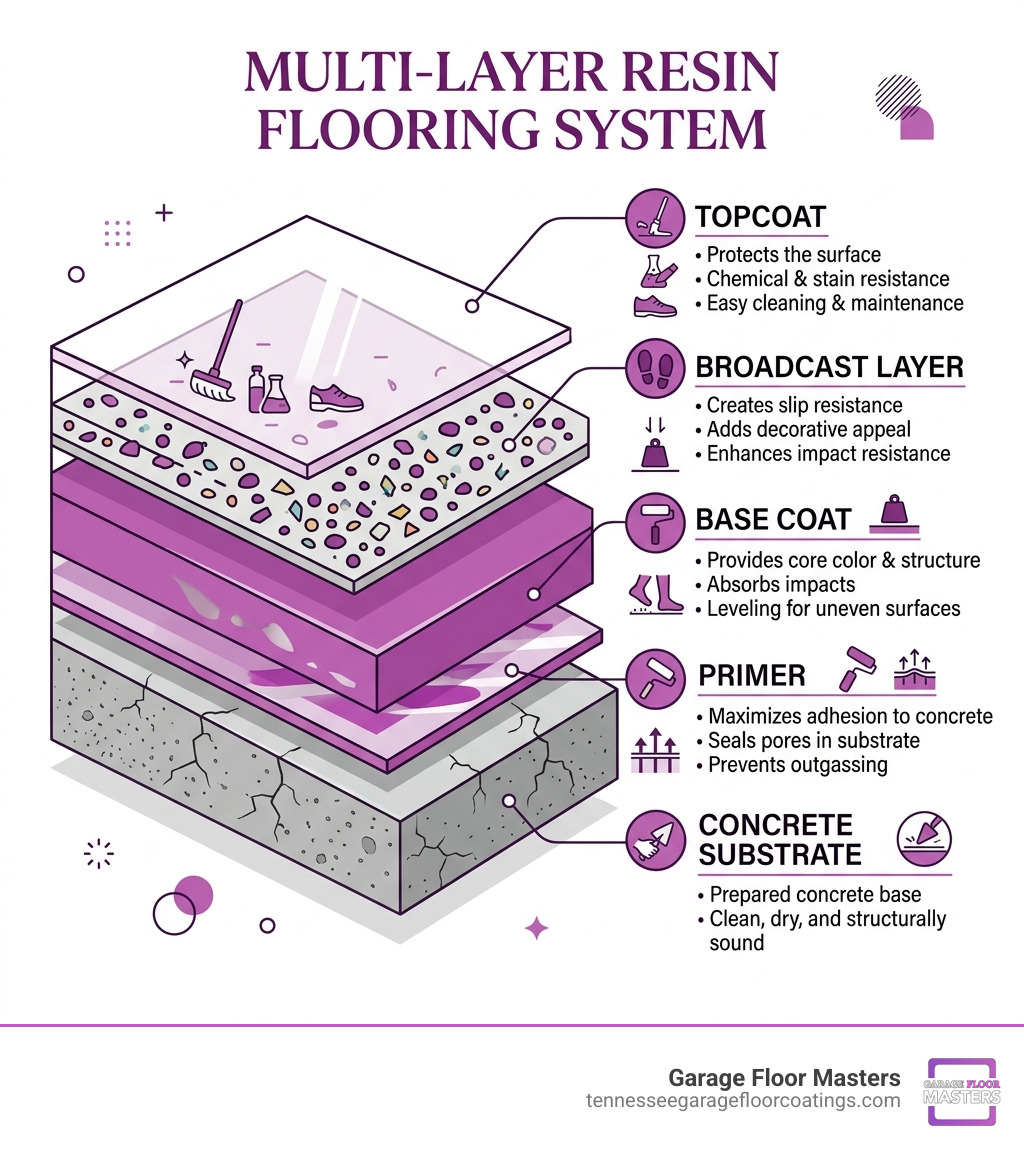
The Application Layers
- Base Coat: This is the “primer” that soaks into the concrete.
- Broadcast: For Chip and Flake Floor Coatings, we broadcast decorative flakes or quartz into the wet base coat. This adds thickness, color, and texture.
- Scrape and Vacuum: Once cured, we remove excess material to ensure a flat surface.
- Topcoat: A high-performance clear coat (like our polyaspartic) is applied to seal everything in. This creates the final Chip and Flake Flooring look that is so popular in modern garages and shops.
Selecting the Right System: Cost and Performance
When evaluating commercial resin flooring, it’s important to look at the Total Cost of Ownership (TCO) rather than just the initial price tag.
Lifespan and Durability
A “cheap” DIY epoxy kit might cost $1.35 to $2.00 per square foot, but it may only last 2-3 years before it starts flaking. A professional installation might range from $5.00 to $8.00 per square foot (depending on the condition of your concrete and the features you choose), but it is designed to last 15 to 20 years. When you divide the cost by the number of years of service, the professional system is almost always the more economical choice.
Performance Metrics
When comparing systems, ask for these stats:
- Abrasion Rating: Lower is better (look for under 10mgs).
- Adhesion Strength: The coating should be stronger than the concrete itself (concrete usually fails at 300-400 psi).
- VOC Compliance: Ensure the system is safe for indoor use and meets local environmental standards.
Maintenance Protocols
One of the best parts of resin flooring is how easy it is to keep clean. You don’t need expensive waxes or buffs. Most floors simply require:
- Regular sweeping or dust mopping to remove abrasive grit.
- Occasional mopping with a pH-neutral cleaner.
- A quick squeegee for wet areas.
Frequently Asked Questions about Commercial Resin Flooring
How does resin flooring compare to traditional tile or concrete?
Traditional tile has grout lines that crack, leak, and harbor bacteria. Bare concrete is porous and produces “concrete dust” as it wears down. Commercial resin flooring is a single, continuous surface that is easier to clean, more hygienic, and significantly more resistant to chemicals and impacts than either alternative.
What is the typical lifespan of a professional resin floor?
With proper maintenance, a high-quality system like those we install at Garage Floor Masters will last 15 to 20 years. Many systems even come with long-term warranties (some up to 20 years) against peeling or delamination.
Can resin coatings be customized for specific safety needs?
Absolutely. We can adjust the “coefficient of friction” by adding different amounts of slip-resistant aggregates. We can also use different colors to designate safety zones, walkways, or “no-go” areas around dangerous machinery.
Conclusion
Your floor is the foundation of your business operations. Whether you are running a high-end salon in Sevierville or a massive warehouse in Knoxville, the right commercial resin flooring protects your investment, keeps your employees safe, and makes your facility look world-class.
At Garage Floor Masters, we specialize in high-performance coatings that are built to handle the everyday use and abuse of East Tennessee businesses. Our polyaspartic systems are 4x stronger than epoxy, UV stable, and can be installed in just one day—meaning you don’t have to shut down your business for a week just to get a better floor.
Ready to see the difference for yourself? With over 140 colors to choose from and a team of local experts ready to help, we invite you to Transform your facility with Commercial Floor Coatings.
We provide free on-site estimates across Knoxville, Oak Ridge, Crossville, Maryville, and all surrounding areas. Let’s get your flooring right the first time. Give us a call today!