
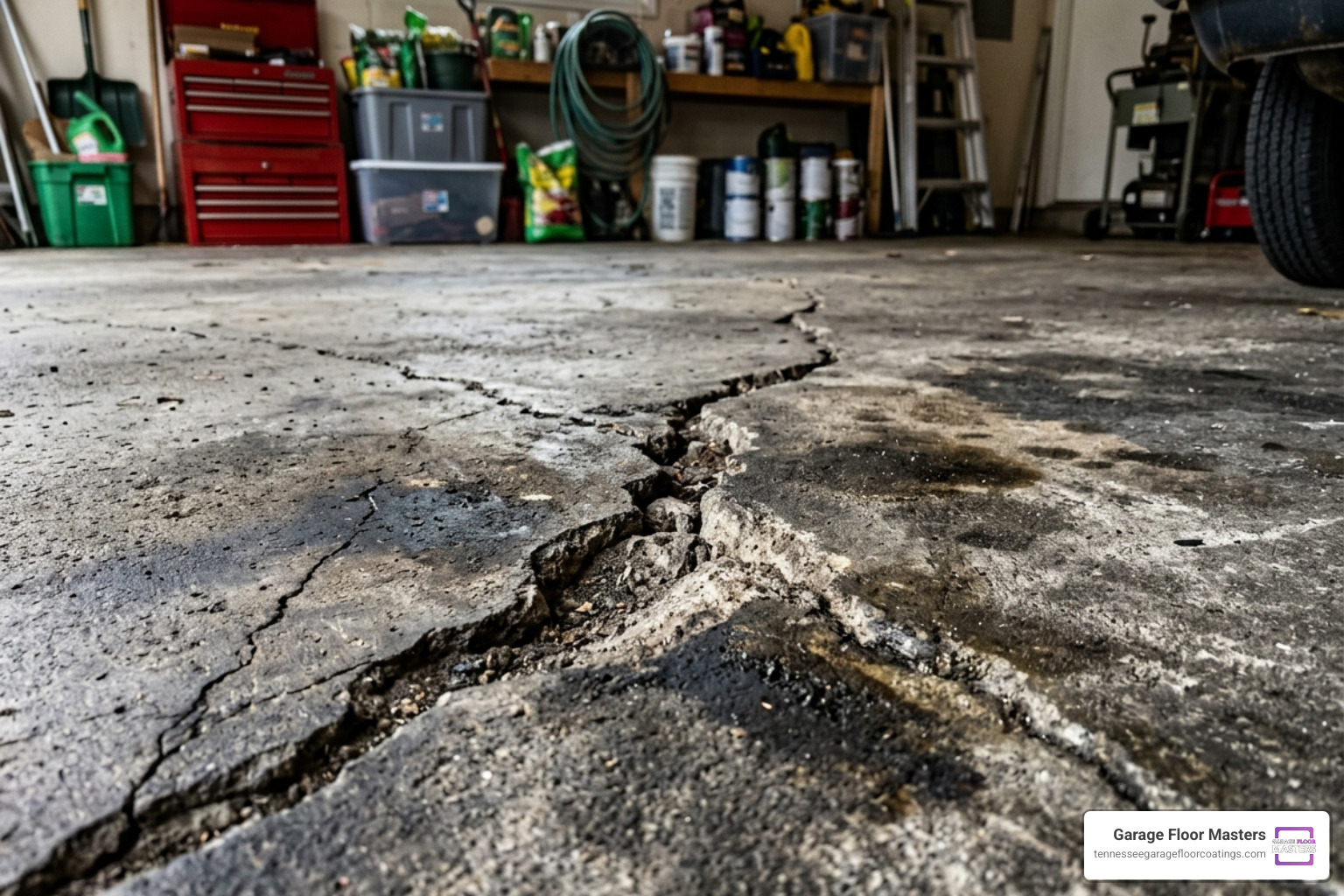
Every Concrete Garage Floor Cracks — Here’s What to Do About It
Garage floor cracks repair is something almost every homeowner deals with eventually. Concrete shrinks as it cures, shifts with temperature changes, and settles as the soil beneath it moves. Cracking isn’t a sign of a bad floor — it’s just what concrete does over time.
The good news? Most cracks are cosmetic and completely fixable. A few are serious. Knowing the difference saves you time, money, and stress.
Here’s a quick overview of your repair options based on crack type:
| Crack Type | Width | Severity | Typical Fix |
|---|---|---|---|
| Hairline / shrinkage | Under 1/8″ | Cosmetic | Concrete caulk or liquid filler |
| Moderate crack | 1/8″ – 1/4″ | Low to moderate | Polyurea or epoxy filler |
| Wide crack | Over 1/4″ | Moderate to serious | Patching compound or pro injection |
| Crack with vertical offset | Any | Structural | Professional evaluation required |
| Heaving or sinking slab | Any | Serious | Mudjacking, foam jacking, or replacement |
When should you worry? If a crack is wider than 1/4 inch, if one side sits higher than the other, or if cracks are spreading quickly — those are signs of a deeper problem. Everything else is usually something you can fix yourself or with professional help.
This guide covers everything: what causes cracks, how to tell cosmetic from structural damage, the best repair materials, a step-by-step DIY process, and when to call in a pro. Whether your Knoxville garage floor has a single hairline fracture or a spiderweb of cracks from years of freeze-thaw cycles, you’ll know exactly what to do by the end.
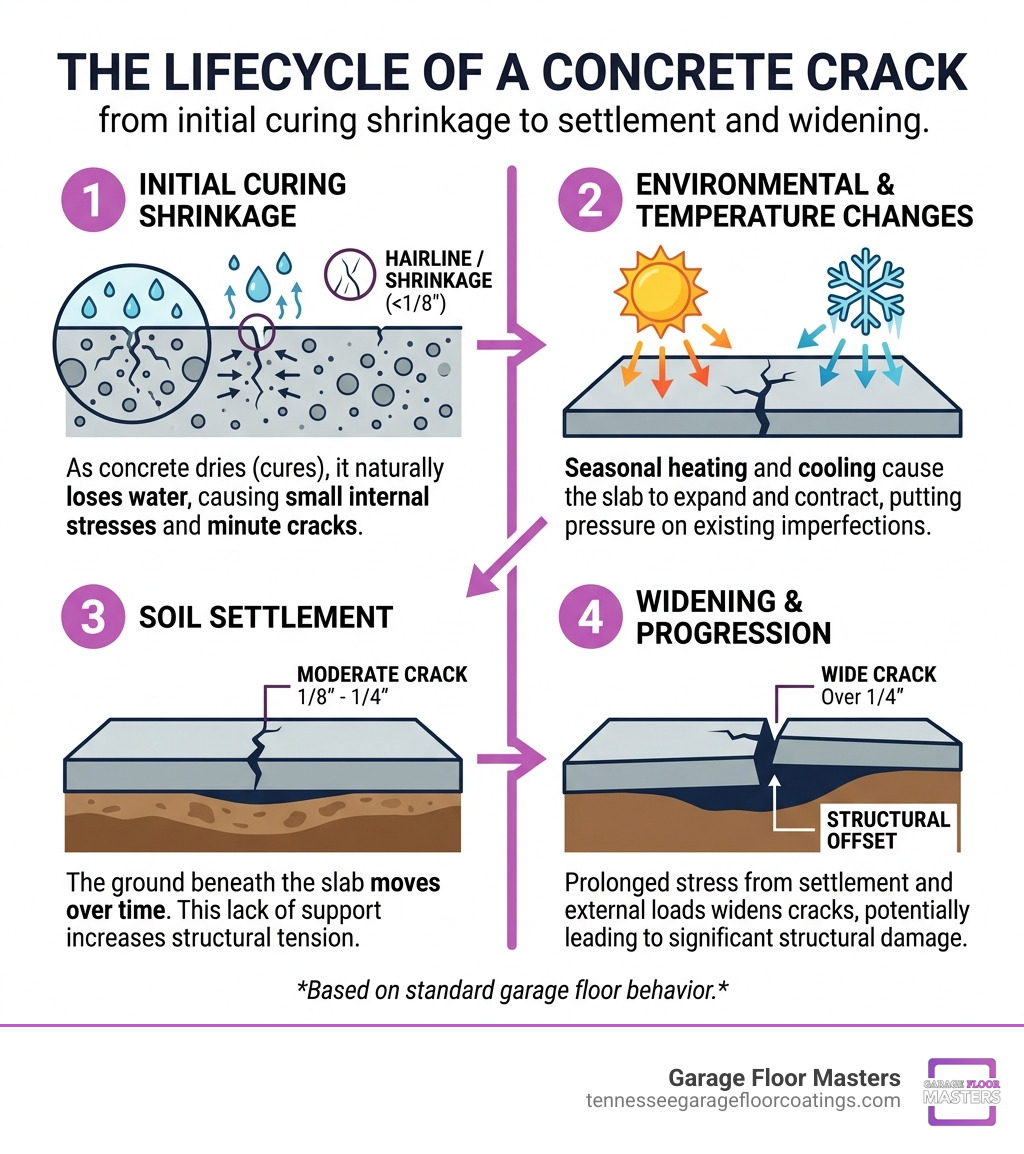
Understanding the Causes of Garage Floor Cracks
To fix a crack permanently, we first have to understand why it’s there. Concrete is incredibly strong in compression (pushing down), but it is surprisingly weak in tension (pulling apart). When the slab is pulled in different directions, it snaps.
Drying Shrinkage
This is the most common cause of Garage Floor Cracking. As new concrete cures, the water inside evaporates. This causes the slab to shrink slightly. If the slab is restrained by the foundation or plumbing pipes, it develops internal tension and “cracks” to relieve that stress. These are usually thin, straight, and appear within the first year of construction.
Thermal Expansion and Contraction
In East Tennessee, we see significant temperature swings. Concrete expands when it’s hot and contracts when it’s cold. Without room to move, the slab will eventually fracture. This is why you’ll often see cracks radiating from corners or doorways where the temperature changes are most frequent.
Freeze-Thaw Cycles
Water is concrete’s greatest enemy. When water seeps into microscopic pores or existing hairline cracks and freezes, it expands by about 9%. This internal pressure acts like a wedge, slowly prying the concrete apart. Over several winters in places like Oak Ridge or Crossville, a tiny blemish can turn into a gaping hole.
Poor Soil Compaction and Hydrostatic Pressure
If the dirt under your garage wasn’t packed down tight before the pour, the heavy weight of your vehicles will cause the slab to sink into the soft spots. Similarly, hydrostatic pressure—water pushing up from the soil—can lift sections of the floor. Both lead to “settlement cracks,” which are often jagged and uneven.
Identifying Cosmetic vs. Structural Damage
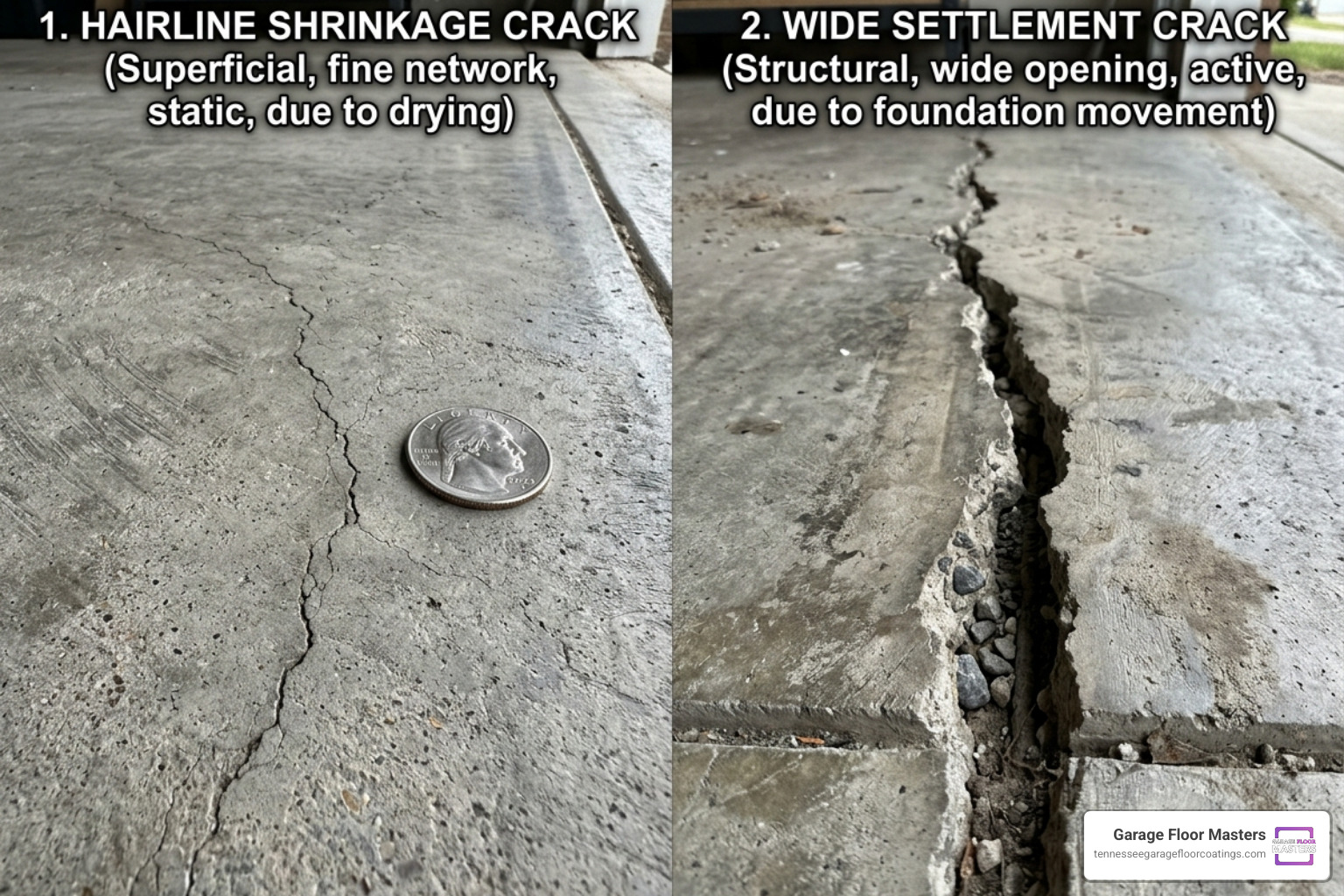
Not all cracks are created equal. We generally use the 1/4-inch rule.
- Cosmetic Cracks: These are hairline fractures (less than 1/8 inch) or “crazing” (a map-like pattern of tiny surface cracks). They are unsightly but don’t threaten the safety of your home.
- Structural Red Flags: You should worry if you see vertical displacement (one side of the crack is higher than the other), heaving (the floor is pushing upward), or crumbling concrete along the edges. If the crack is wider than 1/4 inch or continues to grow month after month, it may indicate a foundation issue that requires a professional eye.
The Role of Control Joints in garage floor cracks repair
Control joints are those deep grooves you see cut into the floor every few feet. They are essentially “planned weak points.” The goal is to encourage the concrete to crack inside the groove rather than across the middle of your floor.
If your garage is missing these joints, or if they are spaced too far apart (a common issue in older homes in Maryville or Sevierville), the slab will create its own “joints” in the form of random, ugly cracks. During a garage floor cracks repair, we often have to address these missing joints by installing new saw-cuts to prevent the repair from failing later.
Choosing the Best Materials for Permanent Fixes
If you walk into a big-box store in Knoxville, you’ll see dozens of tubes claiming to fix concrete. But for a repair that actually lasts, you need to match the material to the job.
Comparing Professional-Grade Fillers
- Epoxy: Extremely strong and bonds well to dry concrete. However, traditional epoxy is brittle. If the floor moves again, the epoxy won’t budge—but the concrete next to it might crack.
- Polyurea and Polyaspartic: These are our favorite materials at Garage Floor Masters. They are thin enough to “wet out” the crack, penetrating deep into the pores for a massive bond. Unlike epoxy, they remain slightly flexible, allowing them to handle the thermal expansion we see in Tennessee.
- Polyurethane: Great for filling large voids or stopping active water leaks, but it doesn’t always provide the “finished” look homeowners want for a decorative floor.
- Concrete Caulk: Best for joints that need to move, but it shouldn’t be used for structural repairs or under a floor coating.
When to Use Backer Rods
If you have a deep fissure (anything deeper than 1/2 inch), don’t just pour filler in until it’s full. That’s a waste of material and can lead to “three-point adhesion,” where the filler sticks to the sides and the bottom, causing it to tear as the slab moves.
Instead, we tuck a backer rod—a flexible foam rope—into the crack first. This provides a “bottom” for the filler and ensures it only bonds to the two sides of the crack, allowing it to stretch and compress like a rubber band. This is a key part of high-quality Garage Floor Coatings preparation.
Step-by-Step DIY Guide to garage floor cracks repair
If your cracks are stable and level, you can certainly tackle the repair yourself. Here is how we recommend doing it to ensure the patch doesn’t pop out in six months.
Preparation and Cleaning Techniques
Preparation is 80% of the job. You cannot simply pour filler over dirt and expect it to stay.
- Crack Chasing: Use a hammer and cold chisel (or an angle grinder with a diamond blade) to “chase” the crack. You want to widen it slightly and create a “V” or “U” shape.
- Undercutting: If possible, try to make the bottom of the crack wider than the top. This “locks” the patch in place mechanically.
- Laitance Removal: Scrub the inside of the crack with a stiff wire brush to remove “laitance”—that weak, dusty layer of concrete that prevents bonds.
- Vacuuming: Use a shop vacuum to suck out every last grain of dust. If you can see dust, the filler won’t stick.
- Degreasing: If the crack is near where your car leaks oil, use a heavy-duty degreaser and let it dry completely before proceeding.
Application and Curing Times
Once the crack is clean and dry, it’s time to fill.
- Mixing: If using a two-part epoxy or polyurea, only mix what you can use in 10-15 minutes (the “pot life”). These materials harden fast!
- Filling: Overfill the crack slightly. As the material cures, it may settle into the crack.
- Trowel Finishing: Use a putty knife or trowel to scrape the excess flush with the floor.
- Curing: Most DIY kits require 24 hours before you can drive on them. At Garage Floor Masters, Our Process uses rapid-curing polyaspartics that can be walked on in just a few hours.
For more details on the professional side of this work, check out our Garage Floor Installation Process.
When to Call a Professional for Slab Restoration
Sometimes, a tube of filler isn’t enough. If your garage floor looks like a jigsaw puzzle or if one section has sunk two inches lower than the rest, you’re looking at a restoration project.
Mudjacking and Foam Jacking
If your slab is sinking, we don’t always have to tear it out. Professionals can drill small holes in the floor and pump in a slurry (mudjacking) or high-density polyurethane foam. This “jacks” the slab back up to its original height. This is often much cheaper than a full replacement.
Professional vs. DIY Cost Analysis
- DIY Kits: You can expect to spend $50 to $400 on tools, fillers, and sealers for a typical 2-car garage.
- Professional Crack Injection: If you have deep structural cracks, a pro might charge $150 to $500 per crack to inject high-strength epoxy or polyurethane.
- Full Resurfacing: For floors with widespread surface damage, a professional resurfacing or coating project usually ranges from $1,500 to $4,000, depending on the size and condition.
- Complete Slab Replacement: If the concrete is completely failed, a new pour can cost between $3,000 and $7,000.
At Garage Floor Masters, our pricing is based on the specific condition of your floor and the features you select. This is why we always offer a free on-site estimate for homeowners in Knoxville and the surrounding areas. Sometimes, Garage Floor Restoration In Oneida Tn is the only way to save a floor that’s seen better days.
Frequently Asked Questions about Garage Floor Repair
Can I apply epoxy over repaired cracks?
Yes, but with a warning. If you don’t use a flexible filler or if the underlying crack is still moving, it will “telegraph” through your new coating, creating a visible line or a new crack in the finish. Before applying Epoxy Floor Coatings, we ensure every crack is ground out, filled with high-strength polyurea, and sanded flush to create a seamless surface. If you are dealing with an old, failing coating, you’ll need to look into Removing Garage Floor Coating before starting fresh.
How much does it cost to repair garage floor cracks?
Based on 2025 data, the average American homeowner spends about $200–$400 on DIY patching. However, the long-term ROI of a professional repair is much higher. A DIY patch often fails after 1-3 winters because it can’t handle the freeze-thaw cycles in East Tennessee. A professional polyaspartic repair is designed to last as long as the house itself.
How can I prevent future cracks in my garage?
- Drainage Management: Ensure your gutters are clean and your yard slopes away from the garage. Water pooling against the foundation is the #1 cause of settlement.
- Sealing: Apply a high-quality concrete sealer every 2-3 years. This keeps water and road salts out of the pores.
- Load Distribution: Avoid parking heavy machinery or oversized trucks in the exact same spot for months at a time.
- Joint Maintenance: Keep your control joints clean and filled with a flexible sealant to prevent rocks from getting stuck in them (which causes “spalling”).
Conclusion
A cracked garage floor doesn’t have to be a permanent eyesore or a threat to your home’s value. Whether you choose to take the DIY route with a chisel and some store-bought filler or decide to invest in a professional transformation, the key is to act before the damage spreads.
At Garage Floor Masters, we specialize in taking cracked, stained, and aging concrete and turning it into a showroom-quality space. Serving Knoxville, TN, and surrounding areas like Lenoir City, Powell, and Jefferson City, we offer UV-stable polyaspartic coatings that are 4x stronger than standard epoxy. Our systems are installed in just one day, available in over 140 colors, and built to handle the heavy use of a busy Tennessee garage.
Ready to stop worrying about those cracks? Get a free estimate for professional Garage Floor Coatings today and let us give your garage the permanent floor it deserves!